

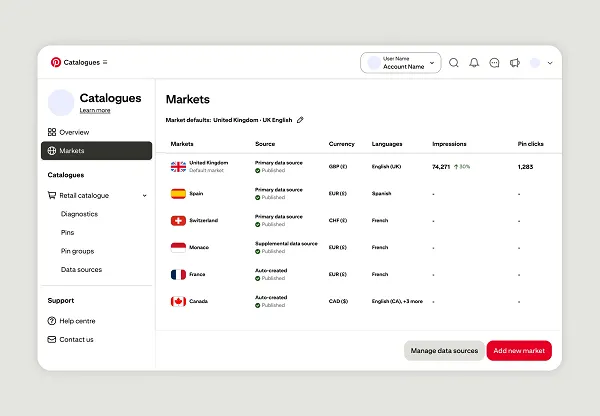
In an era where digital commerce knows no borders, Pinterest is doubling down on its commitment to international growth. Recognizing the friction often associated with scaling advertising campaigns across diverse geographies, the visual discovery engine has unveiled a sophisticated new tool: the "Markets View" element within its advertising platform. Designed to provide a unified dashboard for cross-border performance, this update is poised to transform how businesses approach international marketing, streamlining the complex logistics of currency, language, and regional analytics.
Main Facts: Simplifying the Global Advertising Landscape
The core of Pinterest’s latest announcement is the introduction of the "Markets View" dashboard. This centralized interface is engineered to provide advertisers with an granular, region-by-region breakdown of their Pin campaign performance. By aggregating data points such as impressions, click-through rates, and local currency performance, Pinterest aims to eliminate the "blind spots" that often occur when brands attempt to launch products in foreign markets.
Beyond simple observation, the tool integrates directly with Pinterest’s automated localization features. Advertisers can now toggle auto-translation for Pin titles and descriptions, ensuring that their creative content resonates with local audiences without the overhead of manual copywriting for every region. Furthermore, the platform has introduced seamless currency conversion, allowing businesses to display prices in the shopper’s local currency—a critical factor in reducing cart abandonment rates for international customers.
This rollout is not a standalone feature but a strategic component of Pinterest’s broader "International Selling" ecosystem, which includes support for country-specific catalog feeds and supplemental metadata for language and pricing.
Chronology: The Evolution of Pinterest’s Global Strategy
Pinterest’s journey toward becoming a global commerce powerhouse has been a deliberate, multi-year evolution.
- Phase 1: Foundation (2018–2020): Pinterest began by expanding its ad platform into key international markets, focusing on major economies in Europe and the Asia-Pacific region. During this period, the focus was on establishing local sales teams and basic ad functionality.
- Phase 2: Product Integration (2021–2023): Recognizing that global expansion requires more than just ads, Pinterest introduced "Catalogs" and "Verified Merchant" programs to facilitate cross-border shopping. The platform began testing multi-country ad groups to allow marketers to bundle regions for easier management.
- Phase 3: Optimization and Insight (2024–Present): The launch of the "Markets View" represents the current phase: moving from basic infrastructure to high-level optimization. By providing clear performance data, Pinterest is shifting the focus from "how to launch" to "how to scale effectively."
This progression reflects a shift in market demand. Advertisers no longer want to guess which markets yield the highest ROI; they require data-backed insights to justify increasing budgets in specific territories. The "Markets View" is the logical conclusion of this need for transparency.
Supporting Data: Why Cross-Border Commerce Matters
The impetus behind Pinterest’s latest update is supported by significant shifts in consumer behavior. According to industry research, cross-border e-commerce is projected to grow at a compound annual growth rate (CAGR) of over 20% through 2030. Pinterest, uniquely positioned as a "discovery" platform, acts as a top-of-funnel engine for many brands.
When users interact with a Pin, they are often in a high-intent mindset. However, the conversion funnel often breaks down when the user is presented with a language they do not speak or a currency they cannot easily calculate. Data suggests that:
- Localized Content Increases Engagement: Pins that are translated and localized often see a 20-30% increase in click-through rates compared to generic English-language ads.
- Currency Clarity Drives Conversion: Shoppers are significantly more likely to complete a purchase when prices are transparent and displayed in their local currency, as it removes the psychological barrier of calculating exchange rates.
- Data-Driven Allocation: Advertisers who utilize granular regional reporting—the kind provided by the new Markets View—are able to reallocate budgets from underperforming markets to high-growth regions, often resulting in a 15% improvement in overall Return on Ad Spend (ROAS).
By providing this data directly within the ad manager, Pinterest is empowering small-to-medium enterprises (SMEs) to compete on a global scale—a capability that was previously reserved for large multinational corporations with dedicated data science teams.
Official Responses and Strategic Intent
Pinterest’s leadership has framed the Markets View as a bridge between the creative potential of Pins and the operational reality of international business. In their official communication regarding the update, the company emphasized that the tool is designed to provide a "simplified overview of market-specific insight."
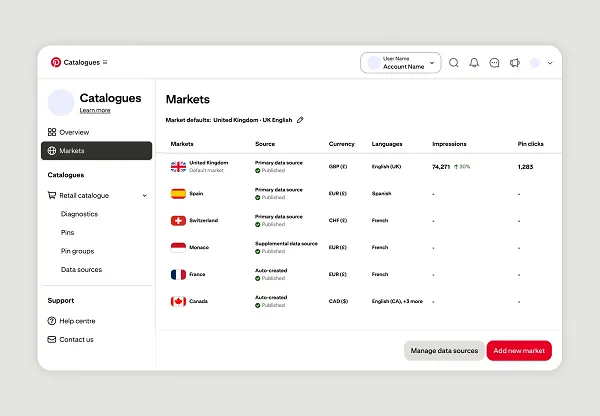
"Our goal is to remove the complexity from scaling," a Pinterest spokesperson noted. "By providing a clear, unified view of performance across borders, we are enabling our partners to move with confidence. Whether a business is entering its first international market or its fiftieth, the Markets View provides the clarity needed to make informed budget allocation decisions."
The company has also highlighted that this tool is a "complement" to its multi-country campaign structures. While multi-country ad groups handle the logistics of bidding and targeting, the Markets View provides the diagnostic layer—helping advertisers understand why a campaign is succeeding in France but underperforming in Germany, for example.
Implications: The Future of Global Ad Management
The introduction of the Markets View has profound implications for the advertising industry, particularly for brands looking to diversify their market footprint.
1. Democratization of Global Advertising
Historically, international expansion was a high-risk endeavor for most brands. The cost of entry, combined with the difficulty of tracking performance across disparate regions, kept many businesses tethered to their domestic markets. Pinterest’s tool lowers the barrier to entry, essentially "democratizing" international advertising by providing the data infrastructure necessary for success.
2. The Rise of the "Borderless Consumer"
Pinterest is betting on the trend of the "borderless consumer"—someone who finds a product on a visual platform and doesn’t care which country it ships from, provided the experience is seamless. By automating translations and currency conversions, Pinterest is facilitating this behavior, effectively turning every advertiser on the platform into a potential global retailer.
3. Data as the Ultimate Competitive Advantage
In the digital marketing landscape, data is the most valuable currency. By offering downloadable report data, Pinterest allows marketers to integrate regional insights into their own internal business intelligence systems. This creates a feedback loop: marketers use the data to refine their products and pricing, which then leads to better performance on the platform, reinforcing the value of the Pinterest ecosystem.
4. Pressure on Competitors
This move puts additional pressure on competitors like Meta and TikTok to refine their own cross-border toolsets. While those platforms have robust international capabilities, Pinterest’s niche as a platform for inspiration and shopping makes it uniquely suited for cross-border commerce. If Pinterest can successfully convert this inspiration into frictionless international transactions, it will solidify its position as an essential channel for global growth.
Conclusion: A New Standard for International Marketing
As the digital economy continues to integrate, the distinction between "local" and "global" marketing is becoming increasingly obsolete. Pinterest’s "Markets View" is a clear signal that the platform is ready to support the next generation of global businesses.
By providing a clear, actionable dashboard that addresses the core pain points of international expansion—language, currency, and reporting—Pinterest is not just updating a tool; it is redefining the role that social commerce platforms play in the global supply chain. For advertisers, the message is clear: the world is now their market, and the data to conquer it is just a few clicks away. As this feature rolls out to all ad partners, it is likely to become a cornerstone of global advertising strategies, setting a new standard for how brands interact with international audiences.
Whether you are a local boutique looking to ship internationally or a global brand optimizing for regional nuances, the Markets View provides the precision needed to ensure that every Pin counts, regardless of where it is seen.










