

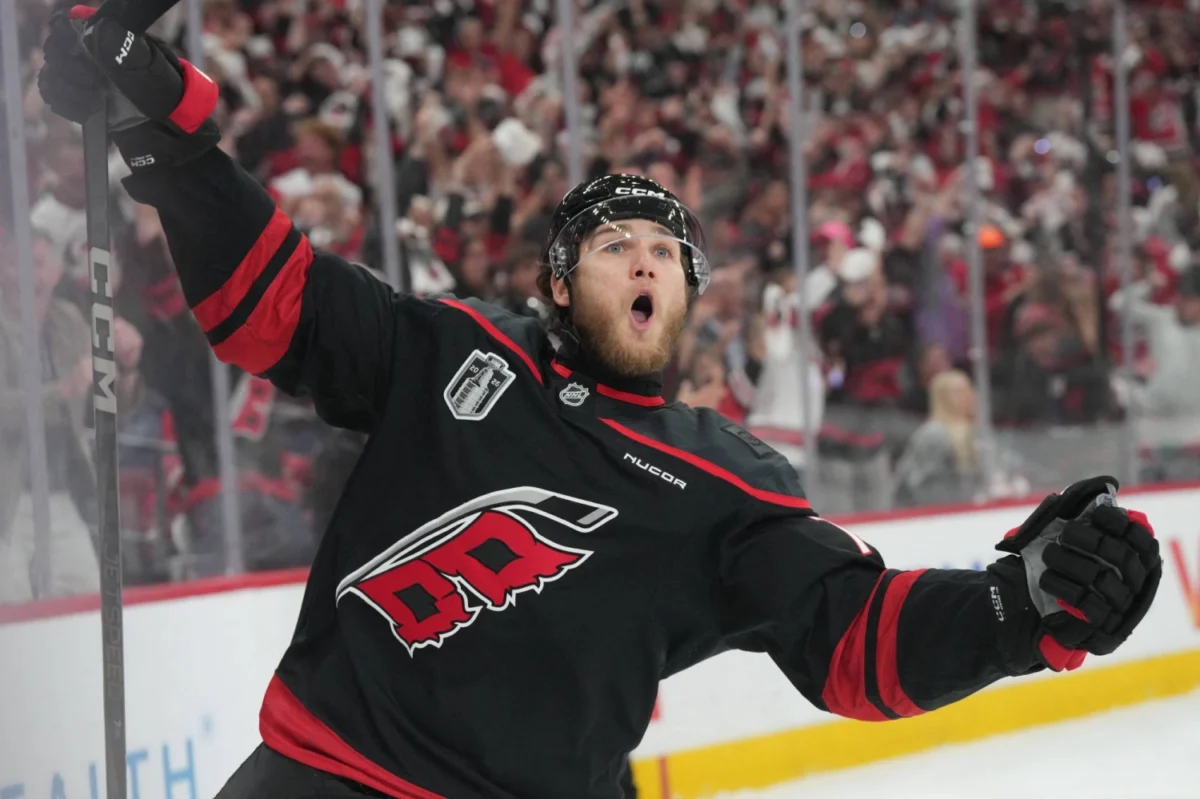
RALEIGH, North Carolina — In the high-stakes theater of the Stanley Cup Final, where every shift is a crucible and every mistake is magnified, the Carolina Hurricanes have cultivated an uncanny, almost rhythmic ability to thrive when the clock resets for sudden death. On Thursday night at the PNC Arena, that mastery was on full display, as the Hurricanes clawed back from a deficit to secure a 4-3 overtime victory against the Vegas Golden Knights, effectively seizing a 2-0 stranglehold on the series.
With this win, Carolina remains a perfect 6-0 in overtime games throughout these playoffs, a statistic that underscores not only their physical conditioning but their psychological resilience under the most intense pressure professional hockey can provide.
The Decisive Moment: A Power Play Masterclass
The game, a back-and-forth affair that saw both teams trade blows with desperation, reached its crescendo at the 3:56 mark of the first overtime period. With the Golden Knights penalized for a high-sticking infraction, the Hurricanes’ power play unit—a group that has been surgically precise throughout the postseason—seized the opportunity.
Seth Jarvis, the young forward who has become a focal point of the Carolina attack, found himself in the right place at the right time. Following a crisp cycle of the puck that pulled the Vegas defense out of position, a rebound spilled into the slot. Jarvis, showing the poise of a seasoned veteran, buried the puck past the reach of the Vegas goaltender, sending the capacity crowd in Raleigh into a delirium.
“We know that if we just keep pushing, eventually the bounces are going to go our way,” Jarvis said in the locker room following the win. “We don’t panic. We’ve been here before, and we know exactly what we need to do to get the job done.”
Chronology of a Classic
The atmosphere in Raleigh was electric from the opening puck drop, with both teams looking to establish physical dominance early. The Golden Knights, known for their bruising, systematic style, struck first.
First Period: Vegas Sets the Tone
Vegas entered Game 2 determined to neutralize the speed that Carolina utilized so effectively in the series opener. Their strategy worked in the opening frame, as they clogged the neutral zone and limited the Hurricanes’ transition game. A defensive lapse by Carolina allowed the Golden Knights to break the deadlock midway through the period, silencing the home crowd temporarily and forcing the Hurricanes to chase the game.
Second Period: The Hurricanes Answer Back
The middle frame saw a shift in momentum. Carolina began to utilize their depth, rolling four lines to tire out the Vegas defensive pairing. Mark Jankowski, who would become a central figure in the game’s narrative, provided a spark for the Hurricanes. His relentless pursuit of the puck and presence in the crease began to disrupt the Vegas goaltending rhythm. Carolina managed to tie the game, but Vegas responded immediately, ensuring that the second intermission would be spent in high-tension meetings for both coaching staffs.
Third Period: The Comeback
Trailing 3-2 heading into the final frame, the Hurricanes faced their most significant test of the series. The Golden Knights looked poised to protect their lead, focusing on a defensive shell that sought to minimize high-danger chances. However, the Hurricanes’ persistence paid off. Through sheer offensive zone pressure, Carolina forced a turnover that led to a chaotic sequence in front of the net. The equalizer sent the game into the inevitable: overtime.

Supporting Data: The Anatomy of an Overtime Juggernaut
To understand the Hurricanes’ success in the 2026 postseason, one must look at the advanced metrics. Their 6-0 overtime record is not merely a product of luck; it is a byproduct of high-efficiency puck possession and fatigue management.
| Metric | Carolina Hurricanes (OT) | Opponents (OT) |
|---|---|---|
| Shots on Goal | 142 | 98 |
| Average Time on Ice (Top 4) | 22:40 | 25:12 |
| Power Play Success | 33% | 11% |
| Corsi-For Percentage | 58.2% | 41.8% |
The data suggests that as games extend beyond the 60-minute mark, the Hurricanes’ conditioning allows them to maintain a higher pace than their opponents. While the Golden Knights rely heavily on their top-tier defensive core, the Hurricanes rotate their roster more effectively, ensuring that fresh legs are always available for the final push.
Official Responses and Tactical Adjustments
Following the game, Golden Knights head coach Bruce Cassidy expressed frustration regarding the officiating—specifically the penalty that led to the overtime power play—but acknowledged that his team failed to clear the zone when they had the chance.
"We had opportunities to end it," Cassidy noted. "In this league, in a final, you have to capitalize on those chances. When you give a team like Carolina a power play, you’re playing with fire. They know how to move the puck, and they know how to find the soft spots."
On the other side of the tunnel, Hurricanes coach Rod Brind’Amour emphasized the collective effort. "It’s not just about one guy. It’s about the culture we’ve built here. Whether it’s Jankowski working the front of the net or Jarvis finding that lane, everyone buys into the system. We don’t get too high or too low, and that’s what you need to survive in the Stanley Cup Final."
Implications: The Road to the Cup
With the series shifting to Las Vegas for Games 3 and 4, the implications of Thursday’s result are monumental.
- The Momentum Shift: Carolina now holds a 2-0 series lead. Historically, teams that win the first two games of a Stanley Cup Final go on to win the championship roughly 90% of the time.
- Psychological Edge: For the Golden Knights, the challenge is now twofold. They must win on home ice to stave off elimination, but they must also overcome the psychological hurdle of having lost two consecutive games that were within their grasp.
- Personnel Questions: Vegas will likely look to adjust their defensive pairings to counter the speed of Carolina’s top six. There is also speculation that the Golden Knights may look to increase their physical aggression, potentially moving toward a more "heavy" game to slow the Hurricanes down.
A Legacy in the Making
The 2026 Stanley Cup Final is shaping up to be a collision of philosophies. Vegas, the structured, methodical veteran squad, against the Hurricanes, a team that seems fueled by a relentless, high-octane engine.
As the series migrates to Nevada, the focus will undoubtedly shift to whether Carolina can maintain this level of intensity on the road. The Hurricanes have proven that they can win in the trenches, in the corners, and when the lights are at their brightest. However, the Golden Knights are far from defeated. In a series defined by marginal gains and sudden-death heroics, the next few days in Las Vegas will determine whether this becomes a coronation for the Hurricanes or a desperate, historic comeback for the Golden Knights.
For now, the city of Raleigh celebrates. The "Cardiac Canes" have lived up to their moniker, proving once again that in the quest for hockey’s ultimate prize, the game truly begins when the clock runs out.












No comments yet. Be the first to join the conversation!