

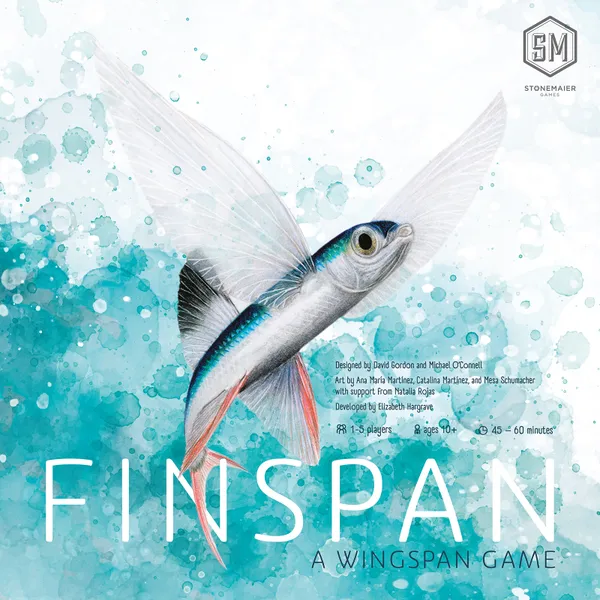
The landscape of modern tabletop gaming has long been dominated by the “-span” suffix, a moniker that has become synonymous with elegant, engine-building experiences. Following the astronomical success of Wingspan and the high-fantasy mechanics of Wyrmspan, Stonemaier Games (and its ecosystem of designers) has introduced the third entry in this spiritual series: Finspan.
By trading the avian skies and draconic caverns for the vast, mysterious depths of the ocean, Finspan attempts to refine the formula into its most streamlined iteration yet. But does a move to the aquatic realm offer enough depth to satisfy veteran players, or has the series finally reached the shallow end of the pool?
The Core Mechanics: How to Play
At its heart, Finspan is a game of ecosystem management. Players act as stewards of a localized ocean environment, populating various depth-defined zones with diverse marine life. The turn structure is deceptively simple, adhering to the series’ tradition of binary decision-making. On your turn, you are faced with two primary options: play a fish or take a dive action.
Playing a Fish
When you choose to play a fish, you are adding a card to your tableau. This requires the expenditure of specific resources—eggs, juvenile fish, or discarded cards—reflecting the biological cost of sustaining a species. Crucially, each fish must be placed in a zone that matches its depth requirements. Many species offer an "enters play" effect, providing immediate utility, while others are geared toward long-term engine building, creating synergies that pay dividends later in the game.
The Dive Action
If you aren’t expanding your population, you are diving. A dive action activates a specific ocean zone on your player board. The game’s unique hook here is the resolution mechanic: you resolve the abilities of the fish in that row from right to left. As your tableau expands, these actions become increasingly powerful, allowing for cascading resource generation, card drawing, and point accumulation. The game concludes after a set number of rounds, with victory determined by a combination of fish values, eggs, and the completion of round-specific objectives.
Pacing and Interaction: A Fluid Experience
One of the most immediate takeaways from Finspan is its velocity. The game moves at a brisk, consistent pace that avoids the mid-game slump often found in heavier tableau builders. Because actions resolve quickly, downtime is kept to a minimum—a vital feature for a game that thrives at lower player counts.
Streamlining the Engine
Compared to its predecessors, Finspan feels significantly more "light." There are no complex multi-step turn sequences to memorize, and the game removes the "extra fee" or "action tax" mechanics that sometimes cluttered earlier entries. This makes it an incredibly accessible entry point for newcomers to the hobby. Even as the game progresses and your engine becomes complex, the board remains readable and the decision space feels intuitive rather than overwhelming.
The Interaction Paradox
The interaction in Finspan remains a point of contention. While the game introduces open-hand play—allowing everyone to see the potential paths and strategies of their opponents—it remains, fundamentally, a multiplayer solitaire experience.
You can see what your opponent is planning, but you lack the tools to meaningfully disrupt it. While you compete for shared end-of-round achievements, the game lacks a "take-that" mechanism. Some may find this lack of friction refreshing, as it allows for a zen-like, high-optimization experience. Others, however, may wonder why the developers chose to implement an "open hand" system if the game provides no meaningful way to act on that information. It is a system that invites strategic awareness but offers little in the way of competitive confrontation.
Replayability and the Achievement System
Despite the lack of direct conflict, Finspan boasts substantial replayability. The sheer diversity of the fish deck ensures that no two boards will ever look the same. Because fish interact with your specific board state and the current pool of resources, players are forced to adapt their strategy based on the "puzzle" presented by their current hand.
The variable achievement system is the game’s primary engine for longevity. While the standard setup provides a stable learning environment, the advanced side of the objectives introduces shifting priorities that force players to pivot. In one game, you might be rewarded for focusing on apex predators; in the next, your strategy might shift toward rapid population growth. This unpredictability ensures that players cannot rely on a single, "solved" strategy, keeping the experience fresh over multiple plays.
Theme and Components: An Immersive Descent
The presentation of Finspan is a masterclass in thematic integration. The artwork is vibrant, capturing the bizarre beauty of deep-sea life with a level of detail that makes every card feel like a collector’s piece.
The Vertical Board
The most striking component change is the vertical ocean board. Rather than the horizontal tracks of previous titles, the vertical orientation provides a tangible sense of "diving." Watching your tokens descend through the different pressure zones feels mechanically sound and visually thematic. It removes the abstraction often associated with engine builders, making the game more approachable for players who prefer a strong thematic anchor.
Production Quality
As expected from a series of this pedigree, the components are functional and polished. The tokens are weighted and easy to handle, and the inclusion of separate, distinct rulebooks for multiplayer and solo modes is a welcome touch that demonstrates a commitment to the user experience. While the iconography can be dense for a first-time player, it becomes second nature by the second round.
Implications: Who is Finspan For?
Finspan is an ideal acquisition for fans of the existing "span" games who desire a more streamlined, approachable experience. It functions beautifully as a "gateway-plus" game—easy enough to teach to new players, but deep enough to satisfy those who enjoy the satisfying loop of engine optimization.
The Verdict
- Best for: Players who enjoy relaxing, low-conflict games where the primary goal is to build a beautiful, high-functioning machine. It sits comfortably alongside titles like Everdell in terms of weight and tone.
- Not for: Those who crave high-tension interaction, complex economies, or direct player-vs-player disruption. If you found Wingspan too solitary, Finspan is unlikely to change your opinion; in fact, it doubles down on the personal, meditative nature of the genre.
Final Summary
Finspan is a triumph of design refinement. By stripping away the bloat and focusing on the core joy of the engine-building loop, it offers a refreshing, fluid, and visually stunning experience. While it may not satisfy those looking for a cutthroat strategic battle, it succeeds brilliantly as a relaxing, replayable puzzle.
In the crowded ocean of modern board games, Finspan proves that sometimes, the best way to move forward is to dive a little deeper into what makes a game fun in the first place. Whether you are a veteran of the series or a curious newcomer, the depths of this game are well worth exploring.
Rating: 8.5/10 — A polished, essential addition to any collection for those who prefer the pursuit of personal excellence over the destruction of their opponents.












No comments yet. Be the first to join the conversation!