

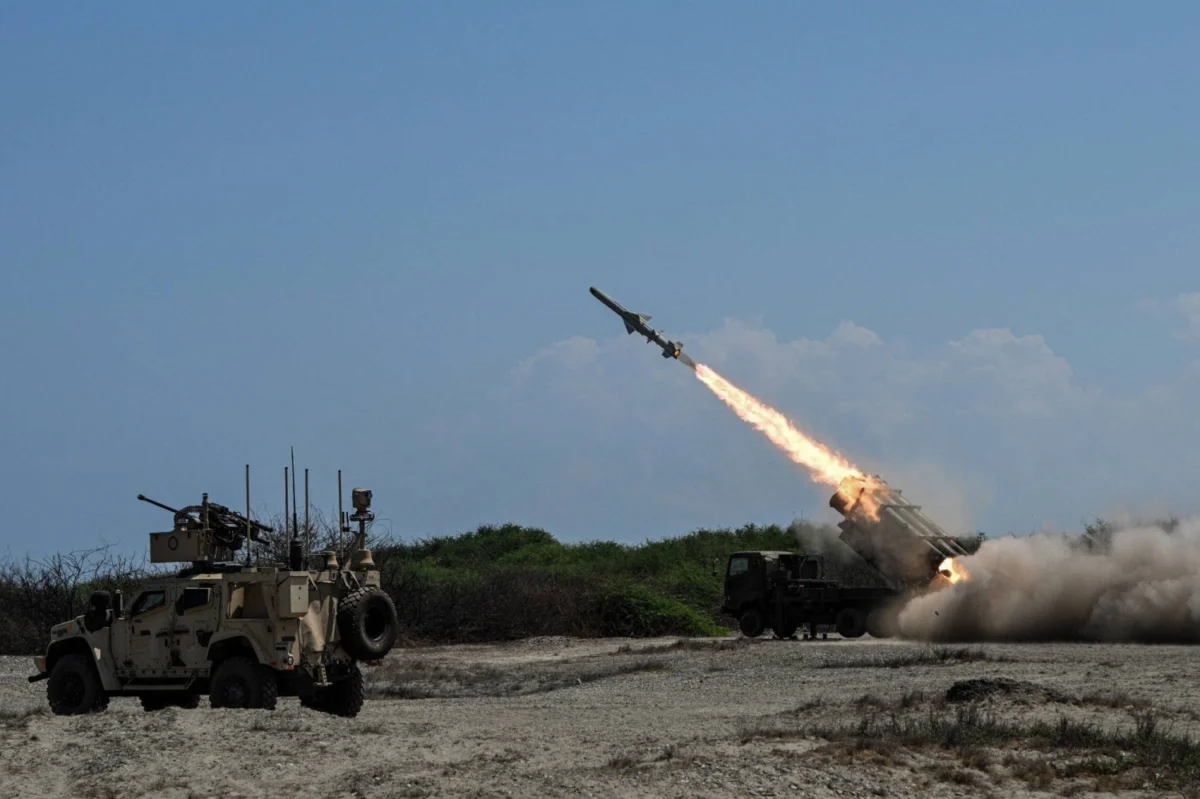
SINGAPORE – In a significant recalibration of regional security architecture, Japanese Defense Minister Shinjiro Koizumi and Philippine Secretary of National Defense Gilberto Teodoro announced on Sunday that Tokyo and Manila will officially commence negotiations regarding the export of advanced Japanese surface-to-ship missile systems to the Philippines.
The announcement, made on the sidelines of a security summit in Singapore, marks a historic departure from Japan’s long-standing restrictions on defense exports and underscores the deepening security interdependence between the two nations. As tensions escalate in the South China Sea, this development signals a robust commitment by Japan to bolster the Philippine military’s "Minimum Credible Defense Posture" against increasingly assertive regional claims.
Main Facts: The New Defense Roadmap
The core of the agreement revolves around the transfer of sophisticated hardware and the formalization of defense supply chains. Minister Koizumi confirmed that the primary focus of the upcoming negotiations is the procurement of the Type-88 surface-to-ship guided missile (SSM-1) system, currently operated by the Japan Ground Self-Defense Force (JGSDF).
Key Deliverables:
- Type-88 Missile Systems: The Philippines has expressed explicit interest in acquiring these mobile, truck-mounted anti-ship missiles, which provide a critical land-based deterrent against naval incursions.
- Maritime Asset Transfers: Beyond missiles, both defense chiefs reached a broad consensus on the transfer of decommissioned Abukuma-class destroyers from the Japan Maritime Self-Defense Force (JMSDF) to the Philippine Navy.
- Aviation Support: The Japanese Ministry of Defense has committed to the delivery of a TC-90 training aircraft to the Philippine Air Force by the end of fiscal year 2027.
- Institutional Frameworks: Alongside hardware, the two nations are formalizing working groups to streamline technological cooperation, following Japan’s strategic pivot in April regarding its "Three Principles on Defense Equipment Transfers."
Chronology: The Path to Strategic Convergence
The deepening of Tokyo-Manila defense ties is not a sudden occurrence but the culmination of a decade of measured diplomatic and military alignment.
- 2012–2024 (The Observer Era): For over a decade, Japan participated in the annual U.S.-Philippine Balikatan (shoulder-to-shoulder) exercises primarily as an observer. This period was characterized by cautious engagement focused on disaster relief and humanitarian assistance.
- 2025 (The Pivot): The landscape shifted dramatically in September 2025, when the Japan-Philippine Reciprocal Access Agreement (RAA) entered into full force. This legal framework allowed for the seamless deployment of troops and equipment between the two nations, paving the way for Japan to participate in the Balikatan drills on a full-scale basis for the first time.
- April 2026 (Policy Reform): The Japanese government implemented historic revisions to the guidelines governing the transfer of defense equipment. By loosening the strictures that previously limited exports to non-lethal items, Tokyo cleared the bureaucratic path for the transfer of offensive capabilities, such as the Type-88 missiles.
- Present Day: The Singapore meetings serve as the operational implementation of these legislative and geopolitical shifts, moving from abstract cooperation to concrete military procurement.
Supporting Data: Why the Type-88 Matters
The Type-88 Surface-to-Ship Missile system is a formidable platform in modern naval warfare. Developed by Mitsubishi Heavy Industries, the system is designed to provide coastal defense through high-precision, anti-ship capability.
Technical Specifications and Utility
The Type-88 features an inertial guidance system with active radar homing, allowing it to engage targets beyond the visual horizon. For the Philippines, which possesses a vast archipelago and thousands of kilometers of coastline, the Type-88 offers a "sea-denial" capability. By deploying these systems on strategic islands, the Philippine military can effectively monitor and threaten any hostile naval assets attempting to enter disputed waters, thereby increasing the "cost" of aggression for adversaries.
The interest in these systems was solidified during the April–May 2026 Balikatan exercises, where Philippine military planners observed the performance of the JGSDF’s Type-88 batteries. Seeing the systems integrated into a multi-domain environment convinced Manila that the platform is a necessary addition to their modernization program.
Official Responses and Diplomatic Context
The Japanese Perspective
Minister Koizumi emphasized that Japan’s shift in policy is a response to a "deteriorating regional security environment." By assisting the Philippines, Japan is not merely engaging in arms sales; it is investing in its own periphery. Tokyo views the stability of the South China Sea as inseparable from the security of the sea lines of communication (SLOCs) upon which the Japanese economy depends.
"Our cooperation with the Philippines is based on the shared principle of maintaining a Free and Open Indo-Pacific," Koizumi told reporters. "By strengthening the defense foundations of our partners, we contribute to the collective stability of the entire region."
The Philippine Perspective
Secretary Teodoro, representing the administration in Manila, has consistently framed the procurement as an exercise of sovereign rights. Under the administration’s current defense doctrine, the Philippines is transitioning from internal security operations toward territorial defense. The acquisition of Japanese hardware is seen as a cost-effective and reliable method to upgrade the Navy and Air Force without the political volatility sometimes associated with other foreign suppliers.
Implications: A Shifting Balance in the South China Sea
The transfer of these assets has profound implications for regional geopolitics.
1. Strengthening Deterrence
The inclusion of destroyers and missile systems creates a multi-layered defense strategy for Manila. While the destroyers provide blue-water patrol capabilities, the missile systems provide a "hard" deterrent against incursions into the Exclusive Economic Zone (EEZ). This forces any potential adversary to account for a sophisticated, integrated defense network rather than a localized coast-guard-level confrontation.
2. Japan’s Role as a Regional Security Provider
This deal marks a milestone in Japan’s "post-pacifist" defense posture. By exporting lethal hardware, Japan is moving away from the role of a passive supporter of regional stability to an active participant. This shift is likely to draw criticism from Beijing, which has historically viewed Japan’s military expansion with suspicion. However, Tokyo maintains that its actions are purely defensive and transparent.
3. Expansion of the Network
Beyond the Philippines, the meeting between Minister Koizumi and Singapore’s Defense Minister Chan Chun Sing suggests that Japan is looking to build a broader security network. The agreement to establish a working group for defense technology and industrial cooperation with Singapore indicates that Tokyo is moving toward a "hub-and-spoke" model of security, where Japan provides technological expertise and equipment to multiple Southeast Asian partners, creating a cohesive, interoperable regional defense ecosystem.
Future Outlook: Challenges and Trajectories
While the momentum for these transfers is strong, several challenges remain. The integration of Japanese systems into the Philippine military will require significant training, maintenance, and logistical support. The working groups mentioned by the ministers will be tasked with creating a sustainable pipeline for spare parts and technical training to ensure that the hardware does not become "white elephants" due to lack of upkeep.
Furthermore, the diplomatic pressure from regional powers will intensify. As Japan and the Philippines deepen their ties, the narrative of "bloc building" will likely be employed by detractors. However, both nations seem committed to the current trajectory, viewing the deepening of their defense partnership as a vital necessity in an era of great power competition.
As the working groups begin their sessions in the coming months, the world will be watching to see how quickly the Type-88s can be deployed and how the broader region reacts to this significant upgrade in Philippine capabilities. One thing is certain: the security architecture of the Indo-Pacific is being rewritten in real-time, with Tokyo and Manila at the center of the transformation.












No comments yet. Be the first to join the conversation!