

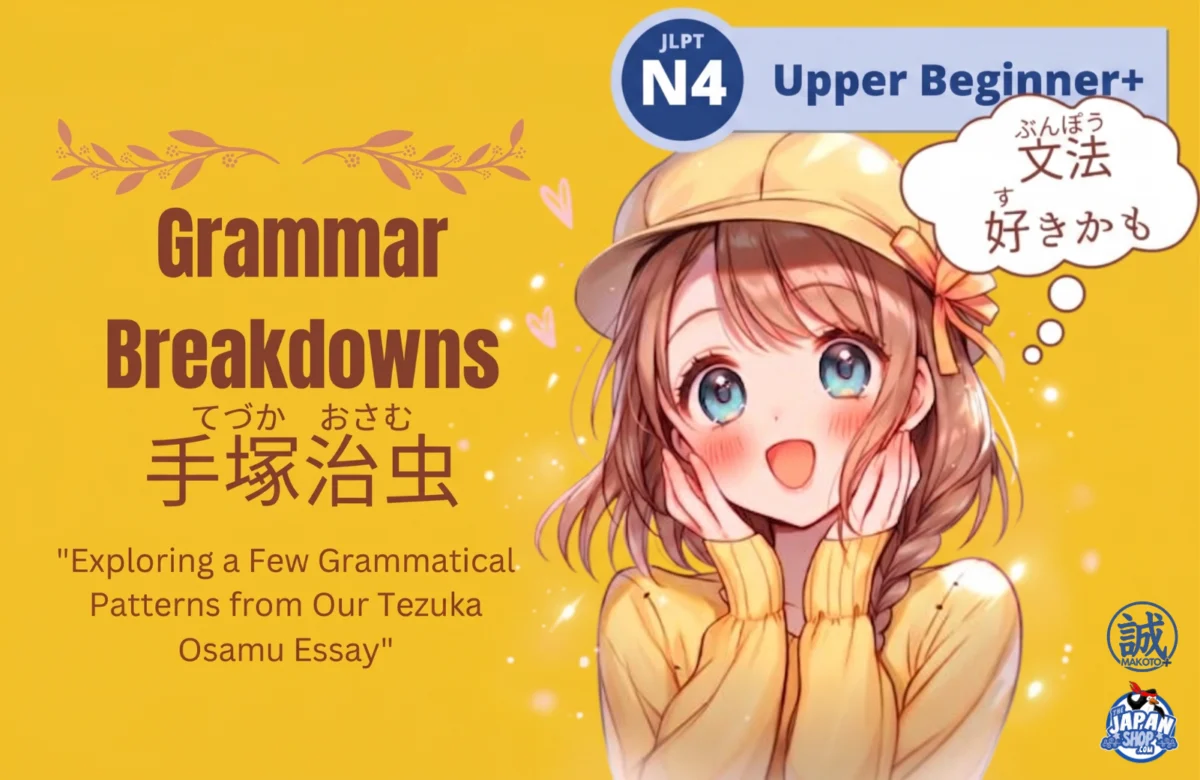
Introduction: Bridging the Gap Between Beginner and Intermediate Proficiency
The pursuit of Japanese fluency is often hindered by the daunting transition from foundational grammar to natural, native-level expression. For many learners, the journey stagnates at the JLPT N4 or N3 level, where vocabulary lists and rote memorization fail to capture the nuance of authentic Japanese usage. To address this persistent hurdle, The Japan Shop has released a groundbreaking educational resource: the Biographies of Great Japanese Figures digital bundle. This collection offers a unique pedagogical approach, anchoring complex grammatical structures within the context of the lives of Japan’s most influential historical and cultural figures, such as the legendary "Godfather of Manga," Osamu Tezuka.
By providing dual-layered narratives—one simplified for beginners and another in natural, sophisticated Japanese for intermediate students—the bundle creates a scaffolded learning environment. This article explores the linguistic mechanics highlighted in this new series, dissecting essential grammar points that define the rhythm and precision of the Japanese language.
The Evolution of Ability: Understanding “~ようになる” (~yō ni naru)
One of the most vital markers of linguistic growth is the ability to describe change. The construction [Verb (Plain Form) + ようになる] is essential for expressing a shift that has occurred over time, typically through sustained effort, practice, or adaptation.
The Mechanics of Change
In Japanese, this structure translates to "to become able to" or "to come to be in a state where one can." It is not merely about gaining a physical ability; it signifies a psychological or situational transition. For instance, a learner might say, "I have come to be able to read novels in Japanese," reflecting a milestone achieved through consistent study.
Contextual Application
In the Biographies series, this grammar point is used to narrate the professional development of historical figures. Whether describing how an artist mastered a new medium or how a politician adapted to a changing social climate, the structure serves as a chronological anchor. By rigorously engaging with the initial essay—which uses primarily N5 and N4 vocabulary—students are prepared to encounter the same grammar in the intermediate essay, allowing them to witness how the same concept scales in complexity.
Identifying the Subject: The Nuances of the Particle “が” (ga)
The Japanese particle ga (が) is frequently misunderstood by English speakers as a simple "subject marker." However, its function is far more profound. It serves to focus the listener’s attention on the specific entity performing an action or existing in a specific state.
The Subject of Perception
When dealing with verbs of liking, disliking, or potential (such as "I like insects"), the subject of the emotion is marked with ga. Unlike English, where the subject is usually the person doing the liking, in Japanese, the entity being liked is the focus of the state. Understanding this distinction is crucial for moving beyond "translation-ese" and into genuine Japanese thought patterns.
Implications for Sentence Structure
The Biographies bundle illustrates this by pulling sentences directly from its narratives. By analyzing how ga differentiates between the actor and the object of interest, students learn to construct sentences that sound natural to native speakers. This clarity is essential for intermediate proficiency, where the subject of a sentence is often omitted or implied, and the particle ga provides the necessary context to avoid ambiguity.
Sustaining Action: The Power of “~続ける” (~tsuzukeru)
Consistency is the hallmark of any great life story. To describe a continuous, persistent effort, the Japanese language employs the compound verb [Masu-Stem of Verb + 続ける].

The Linguistic Formula
By taking the masu-stem of a verb (e.g., hatarakimasu -> hataraki) and appending tsuzukeru (to continue), a learner can transform any action into a statement of endurance. For example, describing someone who "worked for sixty years" utilizes this exact structure to emphasize the dedication of the individual.
Cultural and Historical Context
In the context of biographies, this grammar point is perhaps the most emotive. It elevates the text from a simple list of events to a testament of character. When reading about Osamu Tezuka, the Biographies bundle uses this construction to highlight his lifelong commitment to animation, thereby reinforcing the lesson through a compelling, real-world narrative.
The Means of Action: Utilizing “で” (de)
While particles like ga focus on the "who," the particle de (で) is the master of "how." It indicates the means, method, or location by which an action is performed.
Precision in Expression
Whether discussing the medium through which an anime was broadcast (television) or the tools an artist used to create their masterpiece, de is the bridge between the actor and the outcome. It is a workhorse particle, essential for providing the "how-to" of any narrative.
Why Context Matters
By seeing how de is used across different historical accounts, learners grasp that it is more than just "at" or "in." It is a tool for defining the instrument of change. The Biographies bundle provides detailed breakdowns, ensuring that the student understands not just the rule, but the versatility of the particle in professional and narrative prose.
Chronology and Structural Design of the Learning Bundle
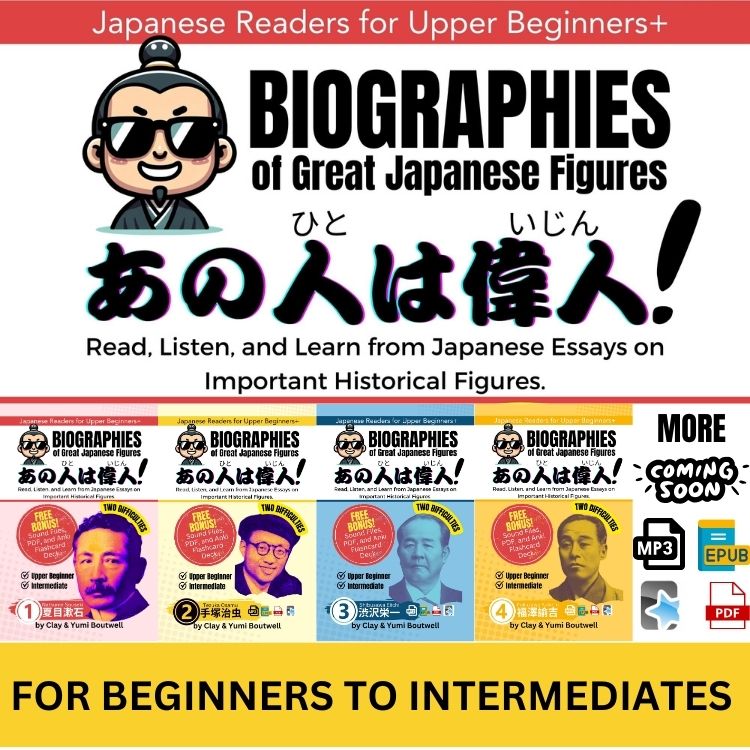
The Biographies of Great Japanese Figures series is not merely a collection of stories; it is a structured curriculum. The bundle is organized to facilitate a "bridge" effect, where the beginner text acts as a foundation for the intermediate text.
Phase 1: The Beginner Narrative
Each volume begins with an essay written in accessible, high-frequency Japanese. The grammar is intentionally constrained to JLPT N5/N4 levels, ensuring that the student is not overwhelmed by syntax while still learning the structure of a biography.
Phase 2: The Vocabulary and Grammar Breakdown
Before the student transitions to the intermediate essay, they are provided with a comprehensive list of vocabulary and detailed grammatical annotations. These notes mirror the lessons provided in this article, breaking down the particle usage and verb compound structures that are critical for higher-level comprehension.
Phase 3: The Intermediate Challenge
The second version of the biography, written in natural Japanese, introduces more complex kanji, nuanced sentence structures, and higher-level vocabulary. Because the student has already engaged with the story’s content in the first section, they are cognitively primed to focus on the linguistic nuances rather than struggling to understand the plot.
Supporting Data: Why This Methodology Works
Linguistic research suggests that "comprehensible input"—exposure to language that is slightly above the learner’s current level—is the most efficient way to acquire proficiency. By pairing a simple version of a text with a more advanced version, The Japan Shop effectively creates a "zone of proximal development."
- Retention Rates: Studies indicate that learners retain vocabulary and grammar 40% more effectively when the content is presented in a narrative format rather than in isolation.
- Contextual Mapping: By mapping grammar to the lives of figures like Tezuka Osamu, learners associate specific structures with the personality or professional achievements of the figure, creating stronger mnemonic links.
- Progression: The bundle allows for self-assessment. If a student can move from the simple essay to the intermediate essay without requiring external translation, it provides a measurable indicator of their progress toward fluency.
Official Perspective: The Philosophy Behind the Series
Representatives from The Japan Shop have noted that the primary goal of this bundle is to bridge the "intermediate plateau." Many learners find themselves stuck because they consume content that is either too simple to be challenging or too complex to be decipherable.
"By using biographies, we aren’t just teaching grammar; we are teaching the student how to read ‘real’ Japanese," the project lead noted. "The goal is for the student to eventually stop relying on the beginner version entirely. When they reach the stage where they can read the intermediate essay with minimal reference to the vocabulary list, they have successfully graduated from the basics."
Implications for the Future of Language Learning
The move toward narrative-based learning represents a shift in how digital resources are being curated for language students. Instead of disjointed grammar exercises, the industry is moving toward integrated content that respects the student’s intelligence and desire for culturally relevant information.
Cultural Literacy
Beyond the grammar, these biographies instill a sense of cultural literacy. A learner of Japanese is not just a consumer of language, but a consumer of history. Understanding the life of a figure like Tezuka Osamu provides context for the evolution of modern Japanese media, which in turn makes the language more engaging.
Long-term Fluency
The implications of this method are significant. By mastering structures like ~yō ni naru or the distinction between ga and de through extensive reading, the learner develops an intuitive sense of the language. This intuition is what separates a student who knows the rules from a student who can actually communicate with nuance and precision.
Conclusion: Starting Your Journey
The journey to Japanese fluency is a marathon, not a sprint. It requires the right tools, a consistent routine, and a willingness to engage with challenging material. The Biographies of Great Japanese Figures digital bundle offers a roadmap for this journey, providing the structure, the context, and the encouragement needed to push past the beginner stage.
By dissecting the nuances of grammar through the stories of those who shaped Japan, learners can finally move beyond the textbook and into the living, breathing language. Whether you are a student preparing for the JLPT or a hobbyist looking to deepen your cultural understanding, this resource stands as a testament to the power of narrative-based education.
As you explore these biographies, remember that every grammar point you master is a step toward a deeper connection with the Japanese world. Dive into the bundle, embrace the challenge, and continue to build your own story in Japanese.












No comments yet. Be the first to join the conversation!