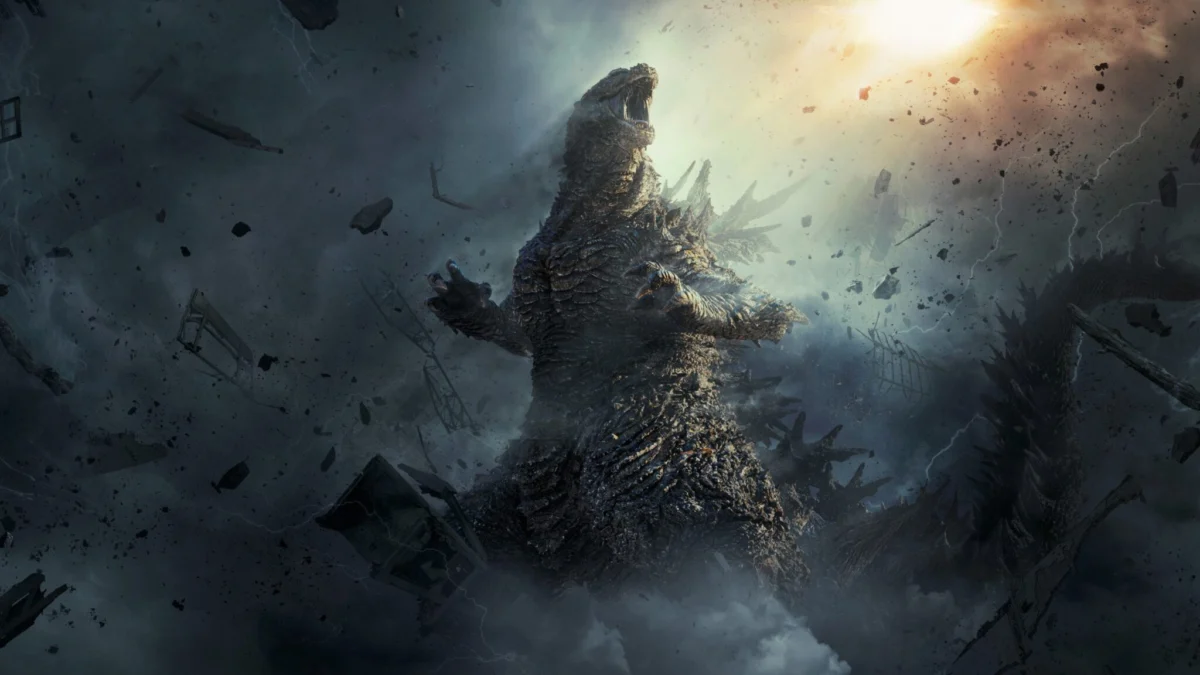
The North American box office is bracing for a seismic event as Toho’s highly anticipated sequel, Godzilla Minus Zero, prepares to stomp into theaters. Following the historic, award-winning success of its predecessor, the film is tracking for a formidable $30 million opening weekend across 3,254 North American screens. As the centerpiece of a diverse cinematic slate, Godzilla Minus Zero leads a weekend marked by high-stakes IP animation, gritty auteur-driven drama, and a historic expansion for international cinema.
Main Facts: The King of the Monsters Returns
Godzilla Minus Zero is not merely a sequel; it is a technological milestone. Directed by Takashi Yamazaki, who returns after the critical and commercial triumph of 2023’s Godzilla Minus One, the new film is the first Japanese production in history to be filmed specifically for the IMAX format.
The film picks up two years after the events of Minus One, finding a scarred, postwar Japan grappling with a regenerating Godzilla who must now confront a terrifying new adversary. Critics have already hailed the film as a cinematic spectacle, with Variety’s chief film critic Owen Gleiberman calling it an “even grander follow-up” that maintains the emotional weight and visual ambition of the first installment. With distribution handled by GKids in the U.S., the film is expected to overindex in premium large formats (PLFs), as audiences flock to see the Kaiju’s return on the largest screens possible.
Chronology: From Oscar Glory to New Heights
To understand the current fervor, one must look back at the improbable trajectory of Godzilla Minus One. Debuting in a landscape hampered by the 2023 Hollywood actors and writers strikes, the film arrived as a "sleeper" hit. With little traditional marketing competition, the sci-fi epic leveraged stellar word-of-mouth and a scarcity of blockbuster alternatives to earn $11.4 million in its opening frame.
What followed was a marathon of success. Godzilla Minus One surged to a domestic total of $57 million, securing its place as the highest-grossing live-action Japanese film in North American history. The momentum didn’t stop at the box office; the film captured global attention, earning $113 million worldwide and culminating in a landmark Academy Award win for Best Visual Effects. Godzilla Minus Zero effectively inherits the mantle of this momentum, launching in a market that is far more receptive to high-concept international genre cinema than it was just two years ago.
Supporting Data: Animation, Auteurs, and Global Imports
While the Kaiju is set to rule the roost, the rest of the box office remains a complex battlefield of demographics and distribution strategies.
The Animated Challenge: The Cat in the Hat
Warner Bros. Animation is entering the fray with a new take on Dr. Seuss’s The Cat in the Hat. Projected to land in second place with $20 million to $25 million from 4,000 venues, the film faces a challenging hurdle: the legacy of previous adaptations. Unlike the massive debuts of The Grinch ($67 million in 2018) or The Lorax ($70 million in 2012), the new Cat is tracking conservatively.
Studio executives are banking on the "long tail" effect. Much like Sony’s Garfield—which bowed to a modest $23 million but grew to $91 million domestically and $257 million globally—Warner Bros. hopes for a sustained run. The film, voiced by Bill Hader and directed by Alessandro Carloni and Erica Rivinoja, faces little competition for the family demographic, which has been underserved since the release of Forgotten Island in September. With a production budget of $92 million, the film needs strong international performance and domestic word-of-mouth to reach profitability.
The Auteur Play: Wild Horse Nine
On the opposite end of the spectrum, Searchlight Pictures is rolling the dice on Martin McDonagh’s Wild Horse Nine. Starring industry heavyweights John Malkovich and Sam Rockwell, the film is a dark buddy comedy set against the backdrop of a Chilean military coup. With a targeted opening of $5 million to $7 million from 1,000 screens, the studio is employing a wider initial footprint than they did for the director’s 2022 hit, The Banshees of Inisherin. While Banshees began in limited release before expanding into a global success ($50 million total), Wild Horse Nine is positioned as a potential Oscar contender that aims to capture the elusive older demographic.
The Indian Epic: Ramayana: Rise of a Legend
Rounding out the newcomers is the Indian epic Ramayana: Rise of a Legend, distributed by Sony. Expected to earn $6 million over its first four days, the film represents a massive expansion for international cinema. By launching in 1,300 theaters, it sets a record for the widest North American release for an Indian production. Its projected performance aligns with the recent "legging out" patterns of Telugu language hits like Kalki 2898 AD and Pushpa: The Rule – Part 2, signaling that North American audiences are increasingly turning out for high-budget, high-concept international films.
Official Responses and Strategic Implications
The current box office climate reflects a fundamental shift in how studios view international content. GKids, in their promotion of Godzilla Minus Zero, has emphasized the film’s "premium" status, highlighting its IMAX certification as a primary selling point. This strategy is a direct response to the "eventization" of cinema—the idea that if a film is to succeed, it must offer a visual experience that cannot be replicated in the home.
For Warner Bros., the stakes are different. The underperformance of the 2003 live-action Cat in the Hat—which struggled with a $100 million-plus budget and mixed reviews—serves as a cautionary tale. By pivoting to animation and focusing on a lighter, more faithful tone, the studio is attempting to revitalize the Seuss IP for a new generation. The lack of direct family-friendly competition until Disney’s Hexed on November 25 provides a crucial window for the film to find its audience.
For Searchlight and the indie sector, the success of Wild Horse Nine is viewed through the lens of awards-season prestige. By prioritizing a measured rollout and targeting an older audience, the studio is betting on the durability of star-driven, high-quality scripts in a market currently dominated by spectacle.
The Market Outlook: A New Equilibrium
As we look at the weekend projections, the broader implication is clear: the North American box office is no longer defined solely by domestic franchise tentpoles. The success of Godzilla Minus Zero will be a test of whether a foreign-language sequel can sustain the same interest as a domestic superhero film. Simultaneously, the struggle to launch The Cat in the Hat highlights the volatility of established intellectual property, even when backed by major studios.
The industry is watching closely. If Godzilla Minus Zero hits its $30 million target, it will reinforce the trend that high-quality, international genre films are a viable, and perhaps essential, pillar of the modern box office. Meanwhile, the wide release of Ramayana suggests that the definition of "mainstream" is expanding, with theaters becoming increasingly comfortable hosting diverse, non-English language programming as a standard offering rather than a niche experiment.
Ultimately, this weekend is a microcosm of the current theatrical experience: a blend of giant monsters, animated whimsy, political drama, and global myth. Whether these films succeed or stumble, they underscore a market that is hungry for variety, provided the product meets the high bar of "must-see" cinema. As the lights go down in over 3,000 theaters across the continent, the question remains: will the King of the Monsters reign supreme, or will the diverse alternatives carve out their own space in a shifting landscape? The results will be tallied by Sunday evening, offering a snapshot of the health and habits of the modern moviegoer.