

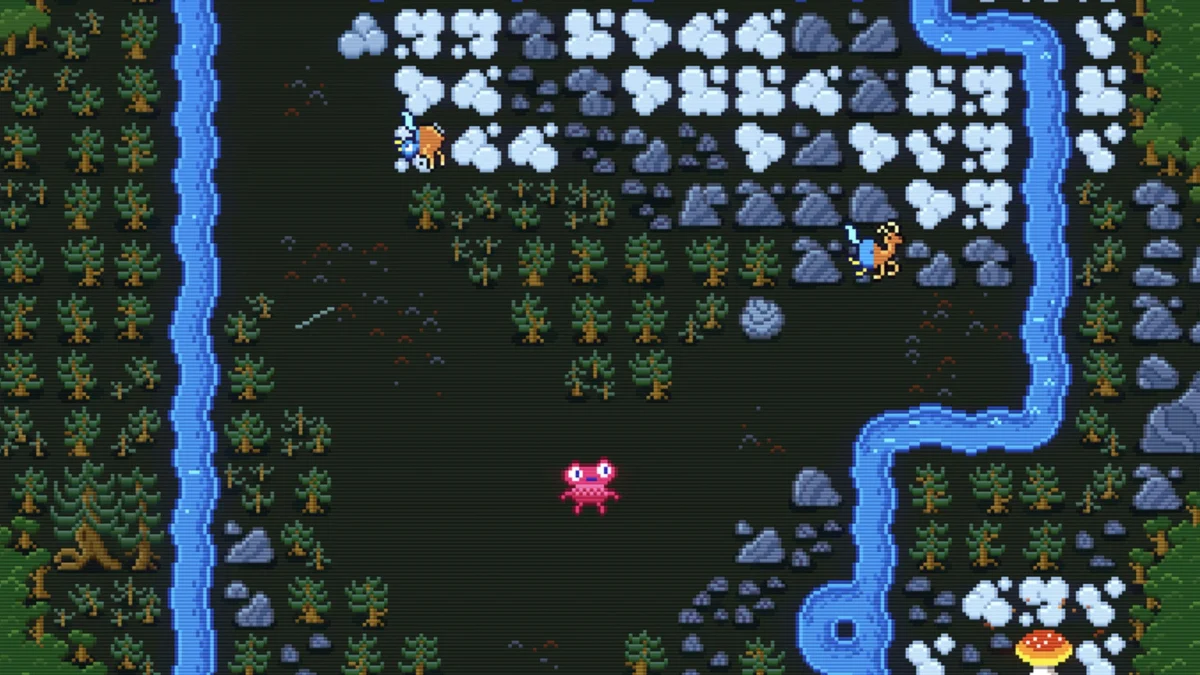
In the landscape of modern indie gaming, the most compelling titles often rely on a single, elegant mechanic that challenges the player’s perception of space and logic. From the reality-bending rules of Baba Is You to the environmental manipulation seen in The Witness, the genre thrives on discovery. Enter Mimic Meadows, a new puzzle title from solo developer sourencho that invites players to shed their human form and adopt the physiological capabilities of the animal kingdom. By observing, tracking, and ultimately mimicking the movement patterns of creatures inhabiting a serene, pixel-art forest, players must navigate increasingly complex grids to uncover the secrets hidden within the brush.
The Core Concept: Morphic Puzzles in a Pixelated Wild
At its most fundamental level, Mimic Meadows is a game about observational learning. Players are dropped into a vibrant, grid-based environment where they interact with various creatures. Unlike traditional puzzle games where one might collect power-ups or keys to bypass obstacles, Mimic Meadows mandates a biological trade-off.
To traverse the environment, the player must synchronize their movements with the creatures they encounter. By matching a creature’s directional inputs and timing, the player undergoes a transformation, adopting the creature’s unique locomotion and, more importantly, its environmental affinity.
For instance, early gameplay introduces the mountain goat. While the player character in their base form is restricted to standard dirt paths, successfully mimicking the goat allows the player to navigate rocky terrain. However, this transformation comes with a cost: the player loses the ability to traverse the original dirt paths while in the goat’s form. This "give-and-take" mechanic turns movement into a strategic choice, forcing players to think several steps ahead—not just about where they want to go, but about what they need to be to get there.
Chronology of Development and the Path to the Demo
The development of Mimic Meadows has been marked by a transparent, community-focused approach. Following the initial conceptualization of the game’s core mechanics—the "movement-mimicry" system—developer sourencho began sharing updates via social platforms, most notably Bluesky.
The project gained traction in early 2026 as screenshots of the game’s distinctive, low-key pixel art style began to circulate. The aesthetic, characterized by soft color palettes and clean, readable grids, drew immediate comparisons to the minimalist brilliance of Baba Is You.
On May 28, 2026, the developer officially released a playable demo on Steam. This release served as a critical milestone, transitioning the project from a theoretical concept into a tangible experience for the public. The demo allows players to experience the early-game tutorialization, which carefully introduces the concept of grid-based synchronicity. Since the demo’s release, the developer has been actively monitoring feedback regarding the game’s "finicky" input system, signaling a commitment to refining the player experience before a full launch.
Supporting Data: Mechanics and Complexity Scaling
The brilliance of Mimic Meadows lies in its gradual escalation of complexity. What begins as a simple one-to-one transformation system quickly blossoms into a multi-layered puzzle engine.
The Terrain-Transformation Matrix
Each animal in the game serves as a key to specific terrain types. The puzzle design is structured around "Terrain-Transformation Matrixes," where the player must identify the correct sequence of transformations to navigate a stage. As the player advances, the game introduces environmental variables:
- Grid Manipulation: Players must occasionally nudge objects or rocks into positions that force animals to move in specific patterns.
- Amalgamated Abilities: Later levels introduce the ability to fuse the movement profiles of two different animals. This creates a hybridized state that allows the player to navigate multiple terrain types simultaneously.
- The Spatial Limit: Because the game operates on a limited grid, the player is restricted in how many times they can shift their form, adding a layer of resource management to the traditional logic puzzle.
These mechanics ensure that the game remains intellectually stimulating. As players progress, they find themselves not just playing a game, but conducting a series of logical experiments. "It is exactly the kind of game that encourages you to try weird things out for the sake of it," says early testers. The freedom to experiment with animal movement combinations—even if they lead to a dead end—is a core tenet of the Mimic Meadows philosophy.
Official Perspectives: The Developer’s Vision
In statements accompanying the demo launch, developer sourencho emphasized that Mimic Meadows is not merely about reaching an exit point, but about "unearthing the many secrets of the meadows." The design goal was to make the player feel like a participant in the forest’s ecosystem rather than an external force.
However, the developer is also keenly aware of the current hurdles. In community discussions, the challenge of the "mimicry window" has been a focal point. Because players must match the movement of an animal in real-time, the controls can feel demanding. When asked about this, the consensus from the developer and the community is that this "finicky" nature is a feature, not a bug. It forces the player to slow down and observe the rhythm of the game world. Mastery of the game requires not just logic, but a degree of mechanical synchronization that mimics the patience required to observe wildlife in the real world.
Implications for the Puzzle Genre
Mimic Meadows arrives at a time when the puzzle genre is seeing a resurgence of "system-based" design. By moving away from narrative-heavy experiences and focusing entirely on the interaction between player, environment, and creature, Mimic Meadows occupies a space similar to The Witness or Stephen’s Sausage Roll.
A New Standard for Emergent Gameplay
The implications for the genre are significant:
- Observational Gameplay: The game rewards the player for watching the world rather than just interacting with the UI. This encourages a slower, more meditative style of play.
- Systemic Depth: By allowing for "amalgamated" movement states, the developer has created a sandbox that allows for emergent solutions. Players are likely to find ways to solve puzzles that the developer hadn’t originally intended, a hallmark of a truly great puzzle game.
- The "Low-Fi" Aesthetic: The game proves that high-concept mechanics do not require high-fidelity graphics. The clear, readable pixel art is functional, ensuring that the player’s focus remains entirely on the grid and the creatures inhabiting it.
Looking Ahead: The Road to Launch
As of June 2026, there is no official release date for Mimic Meadows. The developer is currently focused on gathering feedback from the Steam demo and polishing the feel of the movement system. For those interested in the title, the best course of action is to follow the project on Steam, where updates regarding development progress, potential content expansions, and release windows will be posted.
In an industry often dominated by sequels and massive open-world epics, Mimic Meadows stands as a reminder of the power of small-scale, high-concept design. It challenges us to look at the world differently—to hop, flap, and scurry through a landscape that is as puzzling as it is beautiful. Whether or not you have ever caught yourself mimicking a bird’s flight or a dog’s sprint, Mimic Meadows offers an opportunity to lean into that primal instinct, all while testing the limits of your logical mind.
The meadow is waiting, and its creatures have much to teach those willing to learn their rhythms.












No comments yet. Be the first to join the conversation!