Nila Kartika Wati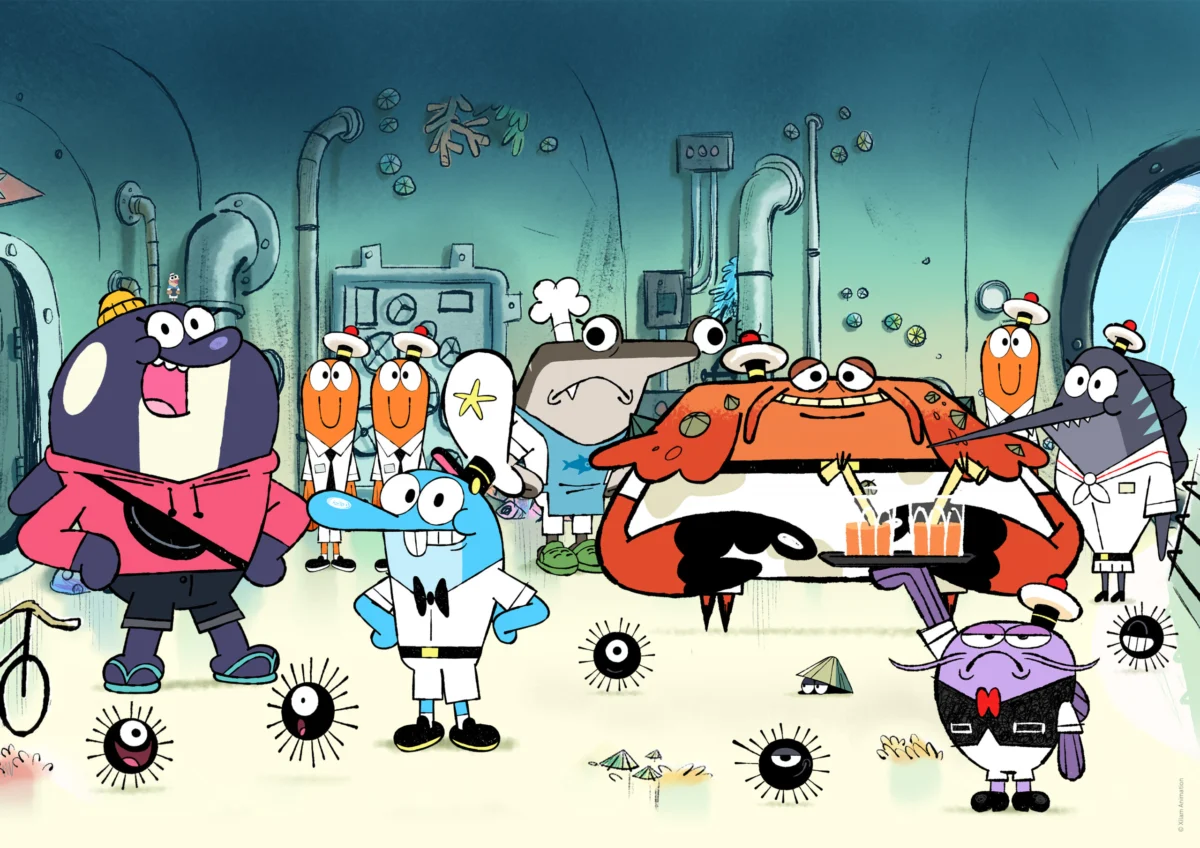
Despite a challenging year for the French animation industry—marked by fluctuating sales and a noticeable cooling in export growth—one production is defying the headwinds with remarkable buoyancy. Submarine Jim, the latest ambitious project from the powerhouse studio Xilam Animation, has emerged as a beacon of creative and commercial resilience. Featuring a naive young dolphin navigating an "inverted" submarine filled with sea water, the series is making waves across international markets, proving that high-quality, character-driven storytelling remains a potent currency in the global content trade.
The Core Concept: An Aquarium on Wheels
At the heart of Submarine Jim lies a premise that is as absurd as it is ingenious. Conceived by Frédéric Martin, the acclaimed director behind the hit Oggy Oggy, the show functions as a high-octane road trip and slapstick comedy. The narrative follows a young dolphin who finds himself in charge of an inverted submarine—a vessel that, rather than keeping water out, is fully submerged and filled with it, acting as a mobile aquarium for its aquatic crew.
"Sitcoms work particularly well in contained settings, so I started looking for one, and landed on a submarine," Martin explains. "Then came the question: what’s unique about this submarine? Simple: it’s obviously filled with water! One logical question led to another, until we landed on having an aquarium on wheels, where the fish experience Planet Earth as if they were exploring Mars."
This "fish-out-of-water" (or perhaps "water-in-a-sub") dynamic provides an infinite sandbox for writers. By placing these characters in environments alien to their biology, Martin and his team have created a comedic structure that feels both fresh and infinitely sustainable.
A Chronology of Success: From Concept to Global Distribution
The trajectory of Submarine Jim is a masterclass in modern animation production and distribution. Developed with a primary target audience of children aged 6 to 10, the series was crafted to bridge the gap between pure slapstick and sophisticated thematic depth.
Following its initial development and production phase—a collaboration between Xilam, Super RTL, and France Télévisions—the series made a high-profile appearance at the Unifrance Rendez-vous. The response from international buyers was immediate and overwhelming.
To date, the show has secured licensing agreements with a prestigious roster of broadcasters:
- United Kingdom and Ireland: BBC
- French-speaking Europe: RTS (Switzerland), RTBF and VRT (Belgium)
- Nordics and Netherlands: NPO (Netherlands), YLE (Finland), NRK (Norway)
- Middle East: Noga (Israel)
- Global Reach: Warner Bros. Discovery for EMEA, Latin America, Southeast Asia, and South Korea.
As the production team looks toward the future, they are already laying the groundwork for a second season, buoyed by the strong market signals received during the Unifrance Rendez-vous and the anticipation building ahead of Cartoon Forum, Europe’s premier co-production event for animated television.
Supporting Data: The Anatomy of a Hit
The success of Submarine Jim is not merely a result of its premise; it is the culmination of a rigorous visual and narrative strategy. Xilam invested heavily in a distinct 2D aesthetic that separates the show from the glossy, hyper-realistic 3D content currently saturating the market.
For the visual development, the team turned to François Maumont, a long-time Xilam collaborator. "François developed the visual style using his own brushes and inks, which we then scanned and digitized," says a spokesperson for the production team. "The real challenge for art director Clémence Bourson was to preserve that handmade quality and achieve the same look on screen."
This commitment to texture and "human" imperfection serves as a differentiator. In an era where digital perfection is the norm, the organic, hand-crafted feel of Submarine Jim provides a visual warmth that resonates with both children and industry veterans.
Furthermore, the show’s structure—52 episodes of 11 minutes each—is designed for modular consumption. This format is ideal for the modern broadcasting landscape, where shows must be flexible enough to air on linear television while remaining punchy enough for short-form digital consumption on platforms like YouTube.

Official Perspectives: The Philosophy of "Dual-Layer" Humor
Caterina Gonnelli-Linden, Chief Content Officer at Xilam, emphasizes that the show’s success is rooted in its appeal to multiple generations. "For sure, adults can laugh out loud watching the episodes, as we’ve woven within the storyline deeper themes and situations," she says.
The production team specifically targeted "workplace comedy" tropes, exploring themes like effective leadership, group dynamics, and the complexities of collaboration. By mirroring the struggles of an office environment within the chaotic, watery interior of a submarine, the show invites parents to engage with the material alongside their children.
"Martin didn’t set out to target adults specifically," Gonnelli-Linden notes, "but he wanted the show to have jokes and different levels of reading. The stories had to work for 6-10-year-olds first, but if we could add a second layer of humor through workplace-comedy situations, we were happy."
This dual-layer approach is a hallmark of Xilam’s broader strategy. By ensuring the show works as a slapstick adventure for kids while functioning as a clever satire for adults, the studio maximizes the "co-viewing" potential, a key metric for broadcasters seeking to capture family audiences.
Implications: The Road Ahead
The implications of Submarine Jim’s success are significant for both Xilam and the French animation sector. As the studio looks to expand its footprint in the United States, Safaa Benazzouz, EVP of Distribution at Xilam Animation, has outlined a clear roadmap.
"Our goal is now to sell the series to a partner in the U.S. and start a digital strategy by securing an SVOD global window, and of course, a YouTube channel," Benazzouz explains.
The YouTube component is particularly critical. Xilam has built a formidable digital empire, with its existing properties—Oggy and the Cockroaches and Zig & Sharko—amassing billions of views. By leveraging this established digital infrastructure, Submarine Jim is poised to transition from a broadcast success to a cross-platform digital phenomenon.
Furthermore, the success of this series serves as a case study for "universal" storytelling. While the show features a distinct French sensibility and highlights the town of Mâcon, its core emotional beats and rhythmic humor are designed to transcend borders.
"The French setting gives it a strong identity, while the humor and rhythm help make it universal," says Frédéric Martin. This balance—between local flavor and global accessibility—is perhaps the most important takeaway for independent studios operating in an increasingly globalized media market.
Conclusion: A Model for Future Growth
As the industry prepares for the next round of co-production markets, Submarine Jim stands as a testament to the power of creative vision when coupled with sound business strategy. By maintaining a cohesive aesthetic, a clear multi-generational appeal, and a flexible distribution model, Xilam has successfully navigated the choppy waters of the current television market.
For the production team, the prospect of a second season is not just a commercial ambition; it is a creative necessity. With a cast of characters that feel fresh and settings that are inherently "topsy-turvy," the series possesses the structural integrity to evolve. If the current market enthusiasm is any indication, the crew of the Submarine Jim will be sailing through international waters for years to come, with their characteristic smiles intact, regardless of the storms on the horizon.


 Siti Muinah
 Laily UPN