In the high-stakes arena of artificial intelligence hardware, where every percentage point of performance gain translates into billions of dollars in market capitalization, Nvidia has long set the gold standard. However, even the undisputed leader of the AI boom is not immune to the harsh realities of physical manufacturing limits. Recent reports suggest that Nvidia has made a significant strategic pivot regarding its upcoming "Rubin Ultra" AI accelerator, slated for a 2027 release. The company has reportedly abandoned its plan to develop a flagship model utilizing four compute chiplets, opting instead for a more conservative—and manufacturable—dual-GPU design.
This shift, initially reported by SemiAnalysis, marks a rare moment of retreat for a company that has defined itself by pushing the boundaries of Moore’s Law and advanced packaging. While Nvidia has yet to issue a formal confirmation, the move highlights the growing tension between theoretical performance ceilings and the practical, often brutal, constraints of semiconductor fabrication at the bleeding edge.
The Anatomy of an Ambitious Vision
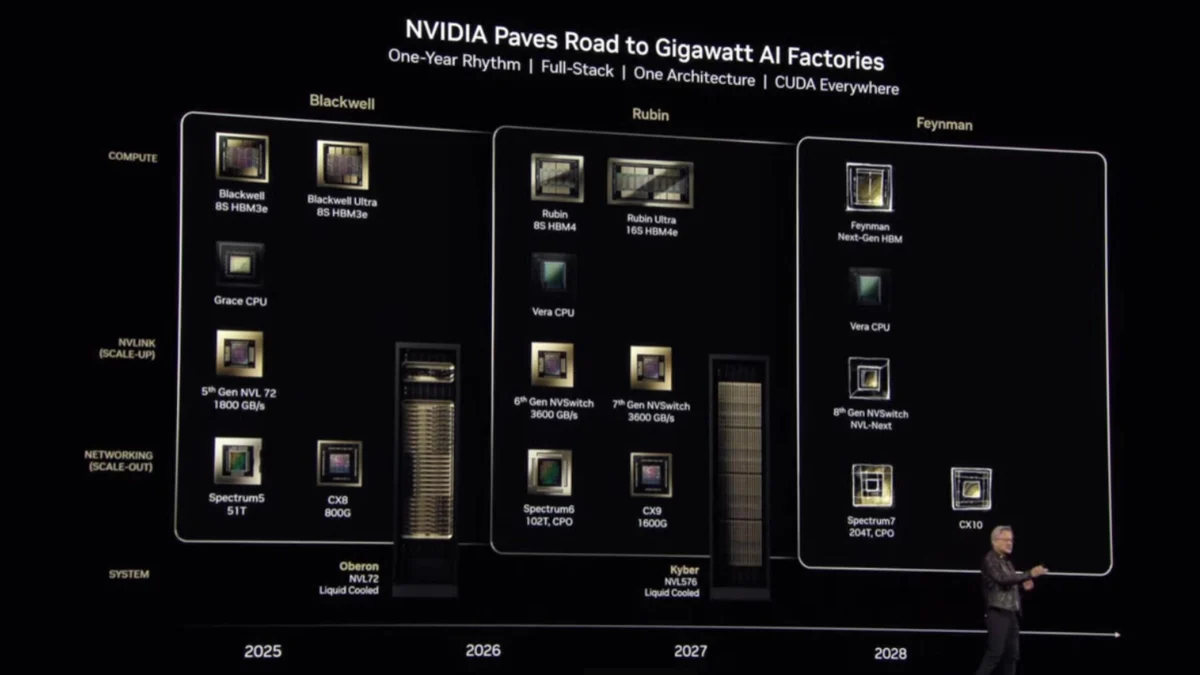
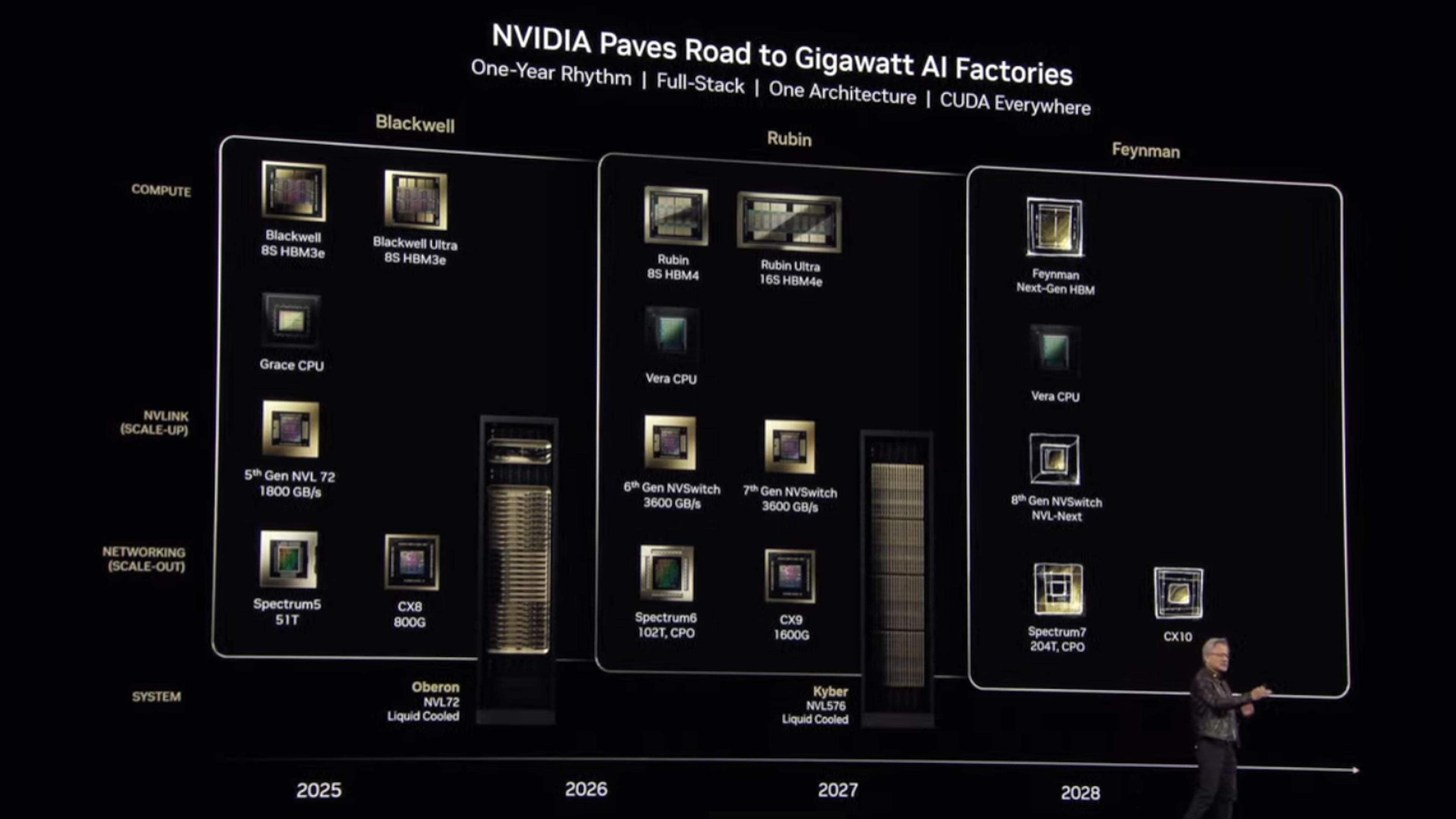
To understand the significance of this pivot, one must look at the roadmap Nvidia had laid out for the Rubin architecture. The original vision for the Rubin Ultra was nothing short of revolutionary. By leveraging four compute chiplets, Nvidia aimed to deliver a level of raw compute power that would have left competitors, including AMD and specialized AI silicon startups, struggling to catch up.
The design was intended to be the pinnacle of "scale-up" architecture. By combining four near-reticle-sized dies, the Rubin Ultra would have essentially functioned as a supercomputer-on-a-chip. However, the engineering complexity required to bridge these four massive dies—each pushing the limits of current lithography—presented a "tremendous engineering challenge."
Beyond the silicon itself, the thermal envelope of a four-die package combined with 16 HBM4E memory modules created a cooling nightmare. Managing the power density and heat dissipation of such a dense assembly requires sophisticated cooling solutions that are not only difficult to design but significantly increase the unit cost and failure rate during the manufacturing process.
Chronology of a Strategic Shift
The timeline of this development reveals the iterative, often volatile nature of hardware R&D.
- Early 2024: Industry rumors begin circulating regarding the successor to the Blackwell architecture. Analysts identify the "Rubin" family as the next major leap, with the "Ultra" variant being the flagship performance tier.
- Mid-2024: Technical discussions emerge around Nvidia’s push into liquid-cooled rack-scale systems. The "Kyber" platform is unveiled as the future home for these next-generation accelerators.
- Late 2024: Engineering prototypes of the four-chiplet Rubin Ultra encounter "manufacturing execution concerns." The challenges of achieving acceptable yields on a four-die interposer become a critical bottleneck.
- Current Status: Reports indicate that the four-die design has been shelved. Nvidia’s internal engineering teams are now pivoting toward a two-die configuration for the Rubin Ultra, prioritizing reliability and supply chain feasibility over maximum theoretical density.
Supporting Data: The Cost of Complexity
The decision to cancel the four-die configuration is rooted in the economics of semiconductor yield. In the world of advanced packaging, "yield" refers to the percentage of functional chips that come off the assembly line. When you combine multiple large, complex dies into a single package, the probability of a defect in any one of those dies—or in the connections between them—increases exponentially.
If a single interposer connects four high-end dies and 16 HBM4E modules, a defect in any one component could render the entire, immensely expensive unit a loss. By shifting to a dual-chiplet design, Nvidia significantly reduces the complexity of the "packaging substrate."
The HBM4E Impact
The shift also ripples through the High Bandwidth Memory (HBM) supply chain. The four-die Rubin Ultra was expected to utilize 16 HBM4E memory modules. With the transition to a two-die design, that requirement has been halved to eight modules. This represents a significant adjustment in procurement volume for memory giants like SK Hynix and Micron. If the industry was banking on the power-hungry Rubin Ultra to drive a massive surge in HBM4E consumption, this change may lead to a cooling of demand forecasts for these specific high-end memory components.
Implications for the AI Hardware Landscape
The implications of this pivot are manifold, touching on everything from competitive dynamics to the way data centers are constructed.
1. Competitive Positioning
With the Rubin Ultra now targeting a two-die configuration, the performance gap between Nvidia and its primary rival, AMD, may narrow. AMD’s Instinct MI500-series has been designed with modularity and scalability in mind. If Nvidia’s "Ultra" tier is now half as powerful as originally envisioned, it provides an opening for competitors to challenge Nvidia’s dominance in specific AI training workloads.
2. The Shift to Rack-Scale Solutions
It is critical to note that Nvidia is no longer selling "just a GPU." Under CEO Jensen Huang, the company has transitioned into a systems-level provider. With the introduction of the "Kyber" liquid-cooled rack-scale systems, Nvidia is effectively abstracting the performance of individual GPUs behind a massive, interconnected cluster.
By increasing the GPU count per scale-up domain to at least 144 packages, Nvidia can achieve the necessary compute performance through sheer scale, even if individual chips are less powerful than the canceled four-die design. This "strength in numbers" strategy allows Nvidia to mitigate the performance loss of a smaller GPU by optimizing the interconnects between a larger number of them.
3. Financial and Market Impacts
For data center operators—the hyperscalers like AWS, Google, and Microsoft—this change could have mixed effects. On one hand, a two-die GPU will likely be cheaper to manufacture, potentially leading to lower per-unit costs. On the other hand, if achieving the desired performance requires purchasing more systems to compensate for the reduction in individual chip density, the total cost of ownership (TCO) might actually rise.
Furthermore, the shift suggests that Nvidia is prioritizing availability over brute force. In an industry where time-to-market is everything, a reliable, manufacturable GPU that can be shipped in massive quantities is infinitely more valuable than a "perfect" GPU that is plagued by manufacturing delays and low yields.
Official Responses and Industry Outlook
To date, Nvidia has maintained its typical policy of not commenting on unannounced product specifications or internal project cancellations. When reached for comment regarding the SemiAnalysis report, the company declined to provide specifics, reiterating its commitment to the "Blackwell to Rubin" roadmap.
Industry analysts remain divided. Some view this as a sign of maturity in the AI hardware market—a transition from "innovation at all costs" to "sustainability and efficiency." Others worry that if Nvidia loses its edge in raw chip-level performance, the barrier to entry for competitors could lower, potentially signaling the beginning of a more fragmented market.
Conclusion: The Path Forward
The story of the Rubin Ultra is a masterclass in the realities of the post-Moore’s Law era. We are entering a phase where the limits of physics and the logistics of manufacturing are the primary governors of progress. While the cancellation of the four-chiplet design may feel like a setback, it is perhaps more accurately viewed as a strategic recalibration.
Nvidia remains in a dominant position, and its focus on rack-scale, liquid-cooled infrastructure suggests that it has already prepared for a world where individual chip scaling is harder to achieve. As we move toward 2027, the focus will shift from how many dies can be crammed onto a single interposer to how efficiently these systems can be networked together. Whether this pivot will successfully sustain Nvidia’s lead remains to be seen, but one thing is certain: in the race to build the brain of the next generation of AI, the smartest path is rarely the one that simply adds more silicon. It is the one that actually makes it to the factory floor.