

Introduction: A Legacy Written in Spray Paint
The walls of the PPOW gallery in New York City are currently humming with the kinetic energy of a bygone era, expertly translated into the contemporary visual language of one of the city’s most prolific street artists. Orchid Rain on the Underground, the third solo exhibition by Chris “Daze” Ellis, is a masterful synthesis of five decades of creative evolution. Running through April 25, 2026, the show serves as a sprawling, multi-sensory love letter to the New York City of the 1970s and 80s—a time of grit, danger, and unparalleled artistic ferment.
Through a curated blend of large-scale paintings, a site-specific mural, and a deeply immersive multimedia installation, Daze manages to bridge the gap between his roots as a teenage graffiti writer and his current status as a mature fine artist. The exhibition does not merely nostalgia-bait; rather, it interrogates how the foundational energy of the graffiti movement continues to pulse beneath the modern, gentrified surface of the city, asserting that the creative spirit of the subway underground remains the heartbeat of New York’s cultural identity.
Chronology: From Brooklyn Trains to Gallery Walls
The Formative Years (1976–1980)
Born in Brooklyn in 1962, Daze’s introduction to the art world was unconventional and inherently rebellious. While attending the High School of Art and Design in the mid-1970s, he became captivated by the burgeoning graffiti movement. Observing legends like Blade, Lee Quiñones, and PHASE 2, Daze began to understand that the subway system was not just a means of transport, but a rolling canvas that spanned the five boroughs.
During these years, the subway car became his primary medium. By tagging and painting exterior panels, he learned the intricacies of color theory, scale, and public visibility. It was a baptism by fire—the art was temporary, often scrubbed away by the MTA within days, forcing the artist to focus on the immediacy of the mark-making process.
The Nightlife Crucible (1980–1985)
As the 1980s dawned, Daze’s practice began to migrate from the tunnels into the studio, yet his inspirations remained tethered to the city’s social geography. He became a fixture of the downtown nightlife scene, frequenting venues that were the true nerve centers of the era: the Lit Lounge in the East Village, the iconic Danceteria on West 21st Street, and the Mudd Club in Tribeca.
These clubs were more than just dance floors; they were cross-pollination chambers where musicians, fashion designers, writers, and painters collided. This environment fostered a sense of urgency and interdisciplinary experimentation that would define Daze’s career. By the mid-80s, he had successfully transitioned into a recognized figure within the fine art world, proving that the skills honed in the subway—perspective, line work, and bold graphic choices—were directly applicable to the canvas.
The Artistic Synthesis: A Dialogue Across Eras
Realism Meets Abstraction
A defining characteristic of Orchid Rain on the Underground is Daze’s ability to reconcile two seemingly disparate artistic lineages. On one hand, he pays homage to early 20th-century urban realists such as John Sloan of the Ashcan School and Reginald Marsh of the WPA era. Like them, Daze views the street corner and the subway platform as the most honest stages of human existence.
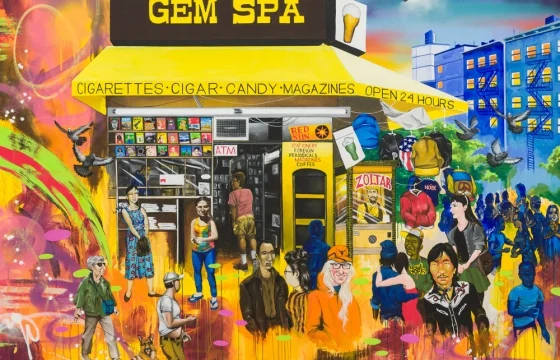
On the other hand, he weaves in the lessons of lyrical abstractionists like Joan Mitchell and Willem de Kooning. In works such as Gem Spa In the 80s (2025), this juxtaposition is starkly apparent. The painting captures the now-shuttered legendary newsstand on St. Mark’s Place—a place immortalized by literary giants like Allen Ginsberg and Jack Kerouac—with meticulous detail, yet the surrounding atmosphere is rendered in explosive, gestural swaths of acrylic and spray paint.
The Symbolism of the Orchid
The exhibition’s title, Orchid Rain on the Underground, introduces a recurring motif: the intersection of nature and the urban machine. Throughout the gallery, viewers encounter paintings where technicolor, vibrant flowers rise out of heaps of grey urban rubble.
For Daze, these flowers are not mere decoration. They serve as a dual metaphor: they are memorials to the aspects of the city that have been lost to the relentless march of redevelopment, and they are hopeful testaments to the resilience of human creativity. By pairing tropical flora with local flowers from his current home in upstate New York, he bridges his past and his present, suggesting that beauty is not only possible amidst destruction—it is inevitable.
The Immersive Experience: Bringing the Underground Inside
The Mural and the Installation
The exhibition pushes the boundaries of traditional gallery display. Daze has transformed a gallery hallway into a site-specific mural, effectively breaking the "fourth wall" of the white cube to bring the street experience into the interior. This transition serves as a gateway to the exhibition’s centerpiece: a multimedia installation that functions as a time machine.
In this final room, Daze has recreated a composite scene of his youth. The installation features a functional light-up dance floor, a vintage disco ball, and authentic subway car seats. A curated soundscape—fusing the essential DNA of 80s house, disco, hip-hop, and club music—fills the room. This space is not an academic observation of history; it is an invitation to participate in the sensory experience of the era. It underscores that the creative inspiration of his youth was not a static object to be archived, but a dynamic, living force that remains vital to his practice.
Implications: The Enduring Relevance of Graffiti
The exhibition poses a significant question for contemporary viewers: Is the New York City of Daze’s youth truly gone, or is it merely hidden?
By highlighting figures like Carlo McCormick and the late Martin Wong within the crowd scenes of his paintings, Daze reminds us that the city is built on a lineage of collective memory. His work asserts that the spirit of the 1970s and 80s—the DIY ethos, the fearlessness, the embrace of the fringe—is the bedrock upon which the modern creative economy is built.
Preserving the Cultural Heartbeat
In an era where New York City is increasingly characterized by digital connectivity and sanitized streetscapes, Orchid Rain on the Underground serves as an essential corrective. It argues that the grit of the past is not a flaw to be erased, but a source of power to be channeled. Daze demonstrates that by acknowledging the "destruction" of the past, artists can find the fertile ground needed to cultivate new, radical ideas.
This show is an act of preservation. It captures the specific, messy, loud, and brilliant texture of a city that once allowed for total creative freedom. For younger generations, the exhibition provides a map of the city’s soul; for those who lived through it, it is a validation of their own history.
Conclusion
Chris “Daze” Ellis has spent nearly fifty years refining his craft, moving from the illicit anonymity of the subway tunnels to the prestigious walls of the PPOW gallery. Orchid Rain on the Underground is the culmination of that journey. It is a dense, thoughtful, and deeply affecting body of work that refuses to let the past fade into irrelevance.
By meticulously documenting the people, places, and aesthetics that defined his early career, Daze has managed to do something quite rare: he has made the past feel urgent. The exhibition is a testament to the fact that while the city changes, its creative heartbeat remains constant. Whether it is through the gestural spray of a mural or the detailed portrait of a long-gone candy store, Daze continues to write his name—and the names of those who shaped him—into the enduring story of New York City. As the show remains on view through April 2026, it stands as a mandatory stop for anyone seeking to understand the intersection of urban history, fine art, and the indomitable spirit of the city that never sleeps.










No comments yet. Be the first to join the conversation!