Suro Senen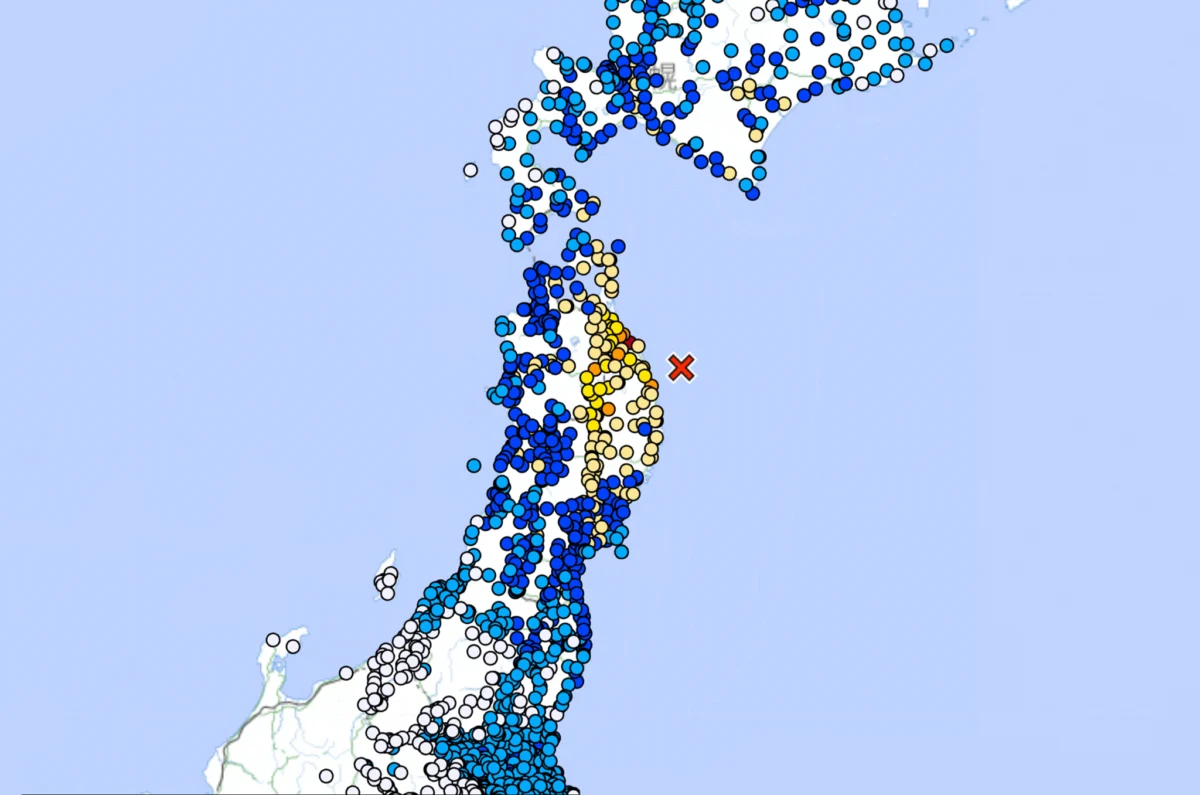
TOKYO — A formidable magnitude 6.9 earthquake rattled northern Japan early Thursday morning, sending tremors across the Tohoku region and prompting an immediate mobilization of government emergency services. While the seismic event caused significant alarm and widespread disruption to public transport, authorities have confirmed that there is no risk of a tsunami, providing a measure of relief to coastal communities still haunted by the memory of historical seismic disasters.
Main Facts: A Violent Awakening
The earthquake struck at approximately 7:30 a.m. local time, catching residents in the Aomori and Iwate prefectures off guard during their morning routines. According to data provided by the Japan Meteorological Agency (JMA), the epicenter was located off the coast of Iwate Prefecture at a depth of 50 kilometers.
The most severe shaking was recorded in the town of Hashikami, Aomori Prefecture, where the quake reached an "upper 6" on Japan’s rigorous seven-level seismic intensity scale (shindo). This specific rating is categorized by the JMA as a level of violence that renders it "impossible to remain standing or move without crawling." At this intensity, the agency warns that individuals may be thrown into the air, while most unsecured furniture and heavy appliances are likely to shift, slide, or topple over entirely.
In nearby Hachinohe, also in Aomori Prefecture, the tremor was measured at a "lower 6," indicating that the impact was widespread. Residents across the region reported violent swaying of high-rise structures, the sound of breaking glass, and the abrupt halt of household appliances.
Chronology of the Event
The progression of the disaster response began the moment the seismic waves hit the northern coastline.
- 07:30 a.m. (JST): The initial rupture occurred off the coast of Iwate. Within seconds, the JMA’s early warning system triggered alerts on millions of mobile devices across the Tohoku region, providing residents with critical seconds to take cover.
- 07:35 a.m. (JST): Seismic monitoring stations across Aomori and Iwate transmitted data to the JMA. Preliminary reports classified the event as a magnitude 6.9.
- 07:45 a.m. (JST): The Prime Minister’s Office in Tokyo officially established an emergency task force. This inter-agency body was tasked with synthesizing data from regional police, fire departments, and utility providers to assess the scale of the damage.
- 08:00 a.m. (JST): East Japan Railway Company (JR East) announced the immediate suspension of the Tohoku Shinkansen bullet train line. Passengers were safely evacuated from stations, and emergency crews were dispatched to inspect the tracks for potential structural compromises or debris.
- 08:30 a.m. (JST): The JMA officially ruled out a tsunami threat. This announcement was crucial in stabilizing public sentiment, as the region remains highly sensitive to oceanic seismic activity.
- 10:00 a.m. (JST): Initial damage assessments began filtering in from local municipalities. While power outages were reported in scattered residential zones, no widespread collapse of major infrastructure was initially identified.
Supporting Data: Understanding Seismic Intensity
To understand the severity of this morning’s event, one must look at the specific criteria of the Japanese seismic scale. Unlike the Richter or Moment Magnitude scales—which measure the total energy released at the source—the shindo scale measures the intensity of shaking at a specific location on the surface.
An "upper 6" intensity is an extreme event. Engineering reports indicate that at this level, wooden houses with low earthquake resistance may tilt or collapse entirely. For modern, reinforced concrete buildings, the structural integrity is generally maintained, but the interior contents often sustain catastrophic damage. The fact that the quake occurred at a depth of 50 kilometers likely mitigated some of the surface-level destruction; had the epicenter been shallower, the surface acceleration would have been significantly more devastating.
Seismologists suggest that the event was likely caused by the subduction of the Pacific Plate beneath the Okhotsk Plate, a tectonic process that defines the geology of the northern Japanese coastline.
Official Responses and Government Coordination
The speed of the Japanese government’s response highlights the country’s high level of institutional preparedness. Prime Minister Fumio Kishida’s administration issued a directive to the Cabinet Office to prioritize the safety of the elderly and those in vulnerable housing.
"Our primary objective is to verify the safety of all citizens in the affected areas and to ensure that utility services, such as electricity and water, are restored as quickly as possible," a spokesperson for the Prime Minister’s Office stated during a press briefing.
Local police in Aomori and Iwate prefectures have deployed patrol units to monitor traffic flow and check on residents in rural areas where the elderly population is disproportionately represented. Simultaneously, utility companies, including Tohoku Electric Power, initiated controlled shutdowns of local grids to prevent electrical fires, which are often the secondary consequence of major seismic events.
Implications for Infrastructure and Safety
The suspension of the Tohoku Shinkansen line serves as a stark reminder of Japan’s reliance on high-speed rail and the fragility of such systems during seismic shifts. JR East engineers are currently conducting "walk-through" inspections of the tracks, bridges, and tunnels along the line. These inspections are mandatory and must be completed to a granular level of detail before service can resume.
Beyond transportation, the earthquake has reignited discussions regarding urban planning and disaster mitigation in the Tohoku region. Since the 2011 Great East Japan Earthquake, building codes have been updated to be among the most stringent in the world. Initial reports from today’s event suggest that these codes performed as intended, preventing major structural failures despite the intensity of the shaking.
However, the psychological impact on the local populace cannot be understated. For many, the sudden, violent jolt of a magnitude 6.9 earthquake brings back traumatic memories. Community support centers have been opened in Hashikami and Hachinohe to provide psychological counseling and basic necessities for those who were forced to evacuate their homes.
Economic and Logistical Disruptions
While no major manufacturing plants reported long-term closures, supply chain logistics in northern Japan have been temporarily throttled. Delivery routes, particularly in mountainous regions where landslides are a secondary risk factor, are being cleared by local road maintenance crews.
Economists monitoring the region note that while the direct cost of the earthquake is expected to be manageable, the cumulative impact of repeated seismic events in the Tohoku region necessitates a continuous investment in resilient infrastructure. The government is expected to release a comprehensive damage assessment report within the next 48 hours, which will guide decisions regarding emergency financial assistance to the affected municipalities.
Conclusion: A Resilient Region
As of mid-day Thursday, the situation in northern Japan is stabilizing. The absence of a tsunami warning has prevented a worst-case scenario, and emergency services are transitioning from search-and-rescue mode to damage assessment and recovery operations.
The residents of Aomori and Iwate have once again demonstrated the discipline and calm that have become synonymous with Japan’s response to natural disasters. While the threat of aftershocks remains—a standard protocol for the next several days—the region is already looking toward the restoration of its daily rhythms. For now, the focus remains on the structural inspections of the Shinkansen lines and ensuring that the most vulnerable residents are provided with the support they need to navigate the immediate aftermath of this significant seismic event.
As Japan continues to exist on the "Ring of Fire," events like today’s earthquake serve as a recurring, sobering reminder of the volatility of the earth beneath, and the vital importance of the rigorous, ongoing disaster preparedness that defines the nation’s survival strategy.


 Neng Nana
 Asro
Asro