MAIN FACTS
Ten years after its acclaimed debut, the indie sensation Reactor – Energy Sector Tycoon is receiving a monumental follow-up. Developer RSGapps, known for its intricate simulation titles, has officially unveiled Reactor 2: Nuclear Tycoon, promising an expanded and refined experience for fans of resource management and industrial simulation. Originally launched in March 2016, the first Reactor garnered significant attention for its deep gameplay loop, challenging players to build and manage a sprawling energy empire. Now, its successor arrives to push the boundaries further, introducing a dynamic living city, an engaging quest system, and an even broader array of energy technologies, from humble wind turbines to futuristic antimatter reactors.
Reactor 2: Nuclear Tycoon positions itself as a free-to-play idle game, ensuring accessibility while catering to both casual and dedicated players. It retains the core premise of its predecessor: establishing and overseeing an energy company, meticulously managing heat, converting it into electricity, and ensuring operational efficiency across a vast network. However, the sequel significantly enhances this foundation with new mechanics, a polished pixel-art aesthetic, and smoother performance, all designed to immerse players in the complex yet rewarding world of energy production. Available on the Google Play Store, the game invites aspiring tycoons to embark on an ambitious journey to power an entire metropolis, evolving from basic renewable energy sources to the most advanced, speculative power generation concepts imaginable.
CHRONOLOGY
A Decade in the Making: From Indie Darling to Ambitious Sequel
The journey to Reactor 2: Nuclear Tycoon is a testament to the enduring appeal of well-crafted simulation games and a developer’s commitment to refining its vision. The narrative begins in March 2016 with the release of Reactor – Energy Sector Tycoon. In a mobile gaming landscape often dominated by casual puzzles and competitive multiplayer titles, Reactor carved out a unique niche. It offered a surprisingly deep and engaging simulation experience, challenging players to build and optimize complex energy grids on their smartphones and tablets. Its success wasn’t merely a flash in the pan; it resonated with a segment of players yearning for strategic depth and a sense of accomplishment in managing intricate systems. The game’s minimalist yet functional interface, coupled with its satisfying progression, cemented its status as an indie darling within the mobile simulation genre.
RSGapps, the development studio behind the Reactor series, was not new to the simulation space even then. Their portfolio, which includes other noteworthy titles like Production Chain Tycoon and Technopoly, showcases a consistent dedication to creating detailed economic and industrial management games. This expertise undoubtedly contributed to the original Reactor‘s success, demonstrating a clear understanding of what makes a tycoon game both challenging and rewarding. They proved capable of distilling complex industrial processes into intuitive mobile experiences, a skill that would be crucial for the ambitious scope of a sequel.
The period between 2016 and 2024 marked a quiet but evidently meticulous development cycle for the follow-up. While many mobile games churn out sequels within a few years, a ten-year gap is significant, suggesting a profound commitment to not just iterate, but genuinely innovate. This extended development time likely allowed RSGapps to thoroughly analyze player feedback from the first game, observe the evolution of mobile technology and gaming trends, and integrate a wealth of new ideas. It suggests a patient approach, prioritizing quality and substantial enhancements over a quick release. The gaming community has often seen that such extended development periods, particularly for beloved indie titles, can lead to highly polished and feature-rich products that truly justify the wait. The advancements in mobile hardware and software over the past decade would also have provided RSGapps with a more robust canvas upon which to paint the intricate world of Reactor 2, enabling smoother performance, more detailed graphics, and more complex simulation logic than was possible with the first installment.
Now, in 2024, the long-anticipated launch of Reactor 2: Nuclear Tycoon is set to capitalize on this legacy. It arrives not just as a sequel, but as a culmination of years of experience and dedication, aiming to redefine what a mobile energy tycoon game can be. The anticipation among fans of the original, coupled with the game’s promise of significant new features, positions Reactor 2 as a potentially landmark release for the mobile simulation genre, building upon a strong foundation laid a decade ago.
SUPPORTING DATA
Deep Dive into Reactor 2’s Core Mechanics: Building the Ultimate Energy Empire
Reactor 2: Nuclear Tycoon isn’t merely a rehash; it’s a comprehensive expansion and refinement of the energy management formula. At its heart lies the captivating journey of transforming a fledgling energy provider into a global powerhouse, a progression that is both intuitive and deeply strategic.
The Energy Empire: From Wind to Wonders
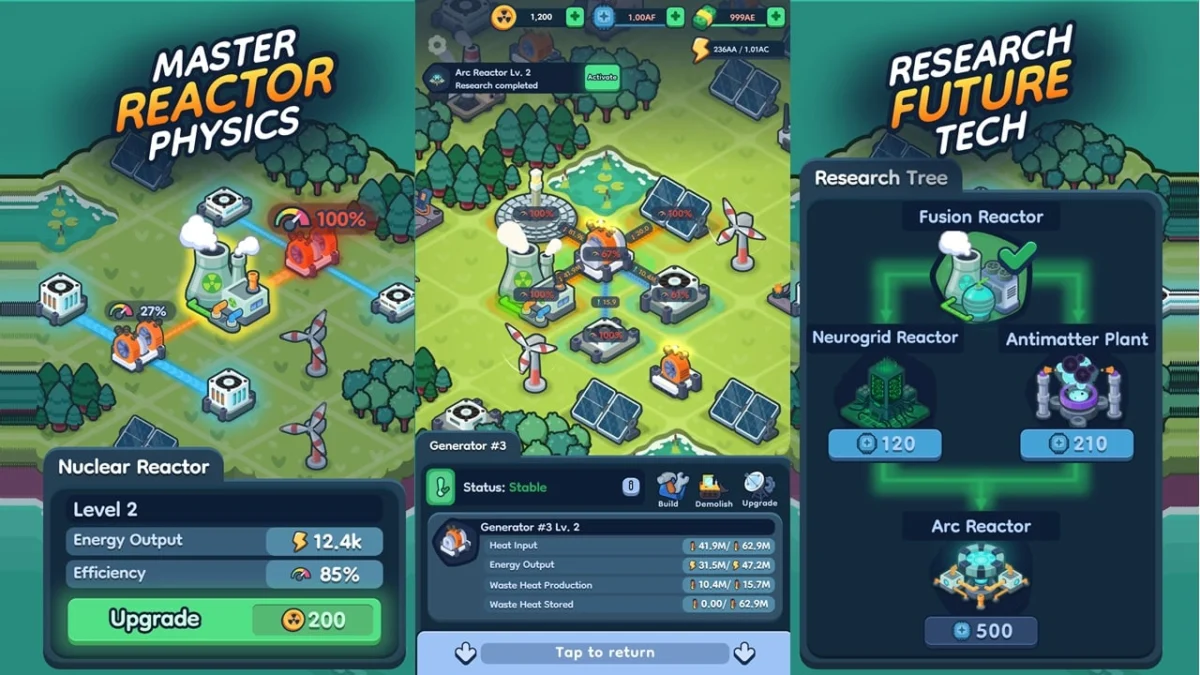
The player’s journey begins with humble origins, mirroring real-world energy transitions. "You start off with a few wind turbines," the game’s description highlights, immediately grounding the experience in accessible and sustainable energy concepts. This early game phase likely involves establishing a basic power grid, understanding resource flow, and making initial strategic decisions about expansion. Players will need to balance immediate power needs with long-term investment in more efficient technologies. Renewable energy sources like Solar, Wind, Hydro, and Tidal power form the bedrock of the early and mid-game, providing diverse options for generating power while introducing varying challenges such as intermittency (for solar and wind) or geographical limitations (for hydro and tidal). These initial technologies serve as crucial stepping stones, familiarizing players with the core loop of production, distribution, and financial management before the true complexities unfold.
The transition to nuclear power marks a significant leap in the game’s progression. This is where the "Nuclear Tycoon" aspect truly comes into its own. Players are tasked with "managing heat, turning that heat into electricity, and making sure everything stays cool enough to keep producing power." This core mechanic simulates the intricate dance of a real nuclear power plant, where efficient heat exchange is paramount. Players will need to design their layouts strategically, optimizing the placement of reactors, turbines, cooling systems, and power conduits. The challenge lies in maintaining a delicate equilibrium: maximize heat for power generation, but prevent overheating that would halt operations.
A standout design choice in Reactor 2 is its approach to reactor failure: "If things get too hot, production stops until your systems cool down. Luckily, your reactors don’t explode, they don’t wipe out hours of progress, and they don’t force you to start over. They just pause, cool off, and let you figure out a better setup." This player-friendly mechanic is a significant departure from more punitive simulation games. Instead of punishing players with catastrophic failures and discouraging resets, Reactor 2 opts for a learning-oriented approach. It encourages experimentation and iterative design, allowing players to test different configurations without the fear of devastating setbacks. This thoughtful design choice reduces frustration and makes the complex process of nuclear energy management more approachable, fostering a sense of continuous improvement rather than anxiety.
Technological Frontiers: Unlocking the Future of Energy
As the company expands, so too does its technological prowess, driven by a comprehensive research system. "As your company gets bigger, you’ll unlock a whole bunch of new technologies through research." This research tree is structured in tiers, leading players from established energy sources to speculative, science-fiction marvels.
- Renewable Energy: The early game solidifies the foundation with Solar, Wind, Hydro, and Tidal power, teaching the basics of energy generation and grid management.
- Nuclear Power: This tier introduces the core nuclear reactors, demanding sophisticated heat management and a deeper understanding of efficiency.
- Fusion and Arc Reactors: Moving beyond conventional nuclear fission, these advanced technologies likely offer significantly higher power output and perhaps new management challenges, reflecting their cutting-edge status in real-world energy research. Fusion, for example, promises clean, abundant energy but requires extreme conditions to maintain.
- Sci-fi Tier: This is where Reactor 2 truly unleashes its imaginative potential, with "Antimatter reactors, Black Hole Reactors, and the HyperSpace Core." These fantastical energy sources push the boundaries of energy production within the game, offering aspirational goals and likely presenting unique, game-specific challenges and immense power outputs. They transform the simulation from a grounded industrial management game into a visionary sci-fi epic, allowing players to truly shape the energy future.
A Living, Breathing Metropolis: Dynamic City Growth
A significant enhancement in Reactor 2 is the introduction of "a living city that actually grows as your energy production increases." This feature adds a dynamic, visual, and tangible reward for the player’s efforts. Instead of simply seeing numbers increase, players will witness their hard work translate into a thriving urban landscape. This city growth isn’t just cosmetic; it likely creates new demands and opportunities. A larger city will require more power, pushing players to constantly innovate and expand their energy infrastructure. It could also unlock new research pathways, special projects, or even story-driven challenges tied to urban development, deepening the connection between the player’s energy company and the world it powers. This dynamic feedback loop transforms the abstract concept of power generation into a visible, evolving ecosystem.
Narrative and Progression: The Quest System
To guide players through this complex world and provide a stronger sense of purpose, Reactor 2 introduces "a new quest system with chapters and rewards, along with story-driven challenges." This system is crucial for an idle simulation game, offering structured goals beyond mere optimization. Quests can serve multiple functions:
- Tutorials: Gradually introduce new mechanics and technologies.
- Goal Setting: Provide short-term and long-term objectives, keeping players engaged.
- Narrative Immersion: Weave a subtle story around the energy company’s growth and its impact on the world, giving context to the player’s actions.
- Rewards: Offer in-game currency, resources, or unique unlockables, incentivizing completion.
The chapter-based structure suggests a progressive narrative, allowing players to feel like they are advancing through distinct phases of their energy empire’s history.
Accessibility and Player Experience: Designed for Mobile
Reactor 2: Nuclear Tycoon is meticulously designed for the mobile platform, incorporating features that cater to the typical mobile player’s habits. As an "idle game," it "keeps earning resources while you’re away, so you can make progress offline even after closing the game." This ensures that players feel constant progression, even during periods of inactivity, making it perfect for those with busy schedules. The ability to "work without an internet connection" further enhances its accessibility, allowing play anywhere, anytime.
The "free to play" model opens the game to a wider audience, reducing the barrier to entry. While specific monetization strategies are not detailed, F2P games typically rely on optional in-app purchases for accelerating progress or acquiring cosmetic items, ensuring the core gameplay remains accessible to all. Finally, the commitment to "refined pixel art and smoother performance" indicates a significant upgrade in visual fidelity and user experience compared to its predecessor. This polish is crucial for retaining player engagement over long periods, making the intricate world of energy management a joy to behold and interact with.
OFFICIAL RESPONSES
The Developer’s Vision and Community Engagement: RSGapps’ Philosophy
While RSGapps has yet to issue a detailed public statement specifically outlining the decade-long development process for Reactor 2: Nuclear Tycoon, the design choices and announced features within the game speak volumes about their underlying philosophy and vision. The extensive period between the original Reactor – Energy Sector Tycoon and its sequel strongly implies a deliberate, unhurried approach, prioritizing substantial innovation and refinement over rapid release cycles. This suggests a developer deeply committed to their craft, taking the necessary time to evolve the game’s engine, mechanics, and visual presentation to meet contemporary standards and player expectations.
The decision to implement a "no explosion" safety net for overheating reactors, allowing systems to merely pause and cool down, is a particularly telling insight into RSGapps’ player-centric design philosophy. This moves away from the often-punitive nature of traditional simulation games, where a single misstep can lead to catastrophic failure and frustrating resets. Instead, it fosters an environment of experimentation and learning, signaling that the developer values player enjoyment and continuous progression over harsh, discouraging penalties. This approach is likely cultivated from years of observing player behavior and feedback from their other tycoon titles, including Production Chain Tycoon and Technopoly, where balancing complexity with accessibility is key.
Furthermore, the introduction of a dynamic, growing city and a structured quest system indicates a clear ambition to deepen the immersion and narrative aspects of the tycoon genre. This suggests RSGapps aims to move beyond purely mechanical optimization, providing players with a tangible impact on a living world and a clear sense of purpose through story-driven challenges. These additions elevate Reactor 2 from a mere resource management puzzle to a more holistic simulation experience, appealing to players who seek both strategic depth and a compelling progression arc.
RSGapps’ consistent focus on mobile-friendly features such as idle progression and offline play further underscores their profound understanding of the platform’s unique demands. They acknowledge that mobile players often engage in shorter bursts, yet still desire a sense of continuous achievement. By designing the game to earn resources even when closed, and to function without an internet connection, RSGapps ensures maximum accessibility and convenience, making Reactor 2 a perfect fit for the modern mobile gaming lifestyle. The commitment to "refined pixel art and smoother performance" also reflects a dedication to delivering a polished, high-quality user experience, demonstrating an evolution in their technical and artistic capabilities over the past decade. While direct official responses might be scarce, the product itself eloquently communicates RSGapps’ vision for a sophisticated, engaging, and player-friendly mobile simulation experience.
IMPLICATIONS
Reshaping the Mobile Tycoon Landscape: The Legacy and Future of Energy Management
The launch of Reactor 2: Nuclear Tycoon carries significant implications for the mobile gaming landscape, particularly within the simulation and idle game genres. Its arrival, a decade after its successful predecessor, is not just a testament to the original’s enduring appeal but also a bold statement about the potential for depth and longevity in mobile titles.
Impact on the Genre: Setting New Standards
Reactor 2 is poised to elevate the standards for mobile tycoon games. By blending deep simulation mechanics with player-friendly design choices (like non-catastrophic reactor failures) and dynamic features (like the growing city), it offers a hybrid experience that could appeal to a broader audience than traditional hardcore simulations. The inclusion of an extensive technology tree, culminating in fantastical sci-fi reactors, pushes the boundaries of imagination within the genre, suggesting that mobile simulations can offer not just realism, but also aspirational and imaginative gameplay. Its refined pixel art and smoother performance indicate a commitment to graphical fidelity and user experience often expected from premium PC titles, challenging the perception that mobile games are inherently simpler.
Player Base Expectations: Satisfying Veterans, Attracting Newcomers
For fans of the original Reactor – Energy Sector Tycoon, the sequel represents a highly anticipated evolution. They can expect a familiar yet significantly enhanced experience, building upon the mechanics they loved while introducing fresh challenges and rewards. The decade-long wait has likely built considerable anticipation, and the comprehensive feature set of Reactor 2 aims to deliver on those heightened expectations. For new players, the free-to-play model and the accessible idle mechanics provide an easy entry point into a complex genre. The quest system will serve as an excellent guide, slowly introducing mechanics and fostering engagement, ensuring that newcomers are not overwhelmed but rather progressively drawn into the intricate world of energy management.
Longevity and Future Potential: A Sustainable Ecosystem
The idle game nature of Reactor 2 is a crucial element for its long-term viability. By allowing players to make progress offline, it encourages consistent engagement without demanding constant active play. This, combined with the chapter-based quest system and the ever-growing city, provides ample incentive for long-term commitment. It implies a potential for ongoing content updates, seasonal events, or even expansions that could introduce new technologies, challenges, or city-specific objectives, ensuring the game remains fresh and engaging for years to come. This sustainable engagement model is vital for F2P titles, fostering a dedicated community and providing a platform for continued development.
The RSGapps Legacy: A Niche Master
Reactor 2: Nuclear Tycoon solidifies RSGapps’ position as a prominent and respected developer within the niche of mobile industrial and economic simulation. Their consistent output of detailed tycoon games demonstrates a deep understanding of the genre and a commitment to providing rich, strategic experiences on mobile platforms. This sequel, with its ambitious scope and polished execution, further cements their reputation, potentially drawing more attention to their other well-regarded titles like Production Chain Tycoon and Technopoly.
Broader Industry Trends: The Hybrid Future
The game’s design aligns with broader trends in mobile gaming, where the lines between casual and core experiences are increasingly blurred. Reactor 2 successfully marries the passive progression of idle games with the deep strategic layers of traditional simulations, creating a ‘hybrid casual’ appeal. This approach caters to the diverse demands of the mobile market, where players seek both quick, satisfying interactions and deeper, long-term engagement. Its success could encourage other developers to explore similar hybrid models, enriching the variety and depth of mobile game offerings.
In conclusion, Reactor 2: Nuclear Tycoon is more than just a sequel; it is a meticulously crafted evolution, poised to redefine expectations for mobile simulation games. It offers an unparalleled journey into the world of energy management, inviting players to build, innovate, and ultimately power a future limited only by their imagination. Aspiring tycoons are encouraged to check out Reactor 2: Nuclear Tycoon on the Google Play Store and embark on their own energy empire adventure.
(Before leaving, be sure to read our scoop on FATE: Reawakened’s Prometheus DLC and Addition of Full Controller Support.)