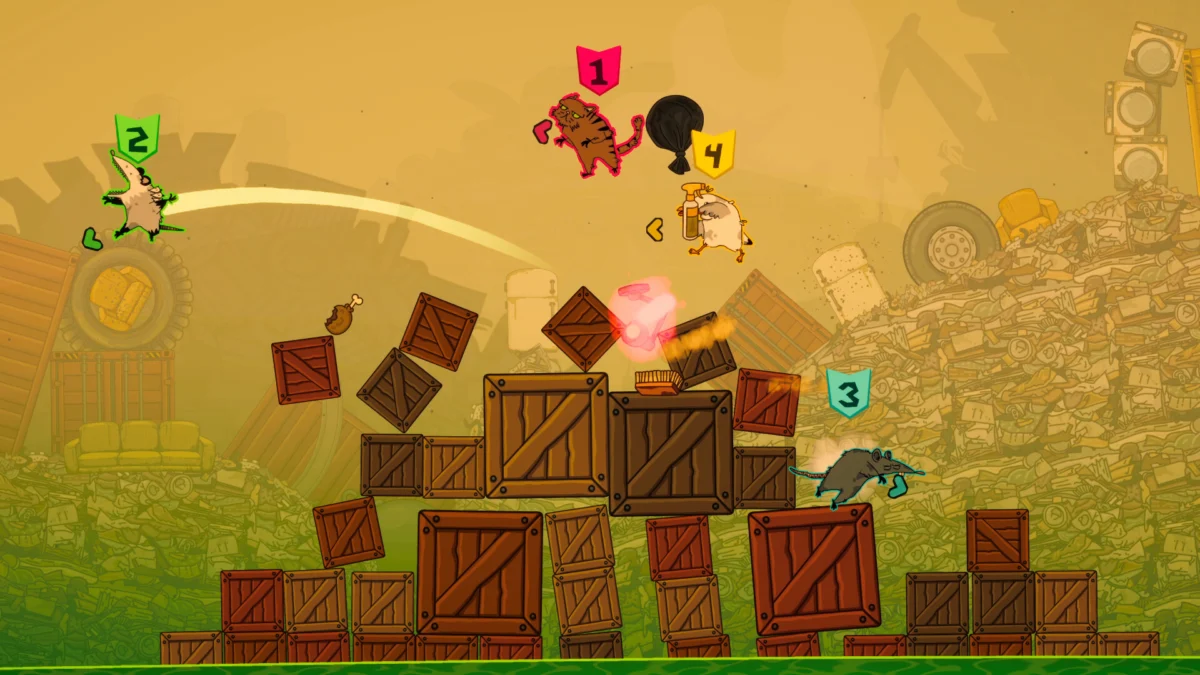
In the ever-expanding landscape of local multiplayer gaming, the "couch co-op" genre has seen a renaissance of titles that prioritize emergent narrative over mechanical precision. The latest entrant, Royal Vermin, is a quintessential example of this philosophy. By blending the strategic artillery combat of Worms, the high-octane platforming of Super Smash Bros., and the unpredictable physics-based comedy of modern indie hits, Royal Vermin carves out a niche defined by its own delightful entropy.
The Core Concept: Chaos as a Design Philosophy
At its heart, Royal Vermin is a game about managing decline. Players take control of various goofy, expressive critters tasked with surviving on arenas that are essentially ticking time bombs. The game’s premise is deceptively simple: you are on a stage that is destined to fail, and your goal is to be the last creature standing as the environment falls out from beneath you.
Unlike traditional brawlers where victory is strictly tethered to frame-perfect inputs and punishing combos, Royal Vermin thrives on the "happy accident." The game utilizes a physics engine that rewards players for manipulating the environment rather than just targeting their opponents. A well-placed throw or a tactical leap can trigger a chain reaction that collapses a bridge, drops a heavy weight, or clears an entire platform of adversaries.
Chronology and Development: From Concept to Couch Co-op
The development cycle of Royal Vermin reflects the current trend of "lean" indie production, where developers focus on a single, core loop and iterate heavily on it.
- Early Prototyping: Initial builds focused on the "collapsing arena" mechanic, which developers realized early on provided the most entertainment when the controls were kept intentionally accessible.
- Refinement Phase: During the mid-development cycle, the team focused on character variance. By adding diverse character models that maintained a unified, cartoonish aesthetic, they ensured that the visual chaos remained readable even when four players were engaged in a frenzy.
- The Balancing Act: Late-stage development shifted toward ensuring that "elimination" did not mean "boredom." By introducing mechanics that allow spectating players to influence the stage or contribute to the chaos, the developers successfully addressed one of the most common pitfalls of party games: the exclusion of the losers.
Supporting Data: Why Accessibility Wins
For a party game to succeed in a living room environment, the barrier to entry must be non-existent. Royal Vermin achieves this through a streamlined control scheme that prioritizes movement and interaction over complex button combinations.
According to community feedback and early playtests, the "pick-up-and-play" factor is the game’s strongest asset. When introducing new players to a session, the ramp-up time is virtually zero. However, the game includes a robust suite of adjustable difficulty settings. These sliders allow players to modify environmental hazards, the speed of stage decay, and character durability. This is a crucial feature, as it allows veteran players to challenge themselves while simultaneously lowering the floor for newcomers, effectively keeping the group engaged for longer sessions.
The Visual and Auditory Landscape
Visually, the game leans into a vibrant, high-saturation color palette that screams "Saturday morning cartoon." This is a strategic choice; in a game where the screen is constantly changing and segments of the floor are falling away, readability is paramount. The art style ensures that even when the screen is filled with debris and explosions, the player is never lost.

The animations are similarly exaggerated. Each critter possesses a distinct set of reactions—from wide-eyed panic to indignant frustration—which elevates the comedic value of every death. This "expressive failure" is what separates Royal Vermin from more sterile competitive titles. When you fall to your death, the game doesn’t just display a "Game Over" screen; it provides a visual punchline.
The Limitations of the Experience
While Royal Vermin hits its mark as a party game, it is important to contextualize its limitations for the modern consumer. In an era where online matchmaking and deep, narrative-driven single-player modes are the industry standard, Royal Vermin intentionally eschews both.
The Solo Player’s Dilemma
Those looking for a profound, single-player journey will likely find the experience lacking. The AI opponents are competent for practice, but they cannot replicate the psychological warfare and genuine laughter that occurs when playing with friends. The game is designed as a social experiment, not a solitary pursuit.
Online Infrastructure
The absence of a robust, cross-platform online matchmaking system may be the game’s greatest hurdle. In a world where long-distance gaming is the norm, the requirement for "couch" co-op narrows the target audience. While this decision ensures the lowest possible latency for the physics-based action—a frequent issue in online party games—it does limit the game’s longevity in households that cannot regularly gather friends physically.
Official Responses and Developer Intent
In various interviews, the developers have been transparent about their intentions: they did not set out to create the next esports phenomenon. They aimed to create a "digital toybox." By prioritizing "silly fun" over "competitive integrity," the team has protected the game from the inevitable toxicity that plagues more serious multiplayer brawlers.
"We wanted to make a game where the best moments happen by accident," one developer noted in a recent breakdown. "If a player wins because they are the most skilled, that’s great. But if a player wins because they accidentally knocked a pillar onto the leader, and that sends the entire stage into a tailspin? That’s where the real magic happens."
Implications: The Role of the "Anti-Competitive" Brawler
Royal Vermin sits at an interesting crossroads in the current gaming climate. We are currently seeing a market saturation of hyper-competitive, skill-gated titles. Games like Royal Vermin serve as an essential palate cleanser.

The implication here is that the party game genre is moving toward a more inclusive future. By emphasizing the "luck-based" chaos, the game successfully levels the playing field. It creates a space where a casual player who has never held a controller before can legitimately defeat a seasoned gamer through a stroke of blind luck and environmental timing. This creates a "leveller" effect, ensuring that everyone at the party has a stake in the outcome.
Conclusion: Is It Worth Your Time?
If you are looking for a game to sink hundreds of hours into to master mechanics and climb a global leaderboard, Royal Vermin is not the title for you. It does not aim to replace the titans of the genre, nor does it attempt to rewrite the rulebook on how brawlers should function.
However, if you are looking for a title to break out during a Friday night get-together, a holiday gathering, or a casual weekend with friends, Royal Vermin is an absolute triumph. Its ability to create memorable, laugh-out-loud moments of failure and triumph is its greatest strength. It is a game that values the player’s experience over their performance, and in the often-stressful world of modern gaming, that is a refreshing and necessary approach.
For the right crowd, Royal Vermin isn’t just a game; it’s an evening of entertainment. It turns the living room into a theater of the absurd, and for that, it deserves a spot in your digital library.
About the Author: Marcus Orchard is a veteran gaming journalist and enthusiast. When he isn’t diving into the latest indie gems or critiquing the structural integrity of a fictional arena, he can usually be found replaying Final Fantasy titles or debating the finer points of comic book lore. He remains a steadfast supporter of thoughtful, accessible game design.