Ammar Sabilarrohman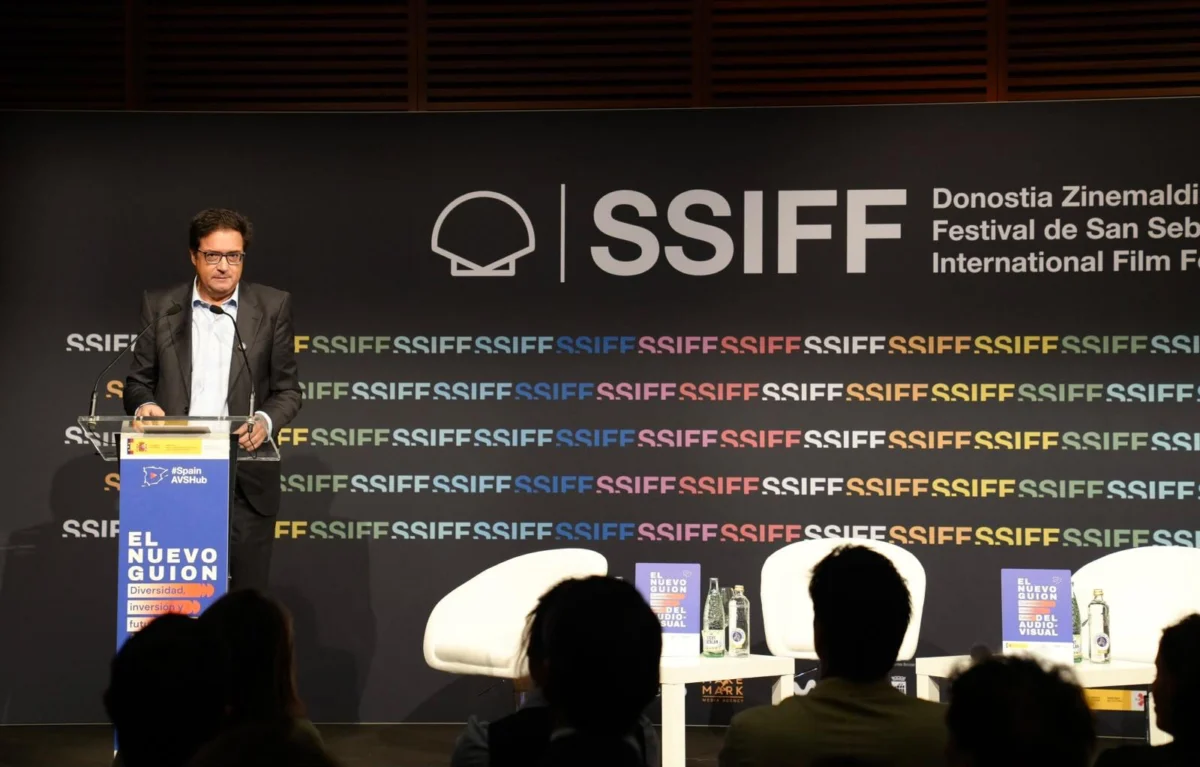
By Editorial Staff
The landscape of global entertainment is undergoing a seismic shift, and at the epicenter of this transformation stands Spain. Once viewed primarily as a picturesque location for international shoots, the nation has methodically evolved into a formidable production juggernaut. This transition, fueled by a potent cocktail of strategic state intervention, institutional investment, and a relentless focus on creative output, was the central theme at the recent “The New Script of the Audiovisual Industry” conference held during the prestigious San Sebastian Festival.
Oscar López, Spain’s Minister for Digital Transformation and Public Administration, arrived at the festival with a clear mandate: to reaffirm the government’s unwavering commitment to the nation’s creative sector. As the industry basks in the glow of recent international accolades—most notably the triumph of Javier Calvo and Javier Ambrossi’s La Bola Negra at the 2026 Toronto International Film Festival (TIFF)—the message from Madrid is one of sustained momentum.
A Strategic Pivot: From Policy to Performance
For years, the Spanish audiovisual sector suffered from a paradox: an abundance of world-class creative talent and diverse, high-production-value locations, coupled with a chronic lack of political will and capital injection. The “Spain Audiovisual Hub Plan” was designed to bridge this chasm.
“When a public policy works, it should be maintained without a deadline,” Minister López remarked during his keynote address. “It is the golden age for our audiovisual sector.”
The core of this policy is the deployment of the Spain Crece Fund and the strategic utilization of SETT (the Spanish Society for Technological Transformation), the Ministry’s sovereign venture capital vehicle. With an initial investment of €1.6 billion, the state has effectively signaled that the industry is no longer a peripheral cultural project but a pillar of national economic strategy. This institutional commitment is described by officials as an unprecedented effort to design an economic transformation on a scale rarely seen in the European creative sector.
The Chronology of Growth (2020–2026)
The ascent of the Spanish audiovisual industry was not an overnight phenomenon; it is the result of a deliberate, six-year strategic roadmap.
- 2020: The inception of the Spain Audiovisual Hub Plan. Following the global pandemic, the government recognized the potential for the creative sector to drive post-crisis economic recovery.
- 2021–2023: Initial capital deployment began. Investments were directed toward digital infrastructure, studio upgrades, and tax incentives, positioning Spain as a competitive alternative to traditional production hubs like London or Los Angeles.
- 2024: The fruits of the policy began to manifest in global streaming metrics. Spanish-language content, once confined to regional markets, began dominating Netflix’s global non-English Top 10 lists.
- 2025: A banner year. Domestic audiovisual production grew by a staggering 31%. Employment within the sector doubled compared to 2020, surging to over 64,000 workers.
- 2026: The current "Golden Age." International recognition peaks with the TIFF People’s Choice Award for La Bola Negra, a major indicator of future Academy Award potential. The government announces a new wave of €450 million in investments mobilized by SETT.
Data-Driven Dominance: The Olsberg-SP Findings
The numbers underscore the scale of this expansion. According to the forthcoming report by the Spain Film Commission and Olsberg SPI, the sector has generated an estimated €20 billion in direct production expenditure between 2020 and 2025. This activity resulted in nearly €18 billion in gross value added (GVA) to the Spanish economy.
Crucially, the ripple effect is immense. The data reveals that for every job created directly in production, a significant number of roles are supported across the supply chain—construction, hospitality, transport, and technology. As Leon Forde of Olsberg SPI noted, the industry is an “ecosystem” where every species is indispensable. With direct investment growing by 45% and GVA rising by 38%, the data validates the government’s decision to move beyond mere cultural funding into the realm of venture capital.
Industry Voices: The View from the Field
The government’s strategy has found favor among those on the front lines of production. Miriam Segal, founder of Good Film Studios, who has produced content across the U.S., UK, and Europe, expressed profound surprise at the maturity of the Spanish infrastructure.
“I didn’t know about this incredible industry infrastructure or the government’s extraordinary passion and commitment to the sector,” Segal noted during the San Sebastian panel. For an independent producer, the government’s support has provided a level of financial security—specifically the ability to offer "pay-or-play" deals to top-tier acting talent—that was previously inaccessible.
Similarly, José Carlos Garcia of Ánima Kitchen highlighted how SETT funding has allowed his firm to scale up recruitment and solidify a five-year pipeline for high-end animated films. This sentiment is echoed across the industry, where the infusion of capital is being treated as a catalyst for long-term sustainability rather than a temporary subsidy.
The European Perspective: Diversity as a Competitive Edge
While Spain is currently leading the charge, the San Sebastian conference also served as a forum for European collaboration. A dedicated panel featuring representatives from Greece and Denmark explored how European nations can maintain cultural diversity while remaining globally competitive.
Carla Redondo of Spain’s Ministry of Digital Transformation argued that Europe’s diversity is its greatest asset. The consensus among the panelists was that there is no "one-size-fits-all" European model. Instead, the focus should be on administrative harmonization and flexible funding mechanisms. Leonidas Christopoulos of Greece’s Ekkomed emphasized that regardless of the funding model, the core mandate remains the same: “It’s all about the stories.” Strong, localized narratives, when supported by robust infrastructure, are the primary drivers of international competitiveness.
Navigating the Future: Linear vs. Digital
A significant portion of the discourse focused on the survival of traditional media. In an era dominated by streaming giants, there is a temptation to declare linear television dead. However, executives from Mediaset, RTVE, Atresmedia, and Movistar Plus argued for a more nuanced reality.
“Television is not dead; it has evolved into a broader ecosystem,” said Fernando Hernaiz of Mediaset. This ecosystem now integrates linear channels with streaming, digital production, and global distribution. The challenge, according to the panel, lies in audience fragmentation and the need for regulatory frameworks that can keep pace with social media and global platforms. The consensus is clear: the future of Spanish media lies in the synergy between technology, high-quality scriptwriting, and aggressive business development.
Implications and the Road Ahead
The implications of Spain’s current trajectory are profound. By treating the audiovisual sector as a critical industry—comparable to tech or renewable energy—Spain has effectively decoupled its creative output from the volatility of cultural budget cycles.
As the government prepares to present the full Olsberg report on September 22, the message to the international market is unequivocal: Spain is open for business, its talent pool is deeper than ever, and its institutional support is locked in for the long haul.
With €450 million in new investments flowing into companies like Lazona, Good Films, and Aurora Media, the Spanish "Audiovisual Hub" is no longer just a government initiative—it is the engine of a national renaissance. As the world watches, Spain is proving that when a nation invests in its own stories, those stories can indeed capture the world’s imagination.


 Neng Nana
 Jia Lissa