The landscape of American home broadband is undergoing a seismic shift. Just over a year after T-Mobile officially entered the fiber-optic arena—a strategic move bolstered by its aggressive acquisition of Lumos—the telecommunications giant is doubling down on its infrastructure ambitions. This week, T-Mobile signaled its intent to dominate the high-speed market by introducing a blistering 5 Gbps fiber internet tier, a move that positions the carrier not just as a mobile provider, but as a formidable challenger to traditional regional cable monopolies.
The Evolution of T-Mobile Fiber: A Chronology
To understand the weight of this announcement, one must look back at the trajectory of T-Mobile’s “Un-carrier” philosophy as it pivoted toward fixed-line infrastructure.
The Foundation: The Lumos Acquisition
T-Mobile’s entry into the fiber market was not an overnight endeavor. It was the culmination of strategic investments and the acquisition of Lumos, a move that provided the carrier with the necessary physical footprint to compete with incumbents like Comcast, Charter, and AT&T. When the service first went live, it reached approximately 500,000 households, offering symmetrical speeds of up to 2 Gbps. This was marketed as a high-performance alternative to the fluctuating speeds of legacy cable providers.
The Expansion Phase
Throughout the last twelve months, T-Mobile has been quietly building out its footprint, leveraging its existing retail presence and brand recognition to convert mobile subscribers into bundled home internet customers. While the company’s Fixed Wireless Access (FWA) service acted as the initial bridge, the transition to fiber represents a permanent upgrade in bandwidth capacity and latency stability.
The 5 Gbps Milestone
This week’s announcement of a 5 Gbps tier marks a transition from "standard high-speed" to "enterprise-grade" residential internet. By offering speeds that exceed the requirements of even the most demanding power users—such as 8K streamers, professional video editors, and households with dozens of smart devices—T-Mobile is effectively future-proofing its network against the next decade of data consumption growth.
Supporting Data: The Economics of High-Speed Connectivity
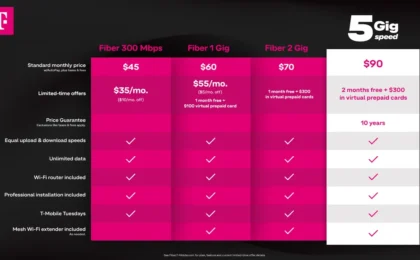
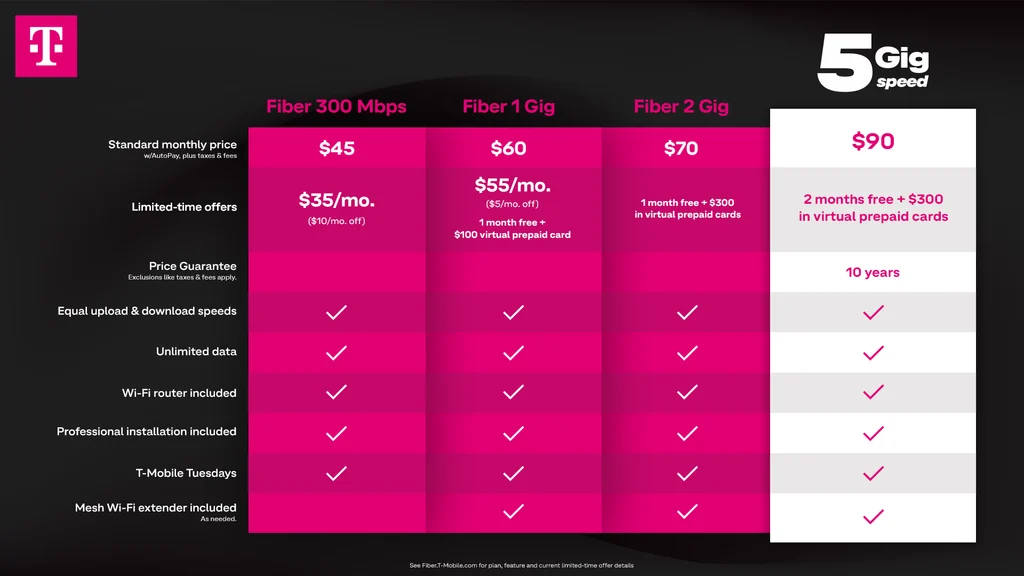
The introduction of the 5 Gbps service is not merely a technical upgrade; it is a calculated economic play. Priced at $90 per month, the plan sits at a competitive intersection of price and performance.
The 10-Year Price Guarantee
Perhaps the most disruptive aspect of the new offering is the 10-year price lock. In an industry notorious for "introductory rates" that expire after twelve months—leading to subsequent, aggressive price hikes—T-Mobile is banking on customer loyalty through stability.
- The Problem with Legacy Pricing: Most legacy cable providers utilize a complex web of promotional pricing. A user might sign up for a service at $60, only to find their bill ballooning to $110 after the first year. This "price creep" has created a massive segment of "churn-prone" customers who spend their time switching providers just to retain an affordable rate.
- The T-Mobile Value Proposition: By guaranteeing the $90 rate for a decade, T-Mobile is attempting to remove the friction of the billing cycle. For the average consumer, this provides a predictable cost-of-living metric that is rarely seen in the utility space.
Understanding the Fine Print
While the $90 price point is enticing, the reality of the telecommunications industry remains complex. The fine print accompanying the offer outlines several exclusions that consumers must factor into their budgeting:
- Taxes and Regulatory Fees: These are non-negotiable government-imposed costs that are rarely included in base pricing.
- Voluntary Upgrades: Should the user decide to upgrade their hardware or seek future speed tiers beyond 5 Gbps, the guarantee may be voided or adjusted.
- Third-Party Services: Bundled services—such as streaming subscriptions or security suites—are billed separately and are subject to third-party price increases.
- Network Management: The agreement includes standard clauses regarding network management, ensuring that the service is used for residential rather than commercial or data-center purposes.
Official Responses and Strategic Positioning
T-Mobile’s leadership has framed this rollout as a direct challenge to the "broken" model of legacy ISPs. In recent statements, the company has highlighted that the 5 Gbps tier is designed to handle the "bandwidth-heavy reality of the modern home."
Industry analysts suggest that this move is a direct response to the increasing availability of municipal fiber and the aggressive expansion of Google Fiber. By anchoring its service with a long-term price commitment, T-Mobile is attempting to build a "moat" around its subscriber base.
From the perspective of network infrastructure, 5 Gbps represents the bleeding edge of current XGS-PON technology. T-Mobile is signaling that it is not interested in merely catching up to the competition; it intends to set the benchmark for what residential fiber looks like in the late 2020s.
Implications for the American Broadband Market
The introduction of this tier carries significant implications for the broader telecom ecosystem.
1. Pressure on Legacy Providers
Traditional cable companies, which rely heavily on HFC (Hybrid Fiber-Coaxial) networks, now face a dual threat. They are losing customers to T-Mobile’s FWA service at the lower end of the market and are now seeing their high-end, gigabit-plus tiers challenged by superior fiber-to-the-home (FTTH) infrastructure. To remain competitive, legacy providers will likely be forced to either accelerate their own fiber-to-the-home upgrades or introduce their own long-term pricing guarantees.
2. The Normalization of Multi-Gigabit Speeds
For years, 1 Gbps was considered the "gold standard" for home internet. However, as the Internet of Things (IoT) matures and cloud-based gaming and high-fidelity virtual reality become more prevalent, the need for multi-gigabit symmetrical connections will shift from a luxury to a requirement. T-Mobile’s push into 5 Gbps helps normalize these speeds, potentially driving down the cost of high-bandwidth equipment (such as Wi-Fi 7 routers) as the market scales.
3. The Shift toward "Utility-Style" Internet
By offering a decade-long price lock, T-Mobile is repositioning home internet as a stable utility rather than a volatile subscription service. This shift could fundamentally change how consumers value their internet provider. If a customer knows their bill will remain the same for ten years, they are significantly less likely to explore alternatives, reducing churn and increasing the Lifetime Value (LTV) of the subscriber.
4. Digital Divide and Infrastructure Investment
While the 5 Gbps service is currently focused on regions where T-Mobile has acquired fiber assets, the expansion of such services highlights the importance of continued infrastructure investment. As the federal government continues to pour funding into broadband expansion (via programs like BEAD), carriers like T-Mobile will likely use these high-speed tiers to justify further expansion into suburban and semi-rural markets.
Conclusion: A Long-Term Bet on Stability
T-Mobile’s launch of a 5 Gbps fiber tier is more than just a marketing gimmick; it is a strategic maneuver designed to lock in market share through the combination of superior hardware and financial predictability. By addressing the primary pain point of modern broadband consumers—unpredictable pricing—T-Mobile is positioning itself to disrupt the dominance of legacy cable incumbents.
As the deployment continues, the industry will be watching closely to see if other providers follow suit with similar long-term price commitments. If the model proves successful, it could signal the end of the "promotional pricing" era, replacing it with a more transparent, utility-focused landscape. For now, consumers in T-Mobile’s fiber-covered regions have a compelling new option: the promise of extreme speed, paired with the rare comfort of a bill that won’t change for the next decade.
Whether this aggressive strategy will force a fundamental restructuring of the broadband market remains to be seen, but one thing is clear: the speed wars are far from over, and T-Mobile has just raised the stakes significantly.