

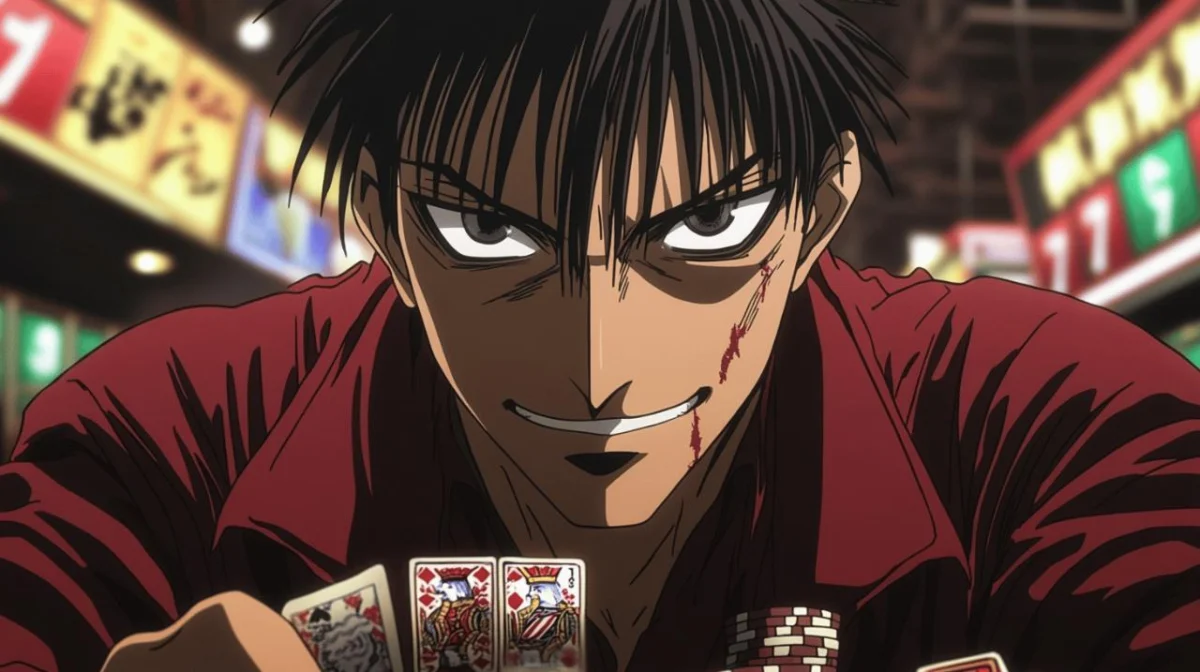
In the landscape of Japanese seinen manga, few works resonate with the visceral, bone-chilling intensity of Nobuyuki Fukumoto’s Kaiji: Ultimate Survivor. Since its inception in the pages of Young Magazine in 1996, the series has transcended its medium to become a profound, albeit harrowing, commentary on the darker facets of modern society: debt, human desperation, and the predatory nature of unregulated financial systems. With over 21.5 million copies in circulation as of 2019, Kaiji is more than a story about gambling; it is a psychological autopsy of the desperate, set against the backdrop of Japan’s economic stagnation.
Main Facts: The Anatomy of Despair
At its core, Kaiji follows the downward trajectory of Kaiji Itou, an aimless, down-on-his-luck youth living in the sprawl of post-bubble Japan. Kaiji is not a hero in the traditional sense; he is a man of the precarious working class, haunted by the crushing weight of a 3,850,000 yen debt (approximately 28,705 euros). This debt, accumulated through the misfortune of co-signing a loan for a friend who vanished, serves as the catalyst for his descent into the "underground."
The narrative premise is simple yet terrifying: Kaiji is lured onto a ship, the Espoir, where he is invited to participate in a high-stakes gambling tournament. Here, the rules are cold, calculated, and often lethal. The series distinguishes itself from typical gambling media by focusing less on "luck" and more on the cold, hard mechanics of game theory, human psychology, and the absolute abandonment of morality in the face of survival.
Chronology: From Manga Panels to Global Icon
The journey of Kaiji began in 1996, and its cultural footprint has expanded significantly over the decades.
- 1996: Kaiji: Ultimate Survivor begins serialization in Kodansha’s Young Magazine.
- 1998: The series receives widespread critical acclaim, winning the prestigious Kodansha Manga Award in the General category.
- 2007–2008: The first anime adaptation, Kaiji: Ultimate Survivor, airs, introducing a broader international audience to the oppressive, high-tension atmosphere of Fukumoto’s world.
- 2009: The first live-action film, Kaiji: Jinsei Gyakuten Gēmu, premieres in Japan, marking the franchise’s transition to mainstream cinema.
- 2011: A second anime season, Kaiji: Against All Rules, is released, covering the iconic "Underground Chinchiro" and "Pachinko SWAMP" arcs.
- 2011–2020: The franchise continues to expand with further live-action sequels, culminating in Kaiji: Final Game (2020).
Supporting Data: The Economics of the Underground
The brilliance of Kaiji lies in its mathematical precision. Fukumoto does not rely on plot armor; he relies on logic. Whether it is the "Restricted Rock-Paper-Scissors" played on the Espoir or the "E-Card" game against the sadistic Tonegawa, the stakes are always explicitly clear.
Perhaps the most iconic example is the "Pachinko SWAMP" arc. The machine itself is a character, a mechanical monstrosity that costs 4,000 yen per ball to play, with a potential payout of 700 million yen. The data provided in the narrative—the probability, the trajectory of the steel balls, and the house’s iron-clad control—serves to highlight the futility of fighting a rigged system.
The financial burden on Kaiji—starting at 3.85 million yen—is not merely a plot point; it is a mirror of the real-world debt traps prevalent in modern economic structures. The "interest" accrued by the creditors serves as an engine for the story’s pacing, driving the characters to commit increasingly desperate acts to satisfy their debts.
Official Responses and Critical Reception
Critics have long lauded Kaiji for its unflinching portrayal of human nature under duress. The "official" consensus, reflected in its awards and massive sales, is that Kaiji is a masterpiece of psychological suspense.
The aesthetic choices of the series have been subject to intense academic and critical debate. Nobuyuki Fukumoto’s art style—characterized by sharp, angular, almost grotesque facial features—has been praised for its ability to convey extreme emotional states. When a character in Kaiji experiences terror, it is not merely expressed through eyes or mouth; it is expressed through a complete contortion of their facial structure. This "ugly" art style is a deliberate narrative choice, stripping away the glamour often associated with high-stakes gambling to reveal the raw, sweating, and trembling reality of the human condition.
Implications: The Legacy and the "Squid Game" Connection
The impact of Kaiji on global pop culture cannot be overstated. It established the "death game" subgenre that has become a staple of modern streaming platforms.
The Mirror of Society
Kaiji acts as a biting critique of the modern Japanese credit system and the exploitation of the vulnerable. The series suggests that the "villains" are not just the individual creditors, but the systemic infrastructure that turns human lives into collateral. This theme has resonated globally, most notably in the international success of the South Korean series Squid Game. Both Kaiji and Squid Game share a fundamental DNA: a group of deeply indebted, desperate individuals forced into a series of games where the cost of failure is death, orchestrated by a wealthy elite who view the participants as nothing more than cattle.
The Psychological Toll
The psychological implications of the series are profound. Kaiji forces the audience to ask: What would I do to survive? How far would I go to erase my past? By presenting scenarios that are logically sound yet morally bankrupt, the series challenges the viewer’s own ethics. It is a masterclass in tension, where the most terrifying aspect is not the game itself, but the knowledge that in the world of Kaiji, the game is almost always rigged.
Conclusion: A Timeless Descent
Kaiji: Ultimate Survivor remains a titan of the genre because it refuses to offer the reader a comfortable escape. It does not promise that the "good guy" will win through virtue; it promises only that the clever, the ruthless, and the desperate may survive long enough to face the next game.
From its humble beginnings in the Young Magazine to its status as a foundational pillar of the death-game genre, the series continues to haunt, educate, and provoke. As long as economic inequality persists and the desperation of the "ordinary man" remains a reality, the world of Kaiji will continue to be a chillingly accurate reflection of our own. It is not merely a story about winning money; it is a harrowing, essential meditation on what it truly means to be human when the world demands everything you have—and more.












No comments yet. Be the first to join the conversation!