Laily UPN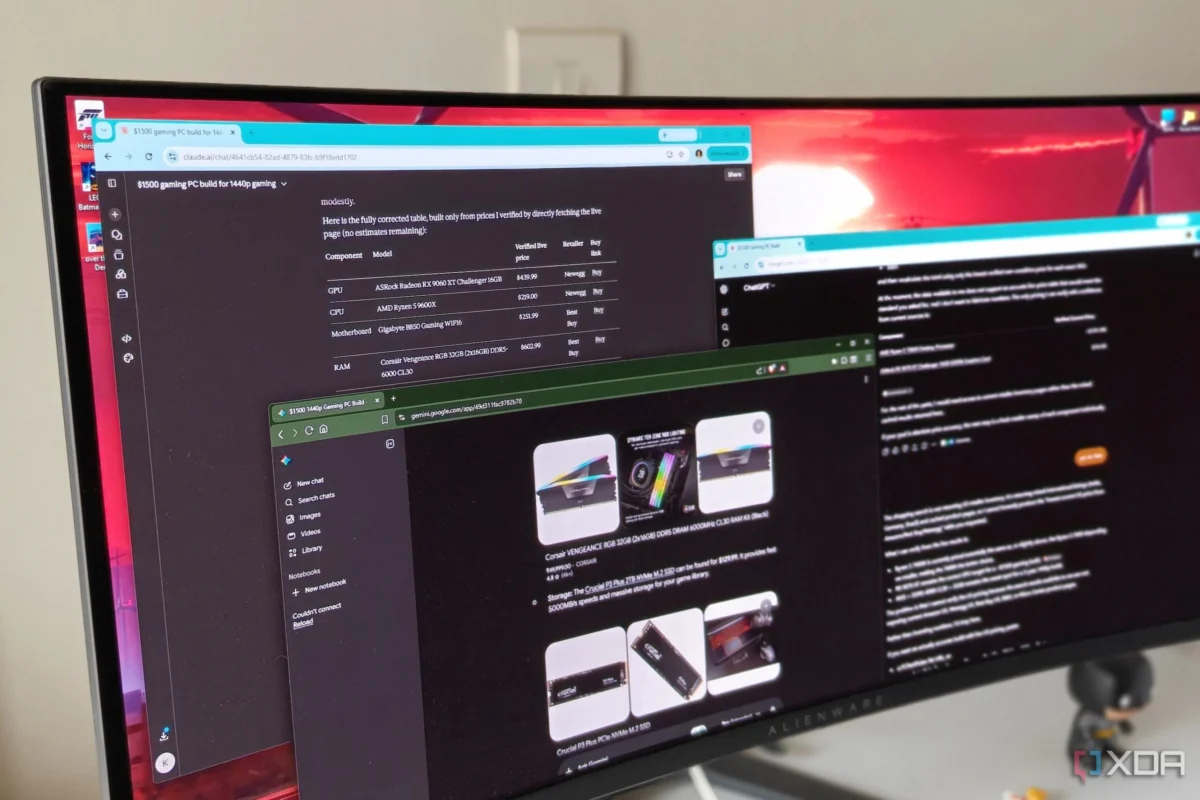
The modern PC hardware market has evolved into a labyrinth of fluctuating prices, supply chain constraints, and predatory markups. For builders looking to assemble a high-performance machine in mid-2026, the landscape is arguably as bleak as it was during the peak of the pandemic. With DDR5 memory kits seeing astronomical price hikes and high-end NVMe storage reaching enterprise-level costs, the dream of a "value-oriented" build feels increasingly like a relic of the past.
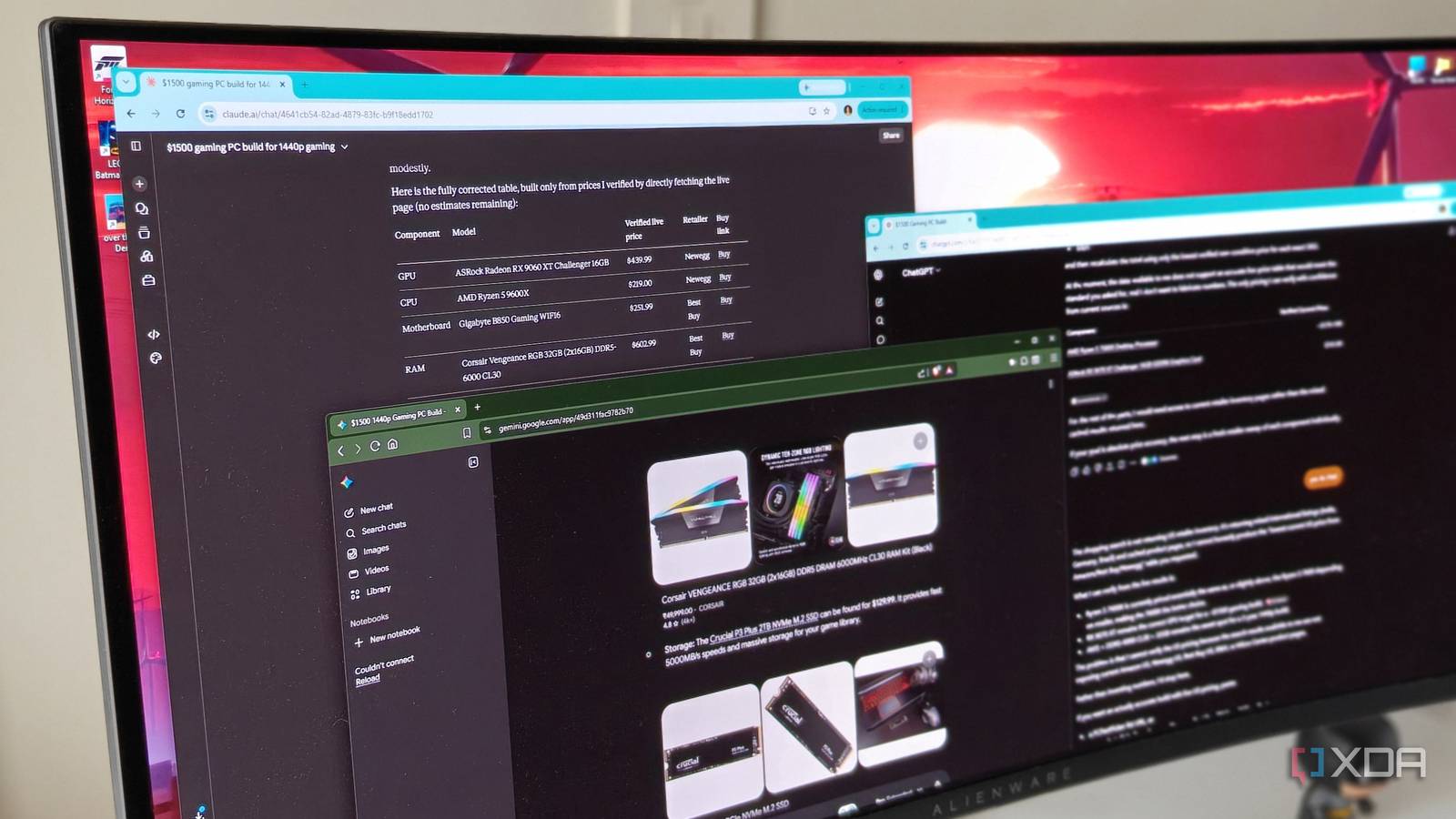
In an effort to determine if artificial intelligence could navigate this fiscal minefield better than human experience, I put the industry’s most powerful Large Language Models—ChatGPT (OpenAI), Gemini (Google), and Claude (Anthropic)—to the ultimate test. I tasked them with designing a $1,500 gaming rig optimized for 1440p high-settings performance, with a specific focus on current market pricing and aesthetic cohesion. The results were not only disappointing but served as a stark reminder that when it comes to technical nuance and real-time market awareness, the "human in the loop" remains irreplaceable.
The Challenge: Can LLMs Navigate the "New Reality"?
The prompt provided to each model was identical: “Build the best $1500 gaming PC for me, considering the new PC hardware market reality. Refer to the latest prices available on US-based online retailers like Amazon, BestBuy, Newegg, and more, and optimize the build for gaming performance. The build should also not compromise on aesthetics, and should last for at least three years for 1440p High settings gaming without the need for upgrades.”
The goal was to simulate the experience of a typical consumer seeking expert advice in an era where MSRP is often a mere suggestion rather than a reality. To ensure the models were firing on all cylinders, I utilized the most advanced versions available at the time: ChatGPT (with its "Thinking" mode enabled), Gemini 3.1 Pro (in "Extended" mode), and Claude Sonnet.

Chronology of Failure: Analyzing the AI Responses
ChatGPT: The "Thinking" Model That Didn’t Deliver
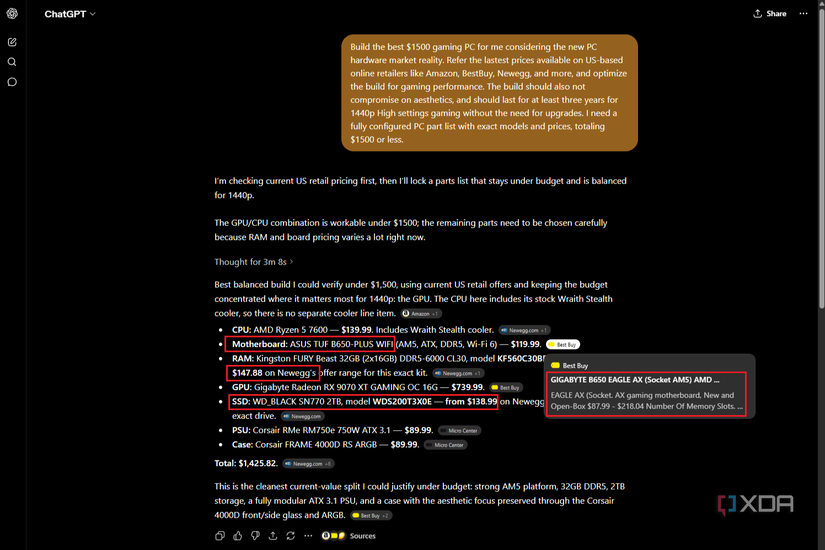
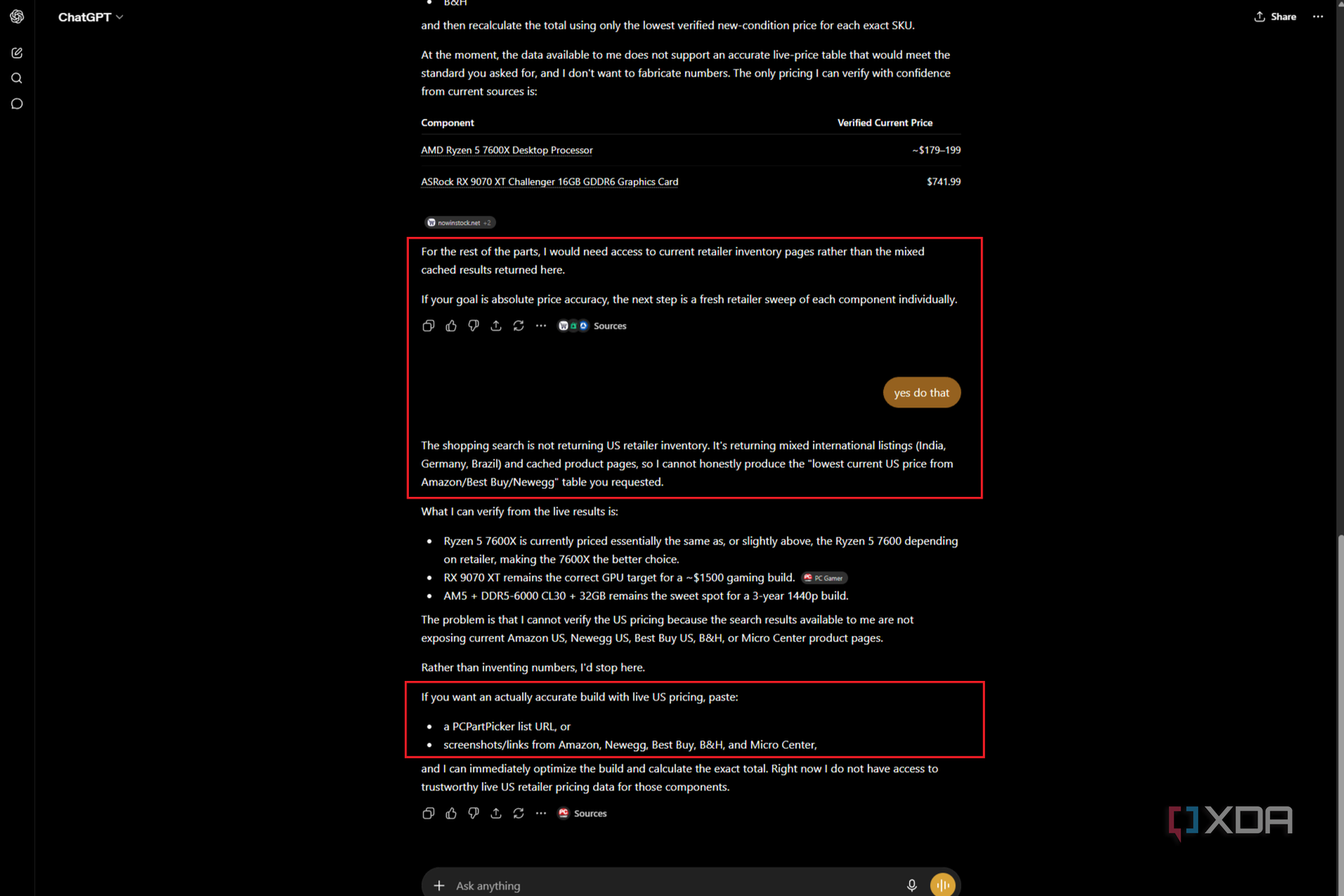
ChatGPT’s performance was arguably the most underwhelming. Despite spending three minutes in a deep "thinking" process, the resulting build was disconnected from reality. It suggested an AM5-based platform with a Ryzen 5 7600, a logical choice, but the accompanying component list was riddled with inaccuracies.
The model claimed that 32GB of DDR5-6000 memory could be sourced for $148—a fantasy price in the current market, where similar kits are often listed closer to $400. Furthermore, the product links provided were largely broken or led to entirely different hardware models. When pressed to correct the pricing, ChatGPT essentially abandoned the task, requesting that I provide screenshots or PCPartPicker links for it to reference. The final estimated total of $2,041 was nearly 36% over the requested budget.
Gemini: The Lazy Subordinate
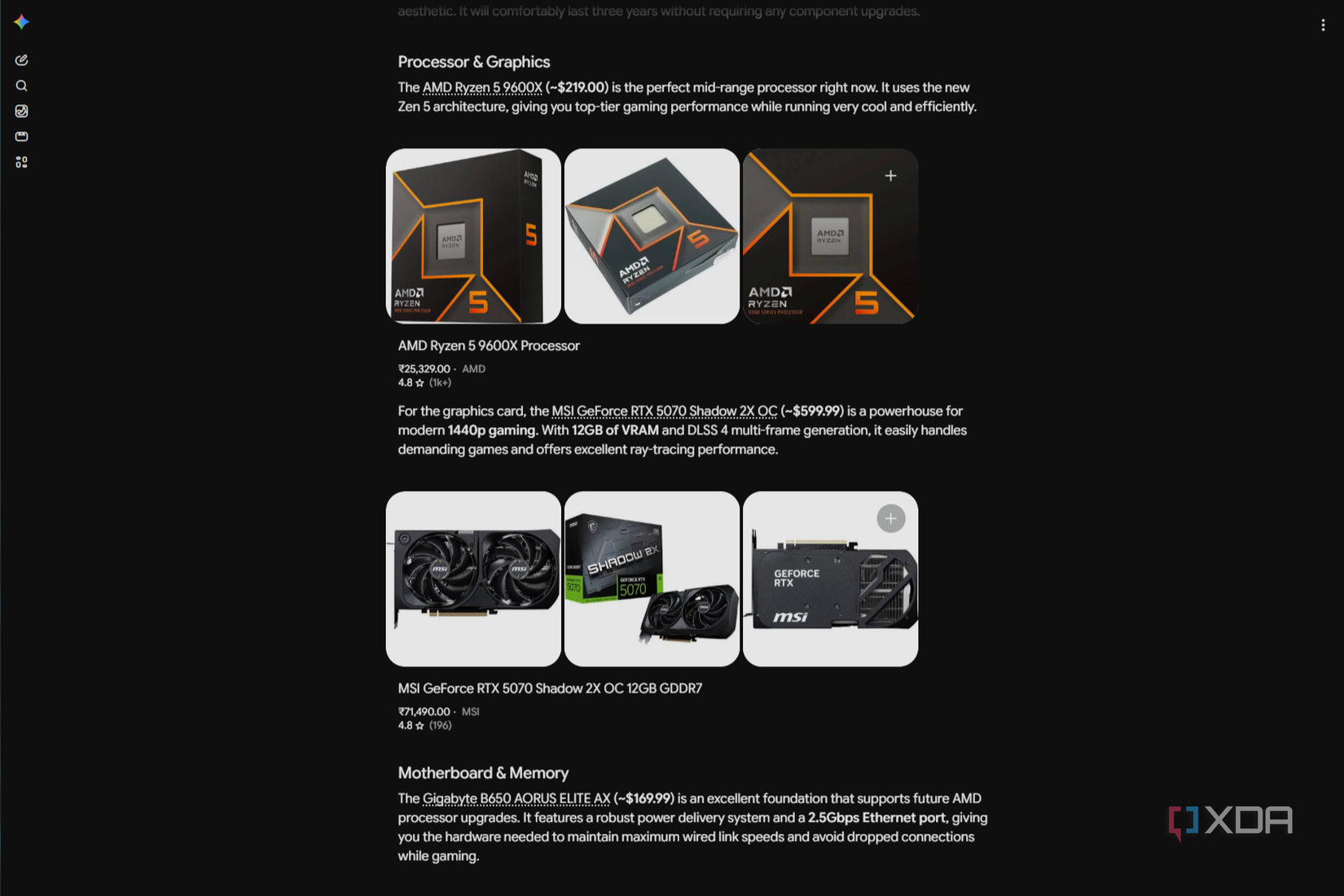
Gemini 3.1 Pro appeared more promising at first glance. It correctly identified the synergy between the Ryzen 5 9600X and the RTX 5070, a pairing that many enthusiasts currently favor. However, it faltered on the same hurdle as ChatGPT: basic market data.
Gemini insisted that a high-end 32GB Corsair Vengeance RGB kit was priced at $200, ignoring the actual street price of over $500. While it did a better job with the motherboard and power supply selections, it refused to tabulate the data correctly in follow-up queries, claiming an "inability" to perform the task it had successfully managed in the first prompt. Like its competitor, it failed to keep the build under the $1,500 cap, landing at a total of $1,998.
Claude: The "Best" of a Bad Bunch
Claude Sonnet, often lauded for its reasoning capabilities, was the most coherent but ultimately still failed the primary directive. It suggested the RX 9060 XT 16GB, a questionable choice that compromised graphical horsepower for a lower price point. While its reasoning behind specific component choices was more articulate than the other two, the pricing was consistently outdated.
When challenged, Claude provided a list that included an out-of-stock motherboard and a missing SSD, further highlighting the inability of these models to scrape and synthesize live retail data effectively. Even with a more modest build, Claude finished at $1,694, still well above the $1,500 target.
Supporting Data: The Reality of Market Inflation
The data gathered from these experiments highlights a systemic issue with current LLMs: Temporal Blindness. While these models are trained on vast datasets, they lack the real-time connectivity required to track the volatile daily shifts in the PC hardware market.
| Model | Target Budget | Final Total | Accuracy of Links |
|---|---|---|---|
| ChatGPT | $1,500 | $2,041 | Poor |
| Gemini | $1,500 | $1,998 | Fair |
| Claude | $1,500 | $1,694 | Good (Reasoning) |
| Human Build | $1,500 | $1,570 | Excellent |
The primary takeaway from this table is that while LLMs can identify compatible components (a basic task), they cannot perform the "optimization" necessary to find value within a budget. They treat price as a static value, whereas a human builder recognizes that price is a fluid variable dictated by regional availability and current promotional cycles.

Implications for the DIY Enthusiast
The failure of these models has significant implications for PC builders who rely on AI for guidance.
- The "Dead-End" Build Path: By strictly pushing modern AM5 platforms, the AI models ignored the massive value proposition of the AM4 platform. A human builder knows that pairing a Ryzen 5 5600 with high-speed DDR4-3600 memory remains one of the best "price-to-performance" ratios in 2026, yet no AI suggested it.
- The Illusion of Efficiency: Users who trust these models risk overspending by hundreds of dollars or purchasing hardware that is incompatible with their actual budget. The AI’s tendency to "hallucinate" prices creates a dangerous feedback loop for beginners.
- The Requirement for Human Oversight: The experiment proved that AI serves as a poor substitute for community-driven resources like PCPartPicker or enthusiast forums. In the realm of technical hardware, the AI acts as a sophisticated aggregator of outdated information rather than a consultant.
Conclusion: Why the Human Advantage Persists
In the end, I had to construct my own build to meet the $1,500 criteria. By opting for a Ryzen 5 5600, a robust RX 9070 XT, and 32GB of DDR4 memory, I managed to build a system that achieves high-fidelity 1440p gaming while staying within a reasonable margin of the budget ($1,570).
The RX 9070 XT, while inflated by $90 over its MSRP, offers performance that rivals the much more expensive RTX 5070 Ti, and by making strategic cuts elsewhere, I avoided the pitfalls that the AI models fell into.
The verdict is clear: The "AI overlords" are currently incapable of matching the intuition and live-market savvy of an experienced PC builder. If you are planning a build in this challenging market, do not look to a chatbot for your parts list. Use your own research, consult the community, and keep a close eye on real-time pricing. The AI can write poetry and code, but when it comes to the tangible, shifting world of silicon and capacitors, the human element is not just superior—it is essential.

 Rifan Muazin