

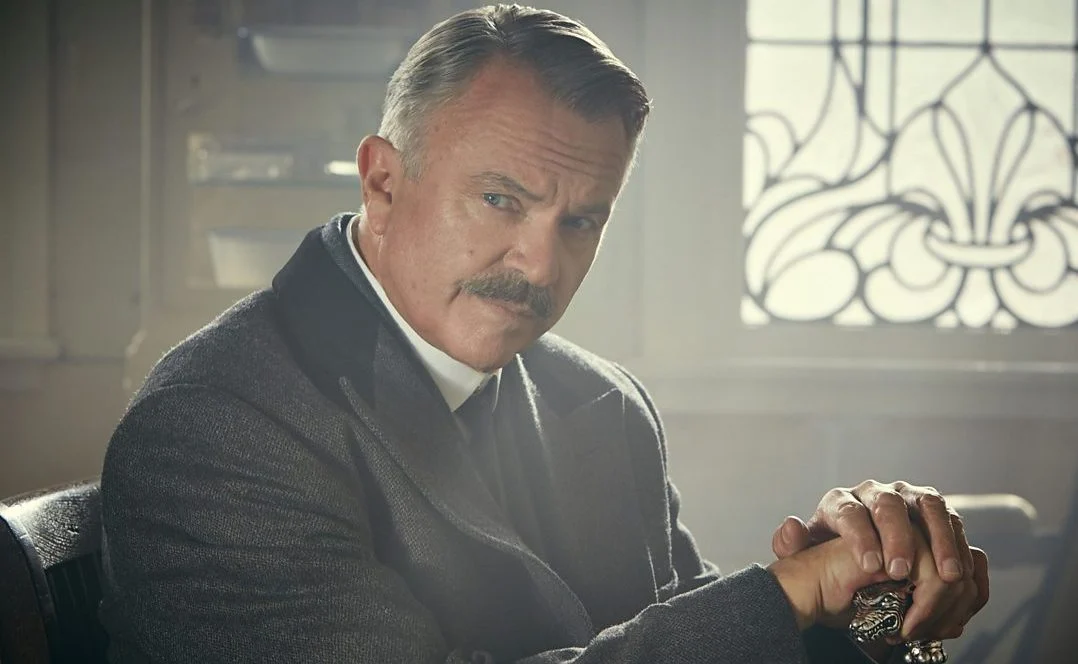
The global entertainment industry is in mourning following the passing of Sam Neill, the acclaimed actor whose career spanned over five decades, crossing genres from gritty crime dramas to blockbuster science fiction. Neill, 78, died this week, leaving behind a legacy defined by profound versatility, quiet intensity, and a rare, grounded humanity that endeared him to audiences and colleagues alike.
While the world remembers him as the intrepid Dr. Alan Grant in the Jurassic Park franchise, the creative team behind the hit series Peaky Blinders has led the tributes, acknowledging the vital role Neill played in anchoring the show’s early, defining chapters.
A Legacy of Villainy and Virtue: The Peaky Blinders Connection
For the legions of fans who discovered the dark, industrial underworld of Birmingham through Peaky Blinders, Sam Neill was the ultimate antagonist. Appearing as Major Chester Campbell in the show’s first two seasons, Neill transformed the role of the "ruthless inspector" into something far more nuanced.
In a poignant statement posted to the show’s official Instagram account, the production team expressed their profound grief: “We are devastated to hear that Sam Neill has died. Sam’s portrayal of Chester Campbell is one for the ages. A villain who is despicable, petty, manipulative, but also charismatic, vulnerable, funny, and supremely entertaining to watch.”
The tribute highlighted the foundational impact Neill had on the series, noting, “Sam was one of the key forces that got Peaky Blinders off to a running start, for which we will be forever grateful. Our love and thoughts are with his family.”
The sentiment was echoed by his co-stars. Joe Cole, who portrayed John Shelby, paid his respects with the brief but heartfelt, “Rest in peace big dog,” while Finn Cole added, “Rest easy, Sam.” These tributes reflect the deep-seated respect Neill commanded on set, where he was known not just as a seasoned professional, but as a generous scene partner who elevated the performances of those around him.
A Chronology of a Storied Career
Born in Northern Ireland and raised in New Zealand, Neill’s path to international stardom was anything but linear. His journey began in the late 1960s with local New Zealand film and television, but his breakout arrived in 1979 with My Brilliant Career. This performance captured the attention of international casting directors and cemented his status as a leading man of immense emotional depth.
- The 1980s: Rising Prominence. Neill’s reputation grew throughout the 80s with roles in Reilly, Ace of Spies, which earned him international acclaim, and Dead Calm (1989), where he starred alongside Nicole Kidman and Billy Zane, solidifying his ability to command the screen in high-stakes thrillers.
- The 1990s: Global Stardom. 1993 was arguably the most pivotal year of his career. As Dr. Alan Grant in Steven Spielberg’s Jurassic Park, Neill became a household name. He balanced the blockbuster spectacle with more introspective, smaller-scale projects like The Piano (1993), showcasing his range as an actor who could navigate both high-concept sci-fi and intimate character dramas.
- The 2000s and Beyond: Genre-Defying Versatility. As the new millennium arrived, Neill refused to be pigeonholed. He moved seamlessly between prestige television—such as The Tudors and Peaky Blinders—and eccentric, auteur-driven films like Hunt for the Wilderpeople (2016), where he demonstrated a sharp, dry comedic timing that audiences had rarely seen in his earlier, more stoic roles.
Supporting Data: An Industry Icon
Beyond the headlines, the statistics of Neill’s career speak to a lifetime of relentless work. He appeared in over 150 film and television productions. His work earned him three Golden Globe nominations, several BAFTA nominations, and an Emmy nod. However, those in the industry argue that Neill’s influence cannot be quantified by awards alone.
As a New Zealander, Neill was a cultural ambassador. His commitment to the local film industry in his home country helped nurture a generation of filmmakers, including Taika Waititi, who frequently cited Neill as a primary influence. His presence in the industry acted as a bridge between the classic era of Hollywood filmmaking and the modern, digital age of streaming and global franchise cinema.
Official Responses and Personal Tributes
The outpouring of grief following the news of his death has been unprecedented. It is rare to see such a unified response across the disparate worlds of high-brow cinema and blockbuster entertainment.
Karl Urban, a fellow Kiwi and star of The Boys, provided a deeply personal look at what Neill meant to his countrymen. "A beautiful man. A national treasure who gave so much to New Zealand and to the world," Urban wrote. "An inspiration and a trailblazer."
Colin Trevorrow, who directed Neill in the Jurassic World franchise, offered a more intimate perspective on the man behind the persona: "Sam Neill was a deeply soulful and beautiful man. He was a friend and collaborator at a challenging time, and his strength gave us all strength. I’ll remember him for his tranquility, his love of wine, and for the calm assuredness he brought to his characters. It’s not every lifetime you get to befriend a legend. Forever grateful."
The statement released by his family, shared on Neill’s own Instagram profile, encapsulated the way he chose to live his final days: “He passed with the dignity that has characterized his whole life.”
The Implications: A Void in the Landscape of Character Acting
The passing of Sam Neill leaves a palpable void in the landscape of modern acting. In an era where "star power" is often equated with social media presence or massive brand endorsements, Neill represented the "old guard" of character actors—those who disappear into a role, making the audience forget the actor and see only the person on screen.
His ability to play the antagonist with charm, or the hero with hesitation, made him a master of subverting expectations. In Peaky Blinders, he made viewers loathe Chester Campbell while simultaneously being unable to look away from his performance. This is the hallmark of a master craftsman.
As the industry looks back at his vast body of work, the implications for future actors are clear. Neill proved that a career could be built on longevity, integrity, and a refusal to be defined by a single genre. He remained curious about his craft until the end, constantly seeking roles that challenged his perceptions of himself and his audience.
Remembering the Man, Not Just the Actor
While the world mourns the loss of a screen legend, his friends and family remember a man of varied interests. Outside of the film set, Neill was a passionate vintner, often sharing his love for his New Zealand vineyard on social media. His appreciation for the quiet, rural life stood in stark contrast to the high-intensity Hollywood environments he navigated for decades.
This duality—the globe-trotting actor and the grounded, wine-loving Kiwi—is perhaps why he was so beloved. He never seemed to lose touch with the reality of the world, even as he was being projected onto screens in every corner of it.
In the final assessment of his career, Sam Neill will be remembered not merely for the characters he played, but for the grace with which he navigated the pressures of fame. He was a quiet force, a collaborator who sought to elevate his peers, and a storyteller who understood that the most powerful performances are those delivered with a sense of soul.
As the film and television community continues to process this loss, one thing remains certain: the characters Sam Neill brought to life will endure. From the dinosaur-filled plains of Isla Nublar to the soot-covered streets of Birmingham, his work will continue to influence, entertain, and inspire generations of storytellers yet to come. The "big dog" may have left the screen, but his legacy is as permanent as the stories he helped weave into our collective memory.










