

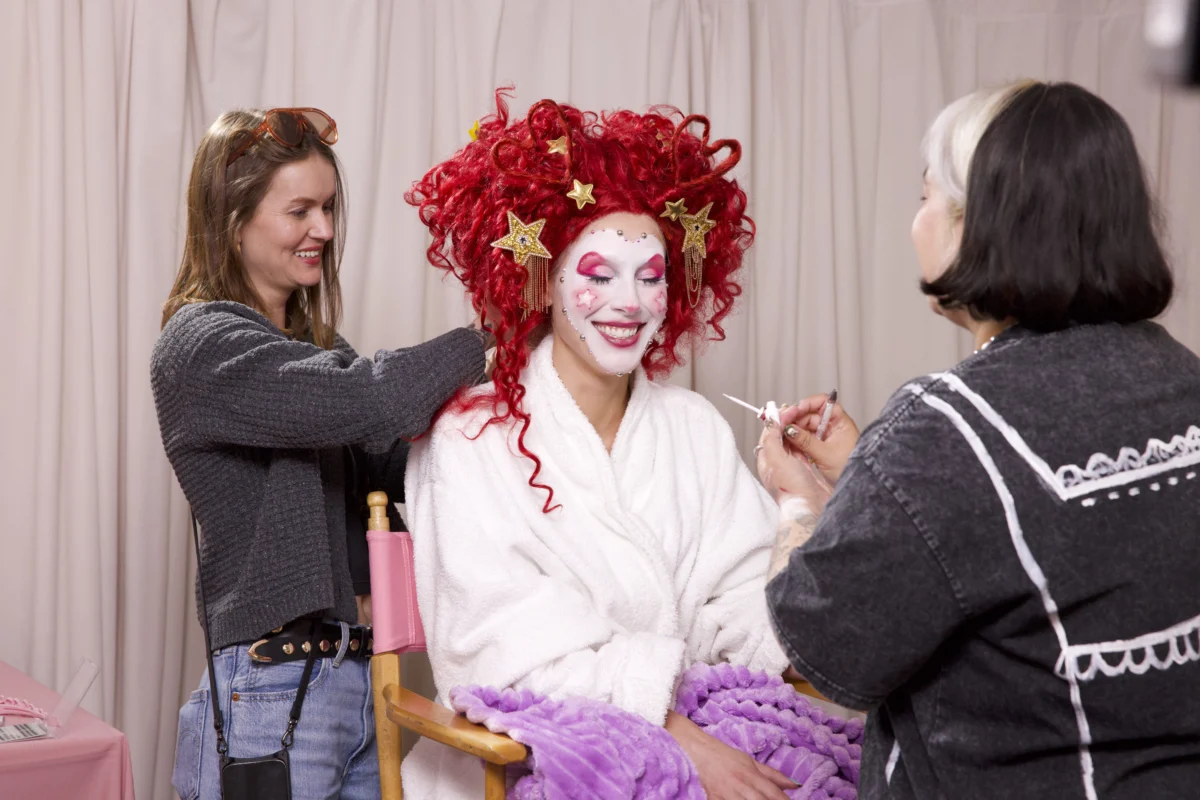
If you were to open the Notes app on the phone of Alex Perrone, the lead makeup designer for Dropout’s hit improvised series Very Important People, you would likely find a collection of ideas that defy conventional television logic. Between lists of prosthetics and color palettes, you might find entries for sentient hot dogs, mumblecore-loving trolls, or bubble-powered superheroes. In an industry where “development hell” often refers to projects languishing in corporate boardrooms, for the team behind Very Important People, it refers to the exhilarating, high-stakes process of turning a bizarre improv prompt into a physical reality.
Hosted by the brilliant Vic Michaelis—who portrays a fictionalized, eccentric version of herself conducting a public access talk show—Very Important People has become a masterclass in collaborative creativity. As the show moves into its third season, the barrier between the human performer and the monstrous, comedic, or downright strange character they portray has never been thinner, thanks to a makeup department that operates with the speed of a startup and the artistry of a high-end film studio.
The Architecture of Improvisation
Very Important People is not your standard talk show. It is a radical experiment in collaborative performance art. The core production team—including Michaelis, director Tamar Levine, makeup lead Alex Perrone, costume designer Alisha Silverstein, and producers Paul Robalino and David Kerns—functions as a tight-knit creative unit. Their goal is simple but daunting: create "total transformations" that provide the guest performer with a visual anchor for their improvised character.
The process is inherently paradoxical. The makeup team must craft a specific, high-fidelity look—sometimes involving complex prosthetics or intricate paint jobs—that is designed to be "lived in" by a comedian who has yet to decide how that character will behave. The guest arrives, often spending hours with their eyes closed in the makeup chair, only to emerge as a character they are effectively discovering in real-time.

"We’ll start ideating for a few weeks with everybody, and then we start locking looks," Perrone explained in an interview. "Throughout that process—say we’re doing 15 episodes—we’ll have three to four locked within the first three weeks, and those builds start happening. So as we’re building, we’re still pitching and creating more looks. So it goes up to the very end, once we have all the cast locked."
A Chronology of Creation: From Concept to Character
The genesis of a Very Important People character is rarely linear. For the makeup department, inspiration can strike from a variety of sources. Sometimes, the catalyst is a specific piece of hardware. Perrone recalls the creation of "Diamond," the werewolf content creator portrayed by Rachel Pegram. The entire look was anchored by the discovery of a specific chest piece—one featuring six nipples—that dictated the aesthetic direction of the character.
Other times, the process is one of legacy and iteration. Returning guests like Lisa Gilroy and Zac Oyama represent a specific challenge for the team: the need to outdo themselves. The goal is not just to provide a new look, but a complete thematic departure from previous seasons.
"It’s nice to see [Gilroy] go from Season 1, this old woman look, to Season 2, a monster, and then Season 3, this kind of beautiful makeup, but she’s a clown," Perrone noted. "We knew we wanted to take her in a new direction and also do a big departure from Spencer. People love Spencer. We love Spencer. But we wanted to give Lisa a different direction to take her improv and something different for Vic to work with as well."

Supporting Data: The Logistics of the Impossible
To the casual viewer, the transformations on Very Important People look like they belong on a feature film set with a six-month lead time. The reality is significantly more grueling. The production team operates on a timeline of roughly two months of total prep for a 15-episode season.
Within this window, Perrone is afforded only about three "custom builds" where they can fully scan, sculpt, and cast pieces for an actor’s specific body. For the remaining episodes, the team relies on a sophisticated "kit-bashing" approach—sourcing high-quality prosthetics from industry stalwarts like RBFX Studio and Dyad Prosthetics, and then modifying them to be unrecognizable.
"We pull from that, and rather than using them [for] what they’re intended for, we add our own spin to them and make a new creation," Perrone says. This requires a level of agility that is rarely seen in traditional television. In Season 3, the team ramped up the complexity by incorporating custom dental appliances and ocular prosthetics to deepen the immersion.
The balancing act is between the "outlandish" and the "human." Not every character requires a full-body transformation. Often, the most effective looks are the ones that allow the performer’s face to remain the primary vehicle for expression. For guest Caitlin Reilly, the team intentionally pulled back on heavy prosthetics, relying instead on subtle makeup nuances and costume design to set the tone, allowing the performance to do the heavy lifting.

Official Perspectives: A Culture of Collaboration
The success of Very Important People hinges on a rare "yes-and" culture that extends from the stage to the makeup trailer. The case of "Sudzo," the bubble-powered superhero played by Eugene Cordero, serves as the ultimate case study in cross-departmental synergy.
The initial prompt was simple: a "low-rent" superhero. However, the team struggled to find a unique angle that hadn’t been done before. When the concept of "bubbles" was introduced, it triggered a multi-week collaborative effort. The costume department, the makeup artists, and the performers all had to align on how to represent this power physically without relying on CGI.
"That one evolved over weeks, and it was a complete collaboration between everybody," Perrone said. "Something I really appreciate about Very Important People is that it’s rare you have this much collaboration and time to really create something you’ve wanted to. They’re very open to different ideas, and those ideas evolve. I think Dropout does such a good job representing their artists on the show."
Implications: The Future of Streamed Comedy
The implications of the Very Important People model are significant for the streaming landscape. In an era where many comedy specials and variety shows are becoming increasingly static or reliant on digital effects, this show proves that there is still a massive appetite for tactile, practical, and highly crafted physical comedy.

By prioritizing the "process" of character creation as part of the entertainment value, the show creates a sense of intimacy with the audience. Viewers aren’t just watching a character; they are watching the culmination of an intense, two-month creative journey between a performer and a team of artisans.
As Dropout continues to grow, the Very Important People makeup department has established a blueprint for how to maximize limited resources through sheer creative ingenuity. They have turned the constraints of time and budget into a stylistic choice, creating a visual language that is as unpredictable and "unhinged" as the improvisers they are dressing.
Ultimately, Alex Perrone and her team aren’t just applying makeup; they are facilitating a psychological shift. By changing how the actors look, they are changing how they think, how they move, and how they interact with Vic Michaelis. It is a testament to the power of craft in an age of automation, proving that sometimes the most interesting things in your notes app are the ones that actually make it onto the screen.
Very Important People is currently streaming on Dropout.











No comments yet. Be the first to join the conversation!