

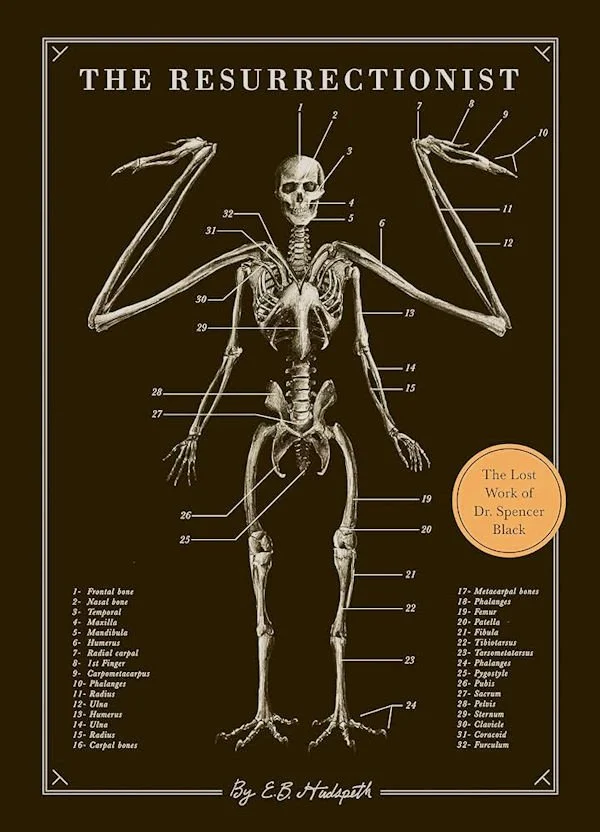
In the landscape of contemporary speculative literature, few works bridge the gap between historical fiction and macabre artistry with the surgical precision of E.B. Hudspeth’s The Resurrectionist. Part gothic biography, part pseudo-scientific compendium, the book invites readers into the gaslit, smog-choked streets of 1870s Philadelphia, introducing them to the singular, controversial figure of Dr. Spencer Black. By framing mythological biology through the cold, analytical lens of 19th-century medical practice, Hudspeth has crafted a work that feels less like a novel and more like a recovered artifact of a forgotten, darker history.
Main Facts: A Surgeon’s Unconventional Hypothesis
At the heart of the narrative is Dr. Spencer Black, a brilliant but ostracized surgeon and the son of a notorious grave robber. Educated at Philadelphia’s prestigious Academy of Medicine, Black is positioned as a man of science operating on the fringes of academic acceptance. His central thesis—that mythological entities such as sphinxes, sirens, centaurs, and minotaurs are not merely products of folklore, but rather the genuine evolutionary progenitors of the human species—serves as the catalyst for his professional and personal undoing.
The book is bifurcated into two distinct sections. The first is a biographical account of Black’s life, detailing his transformation from a gifted medical prodigy to a man consumed by a singular, obsessive hypothesis. The second, and perhaps most haunting, section is The Codex Extinct Animalia. This segment acts as a pseudo-academic atlas, featuring anatomical plates of these "mythological" creatures rendered with the clinical, dry precision of a Victorian-era medical textbook. The juxtaposition of these two sections creates a narrative feedback loop where the art informs the biography, and the biography provides the harrowing context for the art.
Chronology: The Descent of Dr. Spencer Black
To understand the weight of The Resurrectionist, one must track the trajectory of Dr. Black’s intellectual and moral decline.
- Early Life (1850s–1860s): The son of a resurrectionist—a man who exhumed corpses for medical schools—Black is raised in an environment where the physical reality of death is a commodity. This upbringing fosters a detachment from traditional morality and an intense curiosity regarding the structural integrity of the human form.
- Academic Ascent (Late 1860s): Black enrolls in the Academy of Medicine in Philadelphia. He displays an aptitude for surgical intervention and anatomical study that surpasses his peers. It is here that he begins to encounter anomalies in the human skeleton that he interprets as evidence of evolutionary atrophy—vestigial traits of ancient, mythical ancestors.
- The Period of Obsession (Early 1870s): Black begins his unauthorized research. He moves beyond traditional medicine, seeking to "resurrect" these ancestral forms through illicit experiments. His reputation at the Academy suffers as his theories move from eccentric to heretical.
- The Departure and Downfall (Mid-1870s): Ostracized by the medical community, Black leaves the Academy. His transition into the world of carnival side-shows marks the final stage of his descent. He begins presenting his "creations" to the public, no longer a scientist, but a showman fueled by a desperate need for validation.
- The Final Act: The narrative concludes with the total fragmentation of Black’s psyche. His life ends as a cautionary tale of what happens when the pursuit of truth bypasses the constraints of ethics.
Supporting Data: The Codex Extinct Animalia
The Codex Extinct Animalia is the definitive supporting evidence for Hudspeth’s world-building. These illustrations are not merely "fantasy art"; they are rendered with a deliberate, haunting fidelity to 19th-century scientific illustration. The plates utilize cross-sections, skeletal labeling, and anatomical notes that mimic the style of Gray’s Anatomy.
By presenting these as "recovered" documents, Hudspeth forces the reader to suspend disbelief. When one views a detailed diagram of a siren’s internal lung structure or the spinal alignment of a satyr, the absurdity of the premise is momentarily silenced by the authority of the visual language. It is a masterclass in the "fictional non-fiction" genre—a genre that thrives on the reader’s willingness to treat a lie as a discovery.
Official Responses and Critical Analysis
Since its publication, The Resurrectionist has garnered a cult following among fans of the macabre and the academic. Critics have praised Hudspeth’s ability to create a "gloriously unhinged" premise that remains grounded in a tangible, gritty reality.
However, critical discourse has also highlighted a recurring point of contention: the pacing of Black’s decline. While many celebrate the book’s atmosphere, some literary critics have noted that the transition from brilliant surgeon to societal outcast happens with a velocity that occasionally leaves the reader wanting more depth. The "unravelling" of Dr. Black is a slow-burn psychological horror, yet the book’s brevity limits the exploration of his internal monologue during his most critical ethical violations.
Despite this, the consensus remains that the Codex provides the necessary emotional weight. Without the biography, the drawings might be viewed as mere curiosities. Within the framework of the story, they function as the literal evidence of a man losing his grasp on reality. Every line drawn in the Codex is an admission of guilt; every anatomical note is a frantic attempt to justify a descent into madness.
Implications: The Ethics of Discovery
The primary implication of The Resurrectionist is a profound inquiry into the nature of genius versus insanity. Dr. Black is not portrayed as a villain in the traditional sense, but as a man who views the world through a lens so different from his contemporaries that he effectively becomes untethered from reality.
Hudspeth’s work forces the reader to confront the ethical vacuum of scientific obsession. At what point does a quest for "truth" become an act of desecration? By using the trope of the grave robber’s son, Hudspeth emphasizes the theme of inheritance—Black is literally and figuratively digging up the past to justify his future. The book suggests that our modern fascination with the "monstrous" is rooted in our own insecurity about our origins. We look at the centaur or the siren not as creatures, but as reflections of the hidden, primitive potential within ourselves.
Conclusion: A Unique Addition to the Canon
For the reader who finds comfort in the smell of old paper and the thrill of a discovered manuscript, The Resurrectionist is an essential addition to the shelf. It is a book that demands to be held, studied, and questioned. E.B. Hudspeth has not simply written a story; he has curated a haunting, visceral experience that challenges the boundary between the natural and the supernatural.
While one might wish for a more expansive exploration of the titular character’s psyche, the existing work stands as a testament to the power of commitment. Hudspeth never breaks character, never winks at the audience, and never apologizes for the grotesque beauty of his creation. In a world of conventional storytelling, The Resurrectionist remains a singular, defiant anomaly—much like the doctor who gives the book its name. It is a reminder that in the right light, with the right level of obsession, the line between myth and biology, between genius and madness, is as thin as a surgeon’s blade.










