

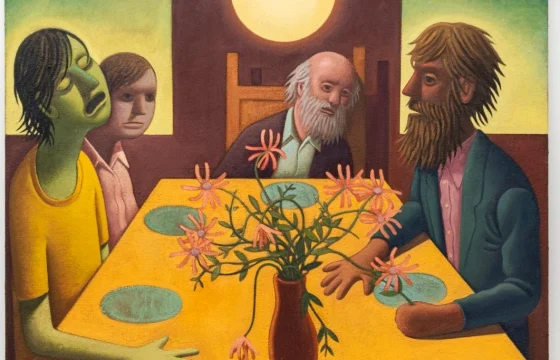
In the quiet, contemplative spaces of the HESSE FLATOW gallery, a new narrative of human experience has taken root. The gallery is currently hosting Franklin, a poignant and intellectually rigorous exhibition of paintings and works on paper by Nat Meade. Marking his third solo presentation with the institution, the exhibition serves as a profound meditation on the cycles of life, the weight of paternal legacy, and the potential for generational healing. Running through April 18, 2026, Franklin offers visitors an immersive look into an artist grappling with the fundamental mechanics of being a son, a father, and a witness to his own history.
The Foundations of the Exhibition: An Overview of Meade’s Archetypes
Nat Meade’s artistic practice has long been defined by its ability to translate the messy, idiosyncratic nature of daily life into universal, archetypal imagery. In Franklin, the artist moves away from portraiture in the traditional sense. His subjects are not specific individuals; rather, they are conduits for existential themes. By stripping his figures of hyper-specific markers, Meade creates an "allegorical distance" that allows the viewer to project their own experiences onto the canvases.
Whether depicting a solitary traveler seeking validation or the complex friction between generations, Meade’s work functions as a mirror. The exhibition invites viewers to inhabit a space that is simultaneously somber and absurd, humorous and devastating. By utilizing these tropes, Meade succeeds in exploring the complexities of human nature with an accessibility that belies the profound depth of his subject matter.
Chronology of the Artist’s Evolution: From Turbulence to Calm
To understand Franklin, one must look at the trajectory of Meade’s career. Historically, his figures have been defined by their struggle against external forces. In previous exhibitions, audiences were met with characters physically besieged by turbulent winds, crashing waves, and the unpredictable, often hostile, whims of nature. These works represented a man caught in the chaotic currents of adulthood and societal expectation.
However, Franklin represents a distinct stylistic and thematic pivot. While the "heaviness" of the past remains, the environment has shifted. The turbulent seas that once threatened his protagonists have calmed. We see figures standing in tranquil, shallow pools or navigating secluded coves. This shift from conflict with the environment to an internal negotiation with one’s own history marks a maturity in Meade’s work. The chronological progression of his output reveals a move from survival to introspection, suggesting that the artist has reached a stage in his life where he is finally ready to confront, rather than merely endure, his personal narrative.
Supporting Data and Thematic Analysis: The Paternal Influence
The thematic heart of Franklin is arguably the artist’s recent bereavement. Following the passing of his father, Meade found himself in a state of deep reflection—reevaluating his own role as a parent and the inheritance of behavioral patterns.
The Haunting of Legacy
Meade does not shy away from the darker aspects of human inheritance. Several works in the exhibition feature "ghostly specters"—ethereal forms that hover over the living, serving as visual metaphors for inherited trauma. In one striking visual, Meade employs a technique reminiscent of classic animation, where a soul appears to peel away from an expiring body. The ambiguity of the expression on this departing spirit—hovering somewhere between happiness and regret—forces the viewer to question the nature of the legacy we leave behind.
The Horror of the Domestic: Why "Franklin"?
The exhibition’s title, Franklin, is a deliberate and provocative nod to the 1974 horror classic The Texas Chainsaw Massacre. The film is renowned for its depiction of a deranged, patriarchal family unit—a dark mirror to the domestic ideal. Meade utilizes this reference to explore the "inner turmoil" of the patriarch. He posits that even in the most well-meaning father, there exist violent and antagonistic impulses that must be sublimated. Through his paintings, Meade effectively puts these impulses "in their place," creating a dialogue between the destructive power of a patriarch and the vulnerable reality of the child.
Official Context: Examining Specific Works
The exhibition provides a masterclass in visual storytelling, with several key pieces anchoring the narrative.
Poise: The Interchangeability of Life and Death
In the work titled Poise, the viewer is confronted with a pair of legs dangling from a cloud. The image is deceptively simple, yet it forces an existential inquiry: is this figure ascending into the heavens, or descending into the material world? By suggesting that birth and death are essentially interchangeable—two sides of the same metaphysical coin—Meade creates a sense of profound vulnerability.
The Weight of History: Prometheus and Nebuchadnezzar
Meade pulls heavily from literary and historical motifs to ground his figures in the burden of the past. A vulture picking away at a corpse serves as a modern-day reimagining of the myth of Prometheus, punished eternally by Zeus. Elsewhere, a figure on his hands and knees evokes William Blake’s Nebuchadnezzar, a king driven to madness by his own hubris and thirst for power. These references suggest that the "struggles" Meade references are not merely personal, but are historical constants of the human condition.
Implications: The Hope for Renewal
Perhaps the most significant takeaway from Franklin is the introduction of a younger, more hopeful generation. In stark contrast to the burdened adults in the gallery, the children in Meade’s paintings occupy a world of discovery and harmony.
One particularly resonant image depicts a young boy steering a boat with a radiant torch. He is unburdened, unclouded by the societal and familial pressures that weigh down his adult counterparts. In another, an adolescent explores a cove teeming with marine life, his actions guided by curiosity rather than survival. The most tender of these scenes shows the legs of a father and son in a shallow pool—the father is not "overtaking" or "struggling" with the child, but "tenderly guiding" him.
The Path to Healing
The implication of these works is clear: the path to reconciliation requires the acknowledgement of one’s "rocky history." Meade’s work argues that by confronting the trauma of the past—by recognizing the vultures and the specters—we can effectively release future generations from those same burdens.
The resilience displayed in Franklin is not the resilience of the stoic, but the resilience of the gardener—someone who clears the brush and tends the soil so that something new may grow. Despite the "insurmountable heaviness" of life’s cycles, Meade reminds us that progress is not only possible; it is inevitable if we choose to face our ghosts with honesty.
Conclusion: A Must-See Exhibition
Franklin at HESSE FLATOW is more than a mere display of artistic skill; it is an act of vulnerability. Nat Meade has curated a space where the private struggle of fatherhood and the public weight of history intersect. Through his mastery of paint and his keen eye for the archetypal, he has created an exhibition that feels both deeply intimate and broadly resonant.
As the gallery continues to host this collection through April 2026, it invites us all to pause and reflect on the specters that hover over our own lives. It asks us to consider what we have inherited, what we are currently carrying, and, most importantly, what we are leaving for the generations that follow. In the quietude of these paintings, there is a profound sense of hope—a quiet acknowledgement that while the tide may be heavy, we are the ones who determine the course of the boat.











No comments yet. Be the first to join the conversation!