Introduction: A Chromatic Investigation of Suspense
In the hushed, cavernous spaces of Harper’s gallery, a new exhibition has emerged that feels less like a traditional display of oil paintings and more like a sequence of frozen film-noir stills. Prussian Blue, the inaugural solo exhibition by New York-based artist Sophia Huitema, presents seven large-scale canvases that demand more than a passing glance. On view through April 25, 2026, the collection serves as a profound meditation on the intersection of aesthetic beauty and psychological toxicity. Through a restricted, atmospheric palette, Huitema invites the viewer into a world where elegance is a weapon and the gaze is a defensive maneuver.
Main Facts: The Anatomy of the Exhibition
Prussian Blue marks a significant milestone in Huitema’s burgeoning career. The exhibition features a cohesive series of seven oil paintings, each linked by the namesake pigment—a color historically rooted in both industrial chemistry and medical intervention.
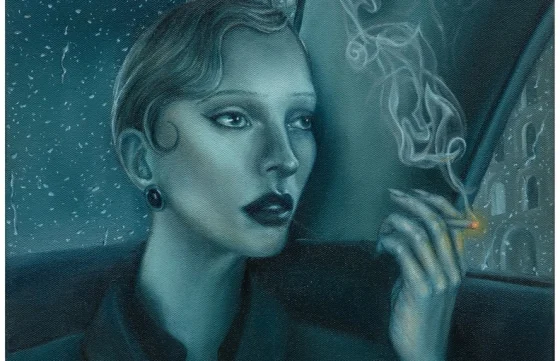
The paintings are characterized by their "moody" lighting and a strict color economy, focusing almost exclusively on deep, resonant blues and cool greens. This chromatic limitation functions as a visual anchor, pulling the viewer into dimly lit interiors that seem to exist outside of linear time. The figures within these works—elongated, sharp-featured, and perpetually watchful—occupy an aesthetic space that bridges the gap between early 20th-century fashion illustration and modern psychological thriller cinema.
Chronology: The Evolution of a Visual Language
To understand the gravity of Prussian Blue, one must examine the trajectory of Huitema’s practice. Operating outside the conventional constraints of formal academic training, Huitema has cultivated her distinct visual vocabulary through a process of rigorous, self-directed studio immersion.
- Early Development: Huitema’s initial forays into image-making focused on the tension between gesture and embellishment. Her early work began to favor the elongated, attenuated proportions that would eventually become her signature.
- Synthesis of Influences: Over several years, she began to bridge the gap between Art Deco design—specifically the streamlined finesse of illustrators like Erté—and the darker, more introspective leanings of Symbolist and Surrealist painting.
- The Current Body of Work: The paintings in Prussian Blue represent a culmination of these influences. They are not merely depictions of women in finery; they are deliberate reconstructions of "Gatsby-era" decadence, recontextualized through a lens of contemporary anxiety and theatrical suspense.
Supporting Data: The Chemistry of the Pigment
The title of the exhibition is not merely a descriptor of color; it is a conceptual framework. Prussian Blue, synthesized in the early 18th century, holds a unique place in the history of science. It is chemically linked to cyanide—a lethal toxin—yet it is simultaneously employed in medical contexts as an antidote for heavy metal poisoning.
This duality is the engine that drives the exhibition. Huitema uses the pigment as a metaphor for the figures she paints: women who are both the source of danger and the survivors of it. By utilizing a substance that is both poison and cure, she underscores the "emotionally guarded" nature of her subjects. The blue tones are not merely aesthetic choices; they are active participants in the narrative, creating a cool, detached environment where beauty is inextricably linked to menace.
Analyzing the Subjects: The Femme Fatale Reimagined
The centerpiece of the collection, Sleeper Car, serves as an ideal case study for Huitema’s thematic concerns. In this painting, a woman in a backless evening gown is captured in a moment of ambiguous potentiality. Her head is tilted, her gaze is sly, but her hand is braced in a posture that suggests she is ready to strike.
The Art of the Pose
Huitema’s figures are defined by their physicality. With slender, exaggerated necks and limbs that seem to stretch into the frame, they possess a predatory grace. They are adorned in the trappings of high society—pearls, jewels, and intricate headpieces—which serve to insulate them from the world while simultaneously marking them as targets.
The Cinematic Environment
The settings in Prussian Blue act as psychological realms. Eschewing architectural realism, Huitema creates "compressed spaces." A train car, a ballroom, or a dimly lit hallway becomes a stage where the internal state of the subject is projected onto the environment. As seen in Sleeper Car, where rain streaks across the window and the aisle recedes into an "uncertain depth," the environment is designed to heighten the viewer’s sense of unease. It is the visual equivalent of a Hitchcockian climax, where the tension is held in suspension, never quite resolving.
Theoretical Implications: Art History in Dialogue
Huitema’s work does not exist in a vacuum. She engages in a complex dialogue with the history of Western art, yet she avoids the trap of mere imitation. By synthesizing the theatricality of interwar stage design with the subconscious-driven, shallow depth of Surrealism, she creates a hybrid style that feels distinctly contemporary.
A Self-Directed Pedagogy
The fact that Huitema has developed this style outside the traditional academy is crucial to the work’s authenticity. Her "self-directed approach to image making" allows her to prioritize the internal logic of the painting over adherence to historical schools of thought. While critics may note the stylistic echoes of fashion illustration, Huitema’s primary concern remains the theatrical staging of human behavior.
The Gaze as a Defense Mechanism
A central implication of the exhibition is the subversion of the traditional "male gaze." While her figures are undoubtedly objects of aesthetic fascination, their posture and demeanor suggest they are keenly aware of being watched—and are actively deploying their own cunning to counteract that scrutiny. This creates a reflexive relationship between the painting and the viewer. We are not just observing these women; we are being evaluated by them.
Conclusion: The Persistence of Tension
As visitors traverse the gallery, the cumulative effect of the seven paintings is one of sustained psychological suspense. Prussian Blue stands as a testament to the power of the painted image to hold multiple, contradictory meanings simultaneously.
By grounding her work in the dual history of her primary pigment, Sophia Huitema has succeeded in creating a body of work that feels both ancient and alarmingly current. The exhibition does not provide answers to the riddles posed by her subjects; rather, it invites the viewer to linger in the tension, to appreciate the beauty of the trap, and to recognize the inherent vulnerability behind the armor of a well-dressed, calculating gaze.
For those interested in the evolution of contemporary figurative painting, the show at Harper’s is an essential visit. It is a rare example of an artist successfully synthesizing historical aesthetic traditions with a modern, psychological sensibility, resulting in an experience that is as intellectually stimulating as it is visually arresting. The exhibition remains on view through April 2026, offering ample time for a deep dive into the hazy, blue-tinged world of Huitema’s making.