

The landscape of professional graphic design has undergone a seismic shift by mid-2026. Once defined by the reliance on monolithic, resource-heavy desktop software, the industry has migrated toward a more fluid, agile, and accessible ecosystem: the browser-based AI platform. Today, graphic designers—from seasoned agency veterans to independent freelancers—are integrating artificial intelligence directly into their daily workflows, not as a replacement for human ingenuity, but as a sophisticated, high-speed digital assistant.
The Paradigm Shift: From Heavy Software to Browser Agility
In previous years, a professional design setup required significant hardware investment, constant software updates, and a steep learning curve. By 2026, that requirement has been largely dismantled. Browser-based AI tools now provide powerful capabilities—ranging from complex UI/UX wireframing to high-fidelity image synthesis—all within a standard web tab.

This transition is driven by three primary factors: Accessibility, Scalability, and Speed. Designers are no longer tethered to a single workstation. Whether working from a high-end studio desktop or a lightweight laptop in a co-working space, the browser acts as a universal bridge, allowing for seamless creative continuity.
Chronology: The Rapid Rise of Web-Native AI
The journey to the current state of browser-based design tools was not an overnight phenomenon but a steady progression of technological maturation:

- 2023–2024: The "Early Adoption Phase," where basic AI background removal and text-to-image generators began to surface as standalone browser experiments.
- 2025: The "Integration Year." Platforms began to move beyond single-function tools, offering suites of services that combined typography, layout, and image manipulation.
- 2026 (Present): The "Ecosystem Era." Major design repositories, such as Envato, have fully integrated AI assistants into their libraries, turning static asset platforms into active design environments.
Supporting Data: Why Designers Are Migrating
Data from industry analysts in 2026 reveals a compelling trend. A survey of over 5,000 design professionals indicates that 72% of respondents now utilize at least three browser-based AI tools in their weekly workflow. Key efficiency metrics cited include:
- Reduction in Prototyping Time: Designers using tools like Visily report a 40% decrease in the time required to move from a conceptual wireframe to a high-fidelity prototype.
- Lowered Overhead: Small agencies have reduced their software licensing costs by approximately 35% by replacing bloated, legacy suites with modular, subscription-based browser AI platforms.
- Hardware Independence: Creative professionals no longer require top-tier GPU-equipped machines to perform complex rendering tasks, as the heavy computation is offloaded to the cloud.
Detailed Review: Top 10 Browser AI Tools of 2026
To understand the current landscape, one must look at the specific tools shaping the industry.

1. Envato AI: The All-in-One Powerhouse
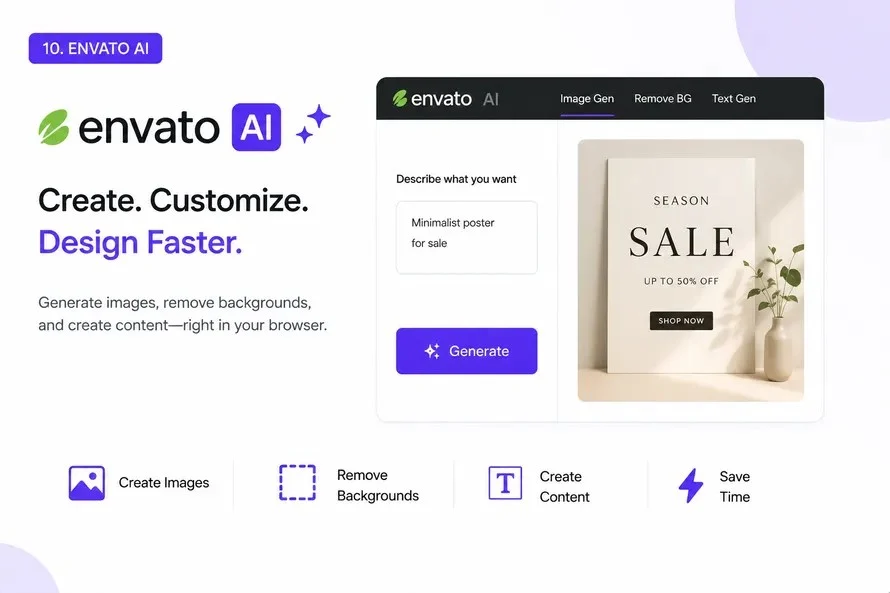
Envato AI represents the integration of generative power with the world’s largest creative asset library. By allowing users to generate custom assets and merge them with professional-grade templates, it eliminates the "context switching" that often plagues designers. It is the premier choice for social media managers and marketing teams who require speed without compromising on asset quality.
2. Visily: Revolutionizing UX Design
Visily has become the standard for rapid UI/UX development. Its ability to turn rough sketches into functional prototypes in seconds has made it indispensable for startups. By automating the mundane aspects of layout structure, it allows UX designers to focus on user journey logic rather than pixel-perfect alignment.

3. Flowstep: Mapping User Journeys
User experience is often lost in the technicality of design. Flowstep brings clarity to complex navigation structures. It is a visual mapping tool that helps teams visualize the user journey, ensuring that every click and transition serves a strategic purpose.
4. Looka: Branding at Scale
For small businesses, branding can be an expensive hurdle. Looka democratizes this process by acting as a brand architect. While it handles the initial generation of logo concepts and color palettes, it provides the essential foundation upon which human designers can build more complex, nuanced brand identities.

5. Fontjoy: The Typography Authority
Typography remains one of the most difficult skills for designers to master. Fontjoy uses neural networks to analyze font relationships, suggesting pairings that are aesthetically harmonious. It serves as a vital tool for preventing the common mistake of disjointed typeface usage in web and print design.
6. Cleanup.pictures: Precision Editing
Gone are the days of spending hours in Photoshop to remove a stray object from a photograph. Cleanup.pictures offers a surgically precise approach to image editing, allowing users to remove unwanted elements in seconds with minimal loss of detail.

7. Clipdrop: The Swiss Army Knife
Clipdrop provides a robust suite of tools including upscaling, relighting, and background removal. It is particularly popular among product photographers who need to prepare large volumes of imagery for e-commerce websites quickly.
8. Leonardo AI: Concept Art and Beyond
For digital artists and character designers, Leonardo AI is a playground of possibilities. It allows for the rapid iteration of visual concepts, game assets, and textures, significantly shortening the brainstorming phase of creative projects.

9. Playground AI: The Creator’s Sandbox
Playground AI excels in the balance between power and simplicity. It allows for advanced prompt engineering and image manipulation, making it a favorite for those who need high-quality visual output for content marketing and social media graphics.
10. Microsoft Designer: Accessible Professionalism
Microsoft has effectively brought professional design capabilities to the masses. By integrating AI into a familiar interface, it allows non-designers and creative professionals alike to produce high-quality, professional-looking presentations and marketing materials with ease.

Official Perspectives and Industry Implications
The rise of these tools has sparked a broader conversation within the design community regarding the future of the profession. Critics initially feared that AI would diminish the value of human creative input. However, the prevailing sentiment among industry leaders is that AI acts as an accelerator, not a replacement.
"The tool doesn’t know the brand’s heart," says a lead UX designer from a top-tier agency. "The AI can suggest a thousand layouts in the time it takes me to draw one, but I am the one who knows which one resonates with the human experience."

Implications for the Future
The move toward browser-based AI has profound implications for the labor market:
- Lower Barrier to Entry: The democratization of design tools allows for a more diverse range of creators to participate in the professional market.
- Focus on Strategy over Execution: As the "labor" of design becomes automated, the value of the designer will shift toward high-level strategy, creative direction, and empathetic design thinking.
- Collaborative Evolution: Future workflows will likely see AI acting as a real-time collaborator, where the designer and the machine iterate together in a live, cloud-based environment.
Conclusion: The New Standard of Work
In 2026, the question is no longer whether to use AI, but how to use it effectively. Browser-based tools have transformed the graphic design process from a siloed, software-dependent endeavor into a decentralized, high-speed creative flow. By embracing these platforms, designers are not just keeping pace with technology—they are leveraging it to expand the boundaries of their own creativity. As these tools continue to evolve, one thing remains certain: the fusion of human intuition and artificial intelligence is the new bedrock of the creative industry.










No comments yet. Be the first to join the conversation!