

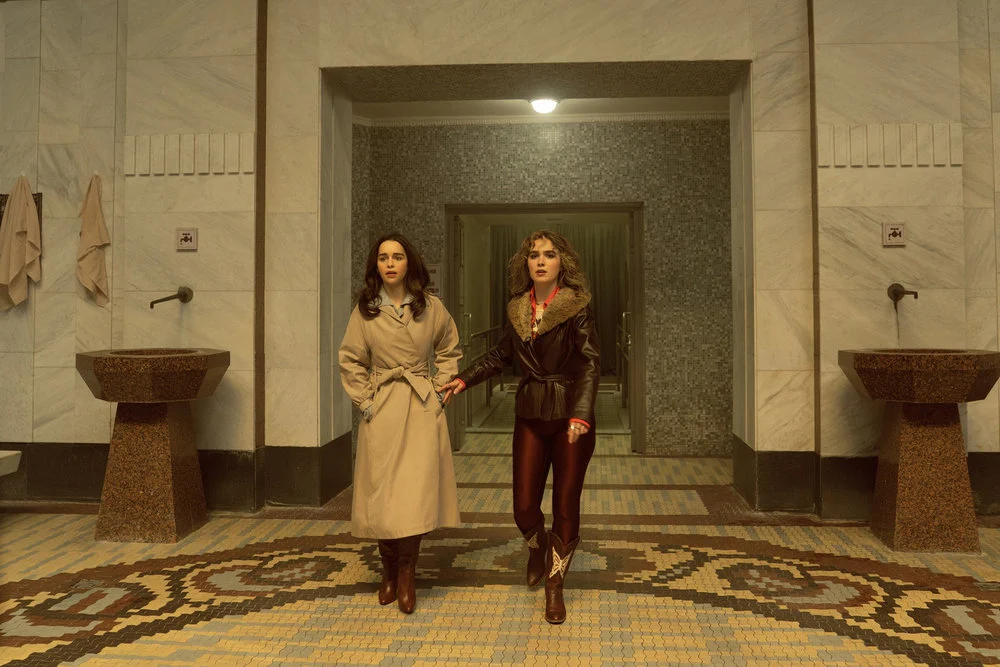
A seasoned secret agent survives by mastering their environment: identifying every entrance and exit, spotting the subtle shift in a false wall, and calculating the precise angle of an enemy’s gaze. For the creative team behind Peacock’s breakout spy thriller Ponies, this same heightened awareness was the guiding principle for crafting the series’ aesthetic. By blending sharp, modern comedy with the high-stakes tension of 1970s Moscow, the show has carved out a unique space in a saturated genre.
In a recent panel discussion hosted as part of the "USG University" series—a collaborative initiative between IndieWire and Universal Studio Group—the architects of Ponies pulled back the curtain on how they balanced historical grounding with stylistic innovation. The panel featured co-creator and showrunner David Iserson, co-creator and director Susanna Fogel, production designer Sara K White, and lead stars Emilia Clarke and Haley Lu Richardson, the latter of whom is currently garnering significant awards buzz for her performance, including a 2026 Gotham TV Award nomination.
Main Facts: A Genre-Bending Operation
Ponies does not follow the tired tropes of the Cold War era. While the show is firmly rooted in the geopolitical friction of 1970s Moscow, the narrative voice is distinctly contemporary. David Iserson and his writing team have constructed a world that feels both authentic to the period and refreshed by a sharp, comedic sensibility.
The core of the series lies in the chemistry between its two leads: Emilia Clarke and Haley Lu Richardson, who portray CIA operatives Bea and Twila. These characters are not merely cogs in a geopolitical machine; they are fully realized, complex individuals tasked with navigating a world of paranoia, dead drops, and deep-cover deception. The show’s brilliance, according to the panel, lies in its refusal to be defined by the "gray and gritty" aesthetic often associated with the era. Instead, Ponies injects color, kinetic energy, and wit into the spy thriller, proving that the genre can evolve without losing its sense of danger.
The Chronology of Creation: From Script to Screen
The development of Ponies was a deliberate, multi-layered process. It began with the foundational writing of Iserson, who sought to capture the duality of the spy lifestyle—the mundane waiting games punctuated by sudden, violent shifts in momentum.
Once the scripts were solidified, directors Susanna Fogel, Viet Nguyen, and Ally Pankiw were brought on board to translate the page to the screen. Their approach was unconventional for a period piece. Rather than settling for traditional, static cinematography, they leaned into playful techniques like stylized zooms and split-screens. However, the directors were careful never to let these stylistic flourishes overshadow the narrative.
"Our philosophy was always to let the character’s emotional state dictate the visual language," Fogel explained during the panel. "If a character feels fragmented, the frame should feel fragmented. If they are hyper-aware, the camera should be searching."

This phase was followed by the intensive work of production designer Sara K White. Tasked with recreating 1970s Moscow, White found a creative solution in the architecture of Budapest. By utilizing the city’s historic, decaying, and monumental buildings, the team was able to provide a tactile reality that CGI could never replicate.
Supporting Data: Architecture as a Character
The production design of Ponies serves as far more than mere window dressing. Sara K White’s work was described by the cast as "next level," providing a tangible landscape that allowed the actors to fully inhabit their roles.
White revealed a fascinating detail about the production process: her team was often "running ahead of the wrecking ball." They deliberately scouted locations in Budapest that were scheduled for demolition, capturing a sense of genuine decay and transition that mirrored the instability of the Cold War. By filming in spaces on the verge of disappearing, the show gained an atmospheric weight that felt inherently authentic.
This level of detail provided the actors with a massive advantage. For Emilia Clarke, the transition from the script to the set was a transformative experience. "You do the work at home," Clarke noted. "You’ve gone through the lines, you’ve thought about the character, but you’re still filling in the blanks. Then you walk onto the set, and it’s all there. The atmosphere is built for you. You don’t have to imagine the tension; the room is vibrating with it."
Haley Lu Richardson, who plays the sharp-witted Twila, echoed this sentiment, highlighting the contrast between the grueling audition process and the immersive nature of a high-end production. "Auditioning is the hardest part of this job because you have to invent everything in your head," Richardson said. "When you walk onto a set that is so accurate, so tactile, and so clearly designed with intent, you aren’t acting anymore—you’re reacting. It makes the work not just easier, but infinitely more fun."
Official Responses: The Philosophy of the "Pony"
The title Ponies itself speaks to the show’s underlying philosophy: the idea that every secret agent is merely a "pony" in a larger, often inscrutable race. The showrunners emphasized that they wanted to explore the human cost of being a tool for government agencies.
"We wanted to look at the people behind the dossier," David Iserson said. "The spy genre is often about the ‘what’—the mission, the file, the code. We were interested in the ‘who.’ Who are these women, and what does it do to their psyche to have to constantly reinvent themselves in a city that is actively trying to hunt them down?"

Susanna Fogel added that the collaboration between the directing team and the production department was crucial to maintaining the show’s balance. "The comedy doesn’t come from the situation being funny," she clarified. "It comes from the characters’ reactions to the absurd and dangerous situations they find themselves in. If the world didn’t feel real, the comedy wouldn’t work. It would just feel like a parody. Because the sets and the performances feel so anchored in reality, the humor becomes a relief valve for the audience."
Implications: The Future of the Spy Genre
The success of Ponies on Peacock suggests a shift in how audiences consume espionage stories. By moving away from the stoic, humorless archetypes of the past, the show demonstrates that high-stakes narratives can successfully integrate character-driven comedy without diluting the suspense.
The critical acclaim surrounding the series, evidenced by awards recognition for its ensemble, indicates that the industry is responding favorably to this "grounded-yet-stylized" approach. For Universal Television, Ponies represents a successful fusion of artistry and commercial viability. The series has set a new benchmark for how period pieces can be modernized through intentional production design and a willingness to break traditional visual rules.
As the series continues to find its audience, the lessons learned by the team—the importance of tactile environments, the value of character-first directing, and the courage to blend genres—will likely influence future productions in the spy thriller space.
For now, Ponies remains a masterclass in tension and tone. It reminds viewers that the best stories are not just about the secrets kept behind iron curtains, but about the people brave—or foolish—enough to try and expose them.
Ponies is produced by Universal Television, a division of Universal Studio Group, and is currently streaming exclusively on Peacock. This article was produced in partnership with USG University, a program celebrating the artistry behind the 2025–2026 television season, presented in association with the Motion Picture & Television Fund.









No comments yet. Be the first to join the conversation!