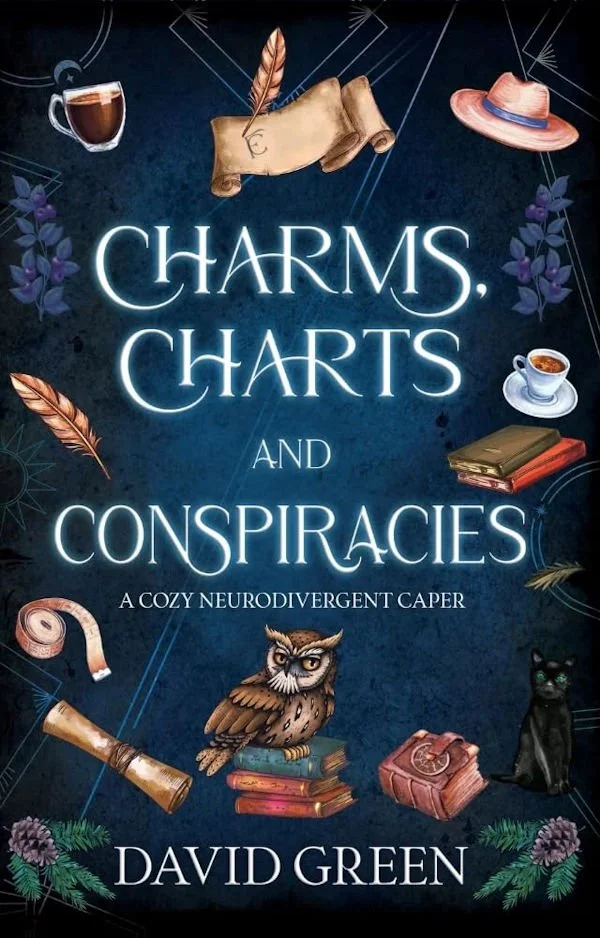
The world of cozy fantasy has found its new champion in the city of Barrow’s Hill. Following the resounding success of Magic, Maps, and Mischief, author Green returns to this idyllic, magical setting with the highly anticipated sequel, Charms, Charts, and Conspiracies. Scheduled for a worldwide release on July 7th, this novel promises to deepen the emotional landscape of its predecessor while introducing a high-stakes mystery that tests the resilience of its neurodivergent protagonist, Greton of Willow.
For readers who have been yearning for a story that balances the "cozy" aesthetic with genuine, high-stakes character development, this installment serves as a masterclass in the genre.
Main Facts: The Return to Barrow’s Hill
Charms, Charts, and Conspiracies centers once again on Greton, an elderly, autistic mapmaker whose life in Barrow’s Hill is defined by his meticulous craft, his beloved owl, and his carefully constructed found family. However, the equilibrium of his peaceful existence is shattered by the arrival of a competitor—a new mapmaker whose presence threatens not only Greton’s livelihood but his internal sense of worth.
As Greton attempts to navigate the social minefield of extravagant dinner parties and the complex, often baffling world of high-society fashion, he discovers a darker undercurrent running beneath the city. The Cartographers’ Guild, now backed by mysterious new investors, has begun to exert influence that feels both predatory and exclusionary. Simultaneously, strange magical phenomena are manifesting in forbidden locations, and ancient ruins beneath the hill have been declared off-limits to "undesirables"—a category that, conveniently, includes Greton himself.
The narrative functions as both a gripping whodunit and a tender character study. As the walls close in, Greton must confront the terrifying possibility that he is being framed for the very conspiracies he is trying to uncover.
Chronology of a Cozy Conflict
The trajectory of the novel marks a significant shift from the darker, more uncertain tone of the series opener. Where the first book utilized shadows to eventually reach a state of comfort, Charms, Charts, and Conspiracies begins in a place of warmth, only to have that warmth tested by external pressures.
- The Incursion: The arrival of a rival mapmaker triggers Greton’s deep-seated anxieties. Rather than reacting with traditional literary jealousy, Greton experiences a personal crisis of belonging. He begins to question his own replaceability.
- The Escalation: Mysterious magical activity begins to permeate the city. Greton notices mages in places they have no business being, signaling a shift in the city’s power dynamics.
- The Accusation: As the mystery deepens, Greton finds himself at the center of a web of suspicion. The realization that he is being framed—and the subsequent internal battle where he begins to suspect his own innocence—serves as the narrative’s most poignant moment.
- The Resolution: Through the support of his found family, Greton discovers that his value is not transactional. The story culminates in a hard-won understanding of self-worth and community.
Supporting Data: Why This Book Resonates
The critical reception of the ARC (Advance Reader Copy) suggests that Green has achieved a rare feat: creating a sequel that surpasses the original in emotional depth and thematic maturity.
Authentic Neurodivergent Representation
The portrayal of Greton’s autism is widely lauded as some of the most authentic writing in modern fantasy. Rather than relying on tropes, the prose delves into the sensory realities of his life. Scenes describing sensory overload—where his thoughts "raged like a blizzard in the Northern Wastes"—provide the reader with a visceral understanding of his internal state.
Crucially, the book challenges the myth that autistic individuals are "unemotional." Instead, it illustrates a life of high emotional sensitivity that has been historically suppressed by societal expectations. The physical manifestations of his anxiety—the "itching" suit, the cramped toes, the scratching pitch of laughter—serve as a grounded anchor for the magical plot.
The Dynamics of Found Family
The relationship between Aria and Petra serves as a benchmark for healthy, mature character dynamics in fiction. Their ability to apologize without unnecessary melodrama and their unconditional support for one another creates a "safe" space within the narrative. This is not a book about confrontation; it is a book about the labor of love and the work required to understand one another better.
Official Responses and Narrative Insight
Advance readers have noted that the book’s greatest strength is its refusal to treat its characters as static props. As the narrator notes, "Even Greton was beginning to suspect himself, and he’d been with himself the entire time." This line highlights the psychological stakes: the danger is not just that Greton might be imprisoned, but that he might lose his own sense of self.
The book also makes a significant stride in LGBTQIA+ representation. The inclusion of an asexual thread is handled with remarkable grace, moving beyond labels to explore the history of Greton’s heart. It validates the idea that one can have loved in their own way, and that such a love is enough.
Implications for the Cozy Fantasy Genre
The release of Charms, Charts, and Conspiracies is set to have a ripple effect on the cozy fantasy subgenre. Here is what this implies for the industry:
1. The Elevation of Stakes
The novel proves that "cozy" does not have to mean "low stakes." By making the mystery deeply personal to the protagonist’s identity, the author keeps the reader engaged without resorting to gratuitous violence or grimdark aesthetics. This suggests a future for the genre where emotional growth is treated as a major plot point rather than a side effect.
2. A Shift in Representation
By weaving neurodivergent and asexual experiences into the core of the story rather than using them as "signposts," the novel sets a higher standard for inclusivity. It demonstrates that readers are looking for stories where their own identities are treated with "matter-of-fact" respect rather than exoticized or tokenized.
3. The "Found Family" Archetype
The prominence of characters like Atlas the owl and Jasmine the cat suggests that the "cozy" aesthetic relies heavily on the integration of companions. These are not merely decorative elements; they are active participants in the characters’ lives, providing grounding and comfort in a world that is becoming increasingly volatile.
Final Verdict
Charms, Charts, and Conspiracies is a profound meditation on whether we deserve the love we are given. It explores the idea that human relationships are not a ledger of debts to be paid, but a community of mutual, unreciprocated care.
As Greton comes to realize by the end of the journey: "Helping those you loved is what people did." This sentiment is the beating heart of the novel. For those who have been looking for a book that acts as a warm embrace while simultaneously challenging the reader to think deeply about their own place in the world, this is the definitive read of the summer.
Charms, Charts, and Conspiracies is slated for release on July 7th. Pre-orders are currently available for those eager to return to the charming, map-filled halls of Barrow’s Hill. With plenty of tea and even more heart, this is a sequel that, quite simply, does not miss.