Asep Darmawan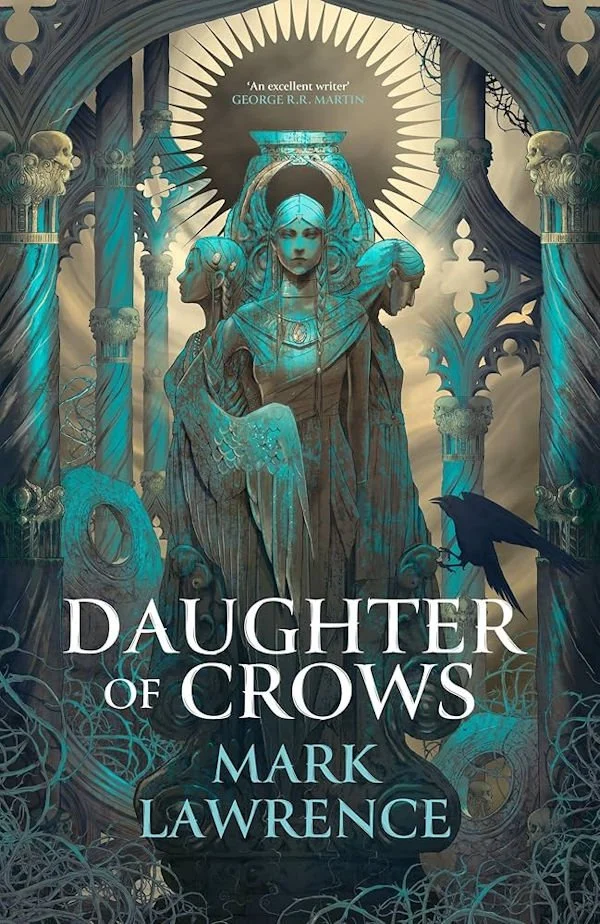
In the landscape of modern grimdark fantasy, few authors possess the surgical precision of Mark Lawrence. Known for his unflinching exploration of morality and violence, Lawrence returns with Daughter of Crows, the explosive first installment of a new trilogy. The novel serves as both a visceral exploration of trauma and a structural masterclass, challenging the genre’s tropes by centering its narrative on a protagonist who has already weathered the worst life has to offer.
The Academy of Kindness: A Legacy of Retribution
The heart of the novel lies in the "Academy of Kindness," an institution whose name serves as a chilling oxymoron. In this world, the Academy exists to manufacture agents of divine retribution, modeled after the Furies—the "Kindly Ones"—whose wrath is feared even by the gods.
Each year, one hundred girls are surrendered to the Academy’s gates. A decade later, only three emerge. These survivors are not merely graduates; they are living weapons, forged in the "Wound Garden" and conditioned amid the necrotic fumes of the "Bone Garden." They leave the Academy as avatars of vengeance, bound by the oldest, most uncompromising laws of the land.
Chronology of a Life Forged in Blood
Daughter of Crows operates on a non-linear timeline, masterfully weaving together three distinct eras of the protagonist’s life.
The Present: The Twilight of a Killer
We are introduced to Rue not as a wide-eyed initiate, but as an elderly, bitter, and weary woman. Having long ago abandoned her violent past, she seeks a quiet existence. However, when war arrives at her doorstep and her village is massacred, the mask of the peaceful old woman slips. Readers are immediately confronted with the reality that, despite her aging body, Rue remains a lethal force. Lawrence uses this to explore the physical limitations of aging against the unwavering sharpness of a trained, tactical mind.
The Middle Years: The Indoctrination of Mollandra
The narrative’s most gripping thread returns to Rue’s formative years, then known as Mollandra. This section chronicles her decade-long struggle for survival within the Academy. It is a raw, unrelenting depiction of institutional abuse where the only currency is violence and the only path forward is the formation of precarious, often tragic alliances. Here, Lawrence’s prose is at its most blunt and eloquent, elevating standard genre violence into a meditation on the cost of becoming a weapon.
The Foundational Trauma: The Eldest
The final narrative thread, and perhaps the most psychologically harrowing, centers on Rue’s early life in a twisted, supernatural household. As the "Eldest," she is charged with the protection of other children who are prisoners of parents who blur the line between human and abomination. This segment provides the emotional bedrock of the series, explaining the origins of Rue’s protective instincts and the tragic series of betrayals that ultimately led to her sale to the Academy.
Supporting Themes: Memory and Identity
At its core, Daughter of Crows is an interrogation of the self. Lawrence posits that our identities are not fixed, but are instead a mosaic of the memories we choose to preserve and the ones we desperately try to suppress.
The novel asks a profound question: Can a person ever truly escape their history? For Rue, the past is an inescapable gravity. The narrative structure—moving between her childhood as the Eldest, her training as Mollandra, and her current status as a survivor—highlights how individual experiences harden into character traits. Lawrence argues that our pasts are the architects of our futures, even when we fight tooth and nail to build something entirely new.
Perspectives from the Author: A Conversation with Mark Lawrence
Following the book’s release, Mark Lawrence shared insights into the creative engine driving this new trilogy. When asked about the decision to cast an older woman as the lead, Lawrence noted the shift from the traditional "coming-of-age" fantasy trope.
"The idea to show her old came from forums and social media where the desire to see older female main characters is frequently voiced," Lawrence stated. "I was either meeting that desire or calling their bluff."
Regarding the multi-timeline structure, Lawrence admitted that his process is largely intuitive. "I don’t plan my books. They just happen as I write them," he explained. "Here, I span many decades. Memory and identity are inextricably woven together, and the process of aging builds us as it goes. We can only remember a tiny fraction of our life."
Lawrence also addressed the moral ambiguity of his characters, which has become a hallmark of his career. When asked why readers should invest in someone as morally compromised as Rue, he kept his answer grounded: "They just have to be interesting. That can be as simple as being entertaining—a sense of humor, outrageous behavior, a dedicated focus on murder… anything like that can be simple fun."
Implications for the Genre
Daughter of Crows signals a departure from the "chosen one" narrative, favoring instead a "hardened survivor" archetype. By focusing on the physical and psychological toll of a lifetime of violence, Lawrence introduces a grounded, gritty realism that many fantasy readers have been craving.
The book’s pacing is particularly noteworthy. Despite the complexity of jumping between three distinct eras, the narrative avoids the "jarring" fatigue often associated with multiple-perspective novels. Instead, the lulls in action are used to build thematic resonance, while the accelerations toward the climax are expertly handled, leaving the reader with a palpable sense of anticipation for the sequels.
A Brutal, Yet Necessary, Read
The success of Daughter of Crows lies in its ability to balance profound darkness with moments of genuine human connection. Amid the systemic cruelty of the Academy and the horror of her early childhood, Rue finds fleeting instances of friendship and companionship. These bonds are not merely plot devices; they are the light that prevents the story from becoming an exercise in nihilism.
As the book concludes, it leaves the reader with a haunting reflection on the nature of choice. While we cannot choose the circumstances of our upbringing or the tragedies that befall us, we are defined by how we navigate the aftermath.
Lawrence’s latest work is an invitation to look into the abyss of human behavior, not to recoil, but to understand. It is a work of "grimdark fantasy with a pulse"—intimate, emotionally ruthless, and undeniably necessary. As for the inevitable wait for the second installment, readers will likely find themselves echoing the sentiment of critics everywhere: it is a high price to pay for such a masterfully told tale, but one that is well worth the cost.
Final Thoughts
Daughter of Crows is not for the faint of heart. It is a book that demands much of its reader, requiring them to hold space for both the monster and the survivor within the same person. By the time the final page is turned, one thing is certain: Rue is a character who will haunt the literary landscape for years to come. Whether the reader is a long-time fan of Lawrence’s work or a newcomer to the grimdark genre, Daughter of Crows offers a masterclass in character development, world-building, and the endurance of the human spirit in the face of absolute despair.


 Raul Delapena Setiawan
 Nila Kartika Wati