Muslim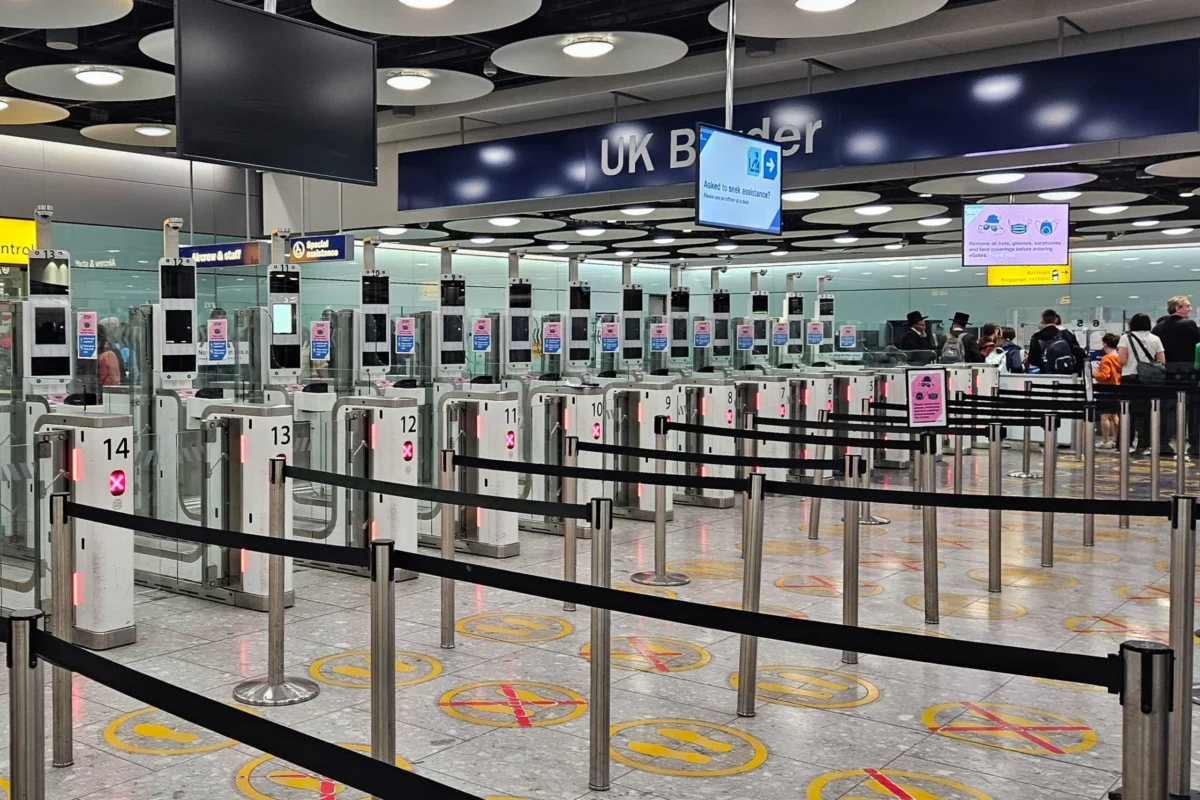
The internet has become increasingly obsessed with age verification. From social media bans in Australia to stringent porn-access restrictions across half of the United States, proving one’s age to gain access to digital spaces has transformed from a rare necessity into an everyday administrative hurdle. However, this gatekeeping technology is now migrating from the screen to the physical border.
Starting in 2027, the British government intends to implement "Facial Age Estimation" (FAE) at its borders. This technology, which uses artificial intelligence to scan a person’s face and predict their chronological age, is intended to help officials determine whether unaccompanied minors seeking asylum are truly children or adults masking their age to gain easier entry. This deployment marks a historic and controversial milestone: the first time such technology is being used as a high-stakes tool in migration enforcement.
The consequences are profound. If a child is misclassified as an adult by an algorithm, they face immediate risks, including the loss of critical legal protections and potential placement in adult-only detention centers. An investigation by WIRED, Lighthouse Reports, and The Independent has uncovered evidence that these systems are not only error-prone but suffer from systemic racial and gender biases that threaten to disproportionately harm the most vulnerable.
The Mechanics of Estimation: How FAE Works
Facial age estimation operates by feeding a photo into a neural network trained on millions of age-labeled images. The AI identifies structural markers—bone development, skin texture, and facial proportions—to generate an estimate. While proponents argue that in controlled laboratory settings, the best algorithms can predict age within a margin of 2.5 years, the real-world application at a chaotic, high-stress border is a vastly different proposition.
The Home Office describes the technology as an "additional tool" meant to support border officers rather than replace human judgment. However, critics argue that once such tools are introduced, they often become the default benchmark. Despite the government’s insistence that individuals will be treated as children in cases of uncertainty, the integration of black-box AI into human rights decisions has triggered alarm among civil society groups and scientific experts alike.
A Chronology of the Policy Pivot
The move toward AI-driven border control follows a multi-year effort by the UK to modernize—and tighten—its immigration infrastructure.
- 2010–2023: For over a decade, age assessments relied on subjective human evaluation, including interviews and "general demeanor" assessments. Critics and independent inspectors have frequently cited poor record-keeping and a lack of formal training as systemic issues within this process.
- July 2025: The Home Office officially announces plans to integrate FAE as a support mechanism for border staff.
- Late 2025: A secret internal report, later leaked to investigators, reveals the results of testing seven different algorithms against 2.5 million images. The report highlights "substantial deviations" in accuracy across different demographics.
- May 2026: The Home Office signs a contract worth over $400,000 with the German firm Cognitec to supply face-scanning technology.
- 2027 (Projected): The official rollout of the technology for frontline border use.
Throughout this timeline, the Home Office has maintained a consistent narrative: that the technology is necessary to "crack down on fake claims" and stop adults from "gaming the system." Yet, the dissolution of a specialized scientific committee—designed to provide independent oversight on age estimation methods—suggests a government intent on bypassing academic scrutiny.
The Evidence of Bias: Data and Disparity
The most damning evidence against the widespread deployment of FAE lies in the Home Office’s own leaked internal documentation. The report evaluated seven algorithms and found that performance dropped significantly when analyzing Sub-Saharan African populations.
For female asylum seekers from this region, the AI’s error rate was staggering: the system was off by an average of 4.6 years. This means a 13-year-old girl could, through a simple algorithmic error, be deemed an 18-year-old woman. Furthermore, the technology performed worse on "in-the-wild" photos taken at arrival points compared to high-quality, controlled passport photos.
The National Institute of Standards and Technology (NIST) has confirmed similar findings. Their data shows that the accuracy of age estimation is highly dependent on race and lighting conditions. For instance, in comparative testing, 16-year-olds from West Africa were far more likely to be classified as 18 or older than their counterparts from Eastern Europe. When the quality of the image is poor—common in the aftermath of a dangerous boat crossing—these errors compound, creating a "digital bias" that is difficult to challenge or appeal.
Official Responses and the "Human-in-the-Loop" Defense
In response to these findings, a Home Office spokesperson emphasized that the technology will not "replace or overrule human judgment." They defended the decision to disband the advisory committee, stating that the project required "different fields of expertise." Regarding the identified biases, the government noted that they have commissioned the National Physical Laboratory to conduct an independent review.
Cognitec, the software provider, acknowledged that demographic differences in performance exist but argued that their technology is competitive. "The reasons for bias are extremely complex and often related to image quality issues," a company spokesperson stated, adding that they are "diligently and continuously working on reducing bias" through more diverse training data.
However, these explanations provide little comfort to human rights advocates. Martha Dark, co-executive director of the rights group Foxglove, argues that the very nature of the task is unethical. "Children seeking asylum have often suffered unimaginable trauma," Dark said. "They should not be the test subjects for experimental tech that has baked-in inaccuracy and racist bias."
Implications: The Normalization of Surveillance
The implications of this policy extend far beyond the specific case of the UK border. By deploying AI to make life-altering decisions about migration, the government is setting a precedent that prioritizes technical expediency over human rights.
1. The Dehumanization of Asylum Seekers
Critics fear that the use of FAE will lead to the "dehumanization" of migrants. If an algorithm becomes the primary tool for verifying a child’s identity, the nuanced, empathetic, and holistic approach required for handling traumatized minors may be discarded in favor of a cold, binary "adult vs. child" classification.
2. The Risk of Entrenchment
Anna Bacciarelli of Human Rights Watch warns that once this technology is normalized, it becomes difficult to remove. "There’s a real risk that this will become entrenched," Bacciarelli noted. "There’s so much risk in every component of this system that it’s really just not worth pursuing to be able to say that you’re using AI to tackle migration."
3. The "Black Box" Problem
Because the internal report did not name the specific algorithms, and because the government has been opaque regarding how these systems will be used in "operational contexts," it is almost impossible for an asylum seeker to challenge a decision. If a child is told they are an adult because of an algorithm, they have no clear mechanism to contest the "math" behind the decision.
4. Global Context
This move comes as governments worldwide—including the second Trump administration in the US—are increasingly adopting aggressive, tech-heavy anti-migrant policies. The UK’s experiment serves as a bellwether for a global trend where billions of dollars are poured into surveillance technologies that are often deployed against the world’s most vulnerable populations.
Conclusion
The push to implement facial age estimation at the UK border is a collision between the ambition of government-led surveillance and the reality of algorithmic fallibility. While the Home Office seeks to streamline its processes and reduce the number of fraudulent claims, the data suggests that in doing so, they are building a system that is fundamentally biased against the very children they are legally obligated to protect.
As the 2027 rollout approaches, the central question remains: Is the efficiency of an algorithm worth the cost of a child’s safety? For now, the government appears determined to proceed, leaving lawyers, human rights organizations, and the migrants themselves to contend with a future where their age—and their legal rights—are decided by a machine that cannot truly "see" them.


 Neng Nana
 Rifan Muazin