For power users, content creators, and competitive gamers, the quest for "more screen real estate" is a permanent state of mind. Whether you are managing complex spreadsheets, editing high-resolution video, or seeking an unparalleled level of immersion in a simulation title, there is always a desire for one more window, one more tool palette, or a wider field of view.
For years, the industry-standard solution for this insatiable appetite for space has been the dual-monitor setup—usually two 27-inch QHD displays placed side-by-side. While effective, this configuration comes with an inescapable physical drawback: the "bezel gap." No matter how thin the frames are, that vertical line down the center of your field of vision is a constant reminder of the hardware compromise. Enter the Deco Gear DG49OLED240, a 49-inch, 32:9 ultra-wide masterpiece that promises to eliminate the divider once and for all.
Main Facts: The 49-Inch Revolution
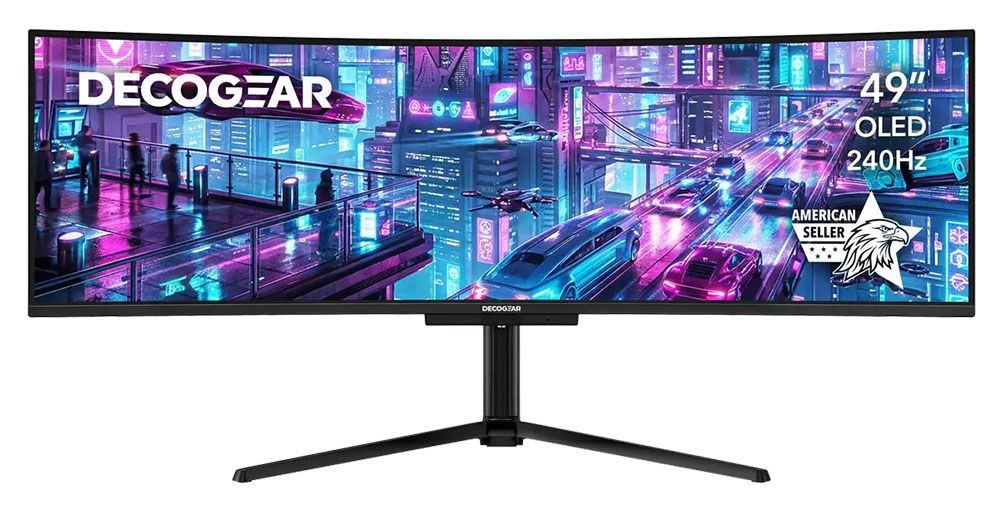
The Deco Gear DG49OLED240 is not just a monitor; it is a total workspace overhaul. By utilizing a 49-inch, 32:9 aspect ratio panel, this display perfectly mirrors the screen real estate of two 27-inch 16:9 QHD monitors, but without the frame interference.
At a price point of approximately $1,230, the DG49OLED240 positions itself as a premium, high-performance solution. Under the hood, it features a cutting-edge Quantum Dot OLED (QD-OLED) panel. This technology is the current gold standard for display enthusiasts, offering perfect blacks, infinite contrast, and vibrant color reproduction. With a 240 Hz refresh rate and a lightning-fast 0.03ms response time, it is engineered for gamers who refuse to settle for motion blur or input lag.
Key Technical Specifications:
- Panel Technology: Quantum Dot OLED (QD-OLED)
- Resolution: 5120 x 1440 (Dual QHD)
- Refresh Rate: 240 Hz
- Response Time: 0.03ms (GtG)
- Color Gamut: 112% DCI-P3 coverage
- HDR Support: HDR10, DisplayHDR 400
- Connectivity: 2x DisplayPort 1.4, 1x HDMI 2.1, 1x USB-C (90W Power Delivery)
Chronology: The Evolution of Ultra-Wide Displays
The trajectory of monitor development has moved rapidly from the standard 4:3 aspect ratio to the 16:9 widescreen, and now, into the era of the "Super Ultrawide."
In the early stages of display technology, multi-monitor setups were the only way to achieve high-resolution productivity. However, as GPU power grew and bezel technology struggled to reach true "frameless" status, manufacturers began looking toward monolithic ultra-wide panels. The Deco Gear DG49OLED240 represents the culmination of this trend.
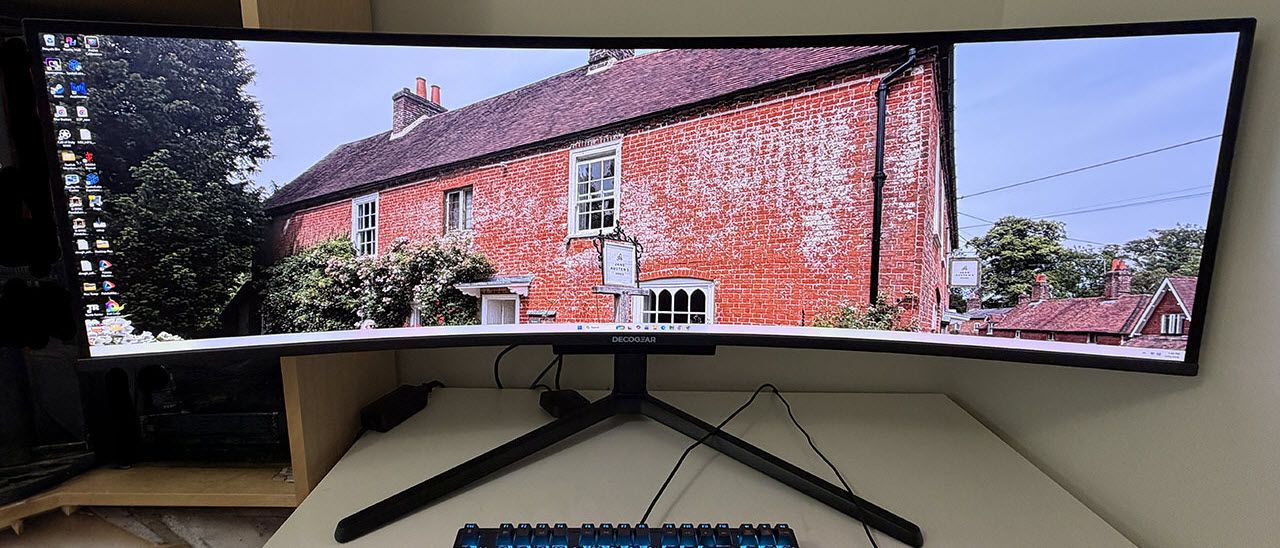
In our testing, we found that the transition to this 32:9 format is not merely a change in hardware—it is a shift in workflow. Unlike previous generations of ultra-wide monitors that suffered from poor contrast or slow refresh rates, the arrival of QD-OLED has enabled manufacturers like Deco Gear to bridge the gap between productivity powerhouse and gaming nirvana.
Supporting Data: Performance Under the Microscope
Testing the DG49OLED240 revealed that its appeal isn’t just cosmetic. We subjected the unit to rigorous color, brightness, and input-lag testing.
Color Accuracy and Brightness
With 112% coverage of the DCI-P3 color space, the monitor offers a level of color saturation that is truly immersive. Out-of-the-box performance was impressive, though enthusiasts will appreciate the inclusion of RGB sliders for precise grayscale tracking. In our testing, the monitor measured well before calibration and achieved professional-grade accuracy after minor adjustments.
Brightness levels were consistent with other high-end OLED panels. We measured around 430 nits for SDR and HDR content using a 25% window pattern, while full-field white brightness hovered around 360 nits. This provides a punchy, vibrant image that performs excellently in ambient-lit rooms while retaining the deep, inky blacks that only OLED can provide.
Motion and Input Lag
For competitive gamers, the 240 Hz refresh rate is a massive upgrade over standard 60 Hz or 144 Hz displays. When paired with the 0.03ms response time, the "blur-free" operation is noticeable. In our testing, the DG49OLED240 displayed lower input lag than other 49-inch panels in our database, making it a legitimate choice for high-stakes shooters and fast-paced simulation games.
Official Responses and Brand Context
One common question among prospective buyers is the pedigree of the "Deco Gear" brand. Deco Gear is a subsidiary of Beach Camera, a well-established name in the electronics industry with a long history of serving the tech community. This background provides a level of assurance regarding support and hardware reliability that generic budget brands often lack. The DG49OLED240 is currently available through their direct channels and physical retail locations, offering a transparent path for consumer support.
Implications: How It Changes Your Workspace
Adopting a 49-inch, 32:9 display requires a shift in how you interact with your digital environment.
The Productivity Workflow
For professionals, the benefit is undeniable. In software like Adobe Photoshop, the center of the screen can be dedicated to the primary image, while the extreme left and right portions of the display house toolbars, layers, and project folders. For spreadsheet power users, the width allows for dozens of columns to be viewed simultaneously, effectively eliminating the need to scroll horizontally. However, it is worth noting that for word processing, the vertical height remains equivalent to a 27-inch monitor; those who prefer massive vertical document viewing might find the extra width less transformative for simple text editing.
The Gaming Experience
The gaming experience is, in a word, "addictive." The 1800mm curve radius wraps the display around your field of vision, creating a VR-like sense of presence. During our testing with Doom Eternal on an NVIDIA GeForce RTX 4090, the monitor maintained a consistent 240 fps, providing an incredibly fluid experience. The inclusion of an integrated audio system—two 5W speakers paired with a 10W woofer—adds a surprising amount of depth, providing a capable audio alternative to standard desktop speakers.
The OSD Frustration
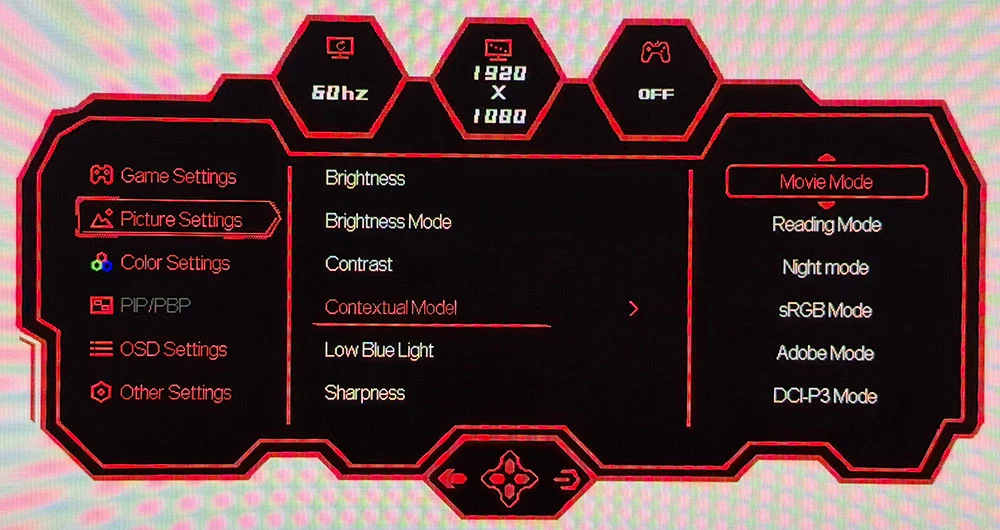
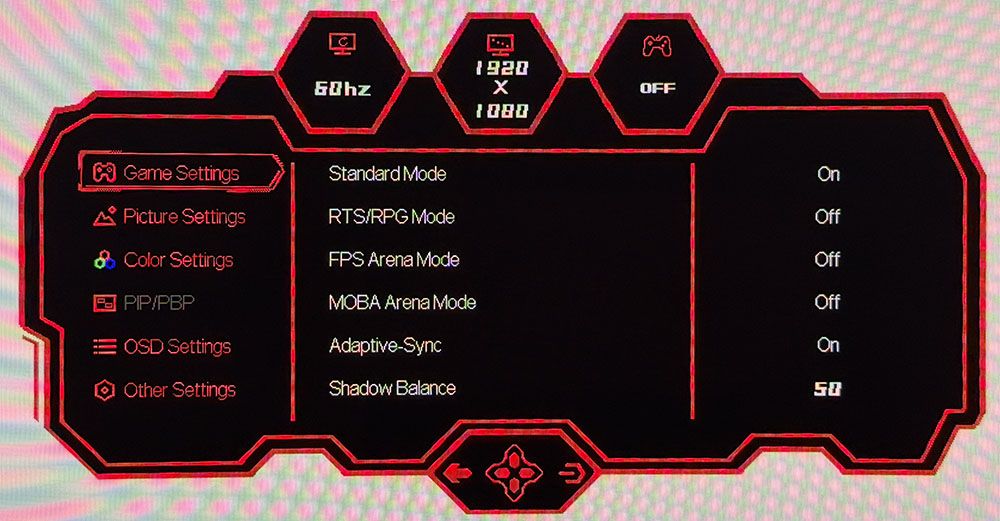
It is important to address a quirk in the user interface. The On-Screen Display (OSD) is controlled by a joystick, but its functionality deviates from industry standards. Pressing the joystick down triggers a power-off command, regardless of where you are in the menu. This led to several accidental shutdowns during our testing phase. Once the user learns the specific "right-click to select" logic, the menu becomes navigable, but the learning curve is steeper than it should be.
Final Verdict
The Deco Gear DG49OLED240 is a triumph of display engineering that effectively solves the "bezel problem" for multi-monitor users. By providing a massive, fluid, and color-accurate canvas, it bridges the gap between high-end professional work and elite-level gaming.
While the OSD controls require a period of adjustment, the trade-off is more than justified by the sheer immersion and utility the monitor provides. If you are currently juggling two 27-inch monitors and find yourself longing for a seamless, unified, and high-performance desktop experience, the DG49OLED240 is not just a luxury—it is the definitive upgrade.
Pros:
- Stunning QD-OLED image quality with perfect contrast.
- Seamless 32:9 canvas eliminates bezel fatigue.
- Exceptional 240 Hz performance with minimal input lag.
- Robust build quality and useful built-in audio with a dedicated woofer.
- Versatile connectivity, including 90W USB-C charging.
Cons:
- OSD control logic is counter-intuitive and prone to accidental power-offs.
- Standard 27-inch height might not suit users who require extreme vertical space for long-form document reading.
- Requires a significant desk footprint and a powerful GPU to drive the full resolution at high frame rates.
For those who spend their days creating and their nights gaming, the Deco Gear DG49OLED240 is a top-tier contender that belongs on the shortlist for any high-end PC build.