

For over a decade, the business blog has been the cornerstone of digital marketing. From SEO benefits to establishing thought leadership, the medium is a staple for brands across every industry. However, the landscape of content marketing is notoriously volatile. As algorithms shift, user behavior evolves, and the barrier to entry lowers, brands that fail to iterate their strategy face the reality of diminishing returns.
To navigate this changing environment, marketers look to the 11th Annual Blogger Survey from Orbit Media. As an authoritative, long-standing benchmark for the industry, this report offers more than just data; it provides a roadmap for how modern teams can improve their ROI.
This year, the most pressing question—spurred by the rise of generative AI—was whether technology has finally decoupled the relationship between effort and output. The findings are a wake-up call for content teams everywhere.
The Persistent Reality: Time Is Still the Currency of Quality
One of the most persistent myths in the age of ChatGPT and Claude is that generative AI would drastically shorten the production cycle for high-quality content. Industry experts anticipated a massive drop in the time required to write a blog post.

The data, however, tells a different story.
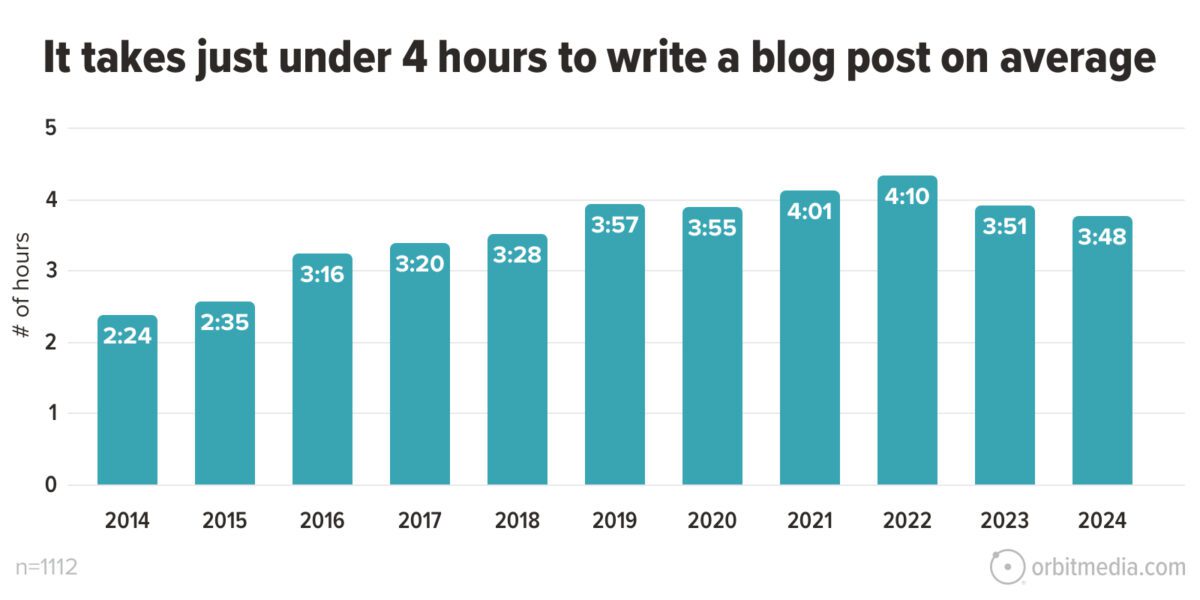
According to the 11th Annual Blogger Survey, the average blog post takes three hours and forty-eight minutes to produce. This is a negligible decrease of only three minutes compared to the previous year. Despite the ubiquity of AI tools—with adoption among bloggers skyrocketing from near-zero in 2022 to 80% in 2024—the "time-to-publish" remains stubbornly high.
Why the Time Sink Persists
The data suggests that while AI can assist in brainstorming or generating drafts, the human element is more critical than ever. Strategic direction, fact-checking, and the infusion of brand-specific storytelling require human oversight that automation simply cannot replicate. To truly stand out in a saturated market, creators are still investing the same amount of time—or more—to ensure their content is authoritative and unique.
Supporting Data: What Drives "Strong Results"?
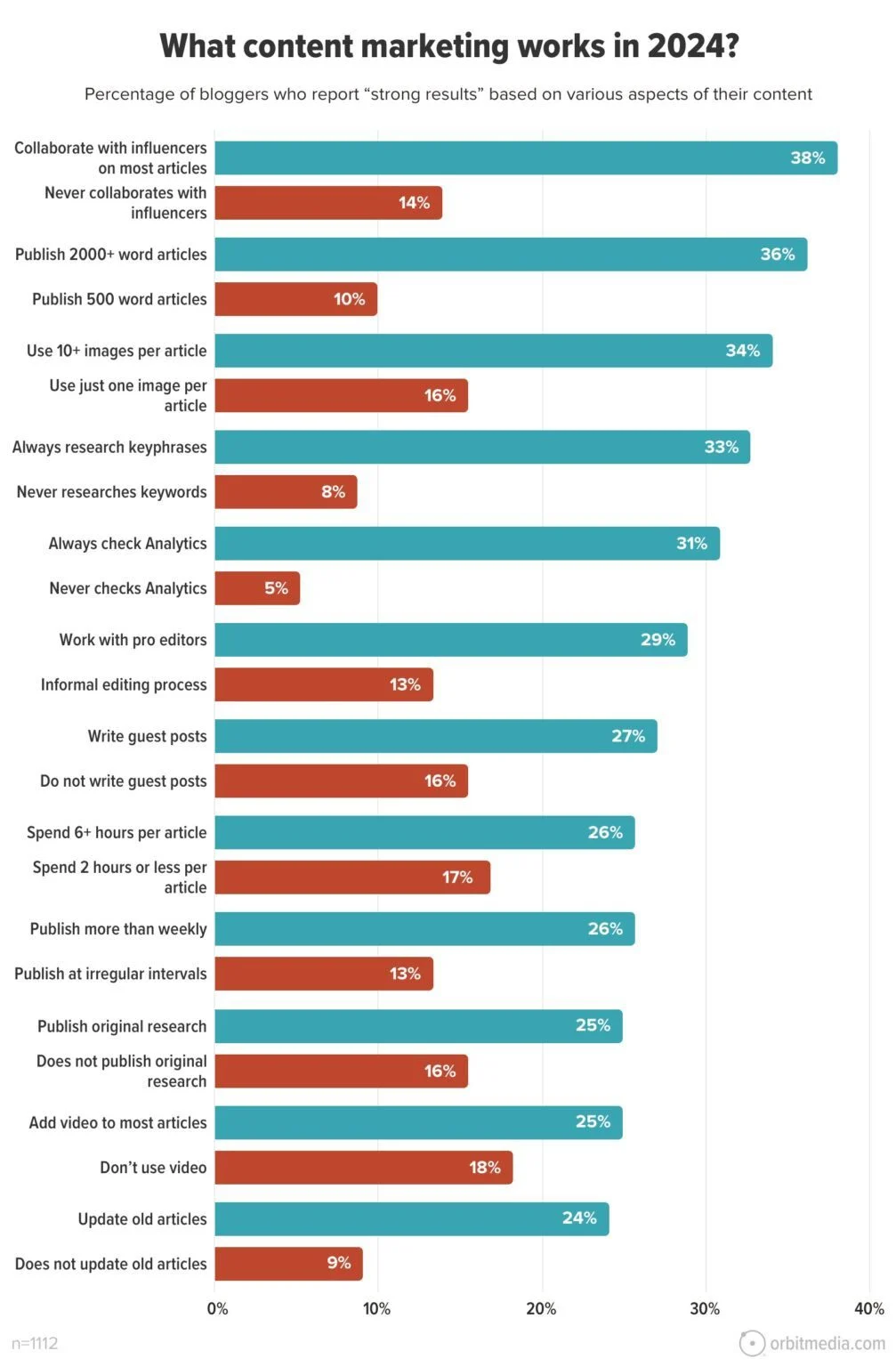
The research reveals that the correlation between effort and impact is stronger than ever. The "low-effort" approach—short posts, infrequent updates, and minimal collaboration—is consistently failing to move the needle.
1. The Power of Depth
Bloggers who consistently produce long-form content (2,000+ words) are significantly more likely to report "strong results." Depth, in this context, serves as a proxy for value. Users today have high expectations; they will not settle for surface-level insights or regurgitated information.
2. The Cadence of Consistency
The data indicates that a bi-weekly posting schedule is the minimum threshold for sustained performance. Consistency functions as a signal to both search engines and human readers that the brand is an active, reliable source of information.
3. Treating the Blog Like a Social Feed
Perhaps the most transformative takeaway is the need to treat a blog feed with the same rigor as a social media channel. Social platforms invest millions in user engagement testing; savvy marketers are now applying those same principles—dynamic formatting, visual storytelling, and interactive elements—to their owned blog assets.
The AI Paradox: Utility vs. Performance
With 80% of bloggers now using AI, one might expect a surge in overall performance. Yet, the survey reveals no direct, widespread correlation between the sheer volume of AI usage and better business outcomes.

The distinction lies in how these tools are utilized. AI is a powerful assistant for the "blank page problem," but it is a poor substitute for a brand voice. The marketers achieving the best results are using AI to streamline the process, not to replace the thought. They use these tools for ideation, structure, and visual generation, while reserving human capital for the final polish and strategic alignment.
Official Perspective: Q&A with Andy Crestodina
To better understand the implications of these findings, we spoke with Andy Crestodina, CMO and Co-Founder of Orbit Media Studios. A pioneer in digital marketing, Crestodina has spent over two decades observing the evolution of web strategy.
Q: What research findings were the most surprising to you personally?
Crestodina: "The data is telling us, year after year, that big efforts drive big outcomes. It’s not surprising in theory, but when you see the side-by-side performance gaps between low-effort and high-effort programs, it’s stark. What is surprising is that so many content programs persist with the same low-effort, short-form, monthly cadence. They aren’t collaborating, they aren’t using video, and they aren’t doing original research. If you don’t put in the effort, you should expect low results. That’s what the data tells us."

Q: The data suggests that podcasters are twice as likely to report strong results. Why?
Crestodina: "It tracks perfectly with the ‘high effort’ trend. Producing a podcast isn’t just about the audio—it’s about collaboration, interviewing experts, and producing rich, original content. Podcasters are rarely working in a silo. They are hitting the record button and working with others, which inherently improves the quality and distribution of their content."
Q: The report notes that the most visible marketing metrics are the least important. How should we be measuring success?
Crestodina: "Most marketers look at traffic because it’s the most visible metric in Google Analytics. But traffic is a vanity metric if it doesn’t lead to business outcomes. As search traffic becomes more volatile and ‘zero-click’ searches increase, we need to look deeper. We should be measuring conversion, time-on-page, newsletter sign-ups, and lead quality. The most important outcomes—word-of-mouth, top-of-mind awareness, and bottom-of-funnel engagement—are the hardest to measure, but they are the ones that actually pay the bills."

Implications for Content Leaders
The decline in overall blogging results over the last five years is not a death knell for the medium; it is a signal that the "easy growth" era of SEO is over. For content leaders, this necessitates a strategic pivot.
1. Re-evaluating Traffic
Traffic is no longer the primary indicator of success. With the rise of AI-driven search (SGE) and the shift toward closed-platform consumption, marketers must focus on building owned audiences.
2. The Rise of "Rented Land"
Crestodina’s advice for B2B brands is to embrace the platforms where audiences already spend time. His number one tip? Launch a LinkedIn newsletter. By aligning with the goals of big tech—keeping users on the platform—brands can often gain more visibility than they would on a standalone blog, provided they redirect that audience back to their core site for deeper engagement.
3. Tactical Recommendations for 2025
- Original Research: Invest in data that only your brand can provide. This remains the gold standard for high-performing content.
- Collaborative Content: Interview guests and co-create articles. It expands your reach and improves your credibility.
- Repurposing Engines: Every blog post should be a source for social clips, email newsletters, and video content. Do not treat a blog post as a finished product; treat it as a raw material for a multi-channel campaign.
- Strategic Human Input: Use AI to build the frame, but use humans to build the house. Ensure every piece of content contains unique insights, personal anecdotes, or expert perspectives that an AI model cannot synthesize from existing web data.
Conclusion
The 11th Annual Blogger Survey serves as a sobering reminder: there is no shortcut to excellence. While the tools of the trade have become more sophisticated, the fundamental requirements for success remain the same: high-quality input, strategic consistency, and a relentless focus on the audience rather than just the search engine.

As we look toward 2025, the marketers who win will be those who stop chasing the "low-effort" trap and start doubling down on the deep, collaborative, and human-centric strategies that have always defined authority. The data is clear—it is time to stop playing the game of volume and start playing the game of value.











