

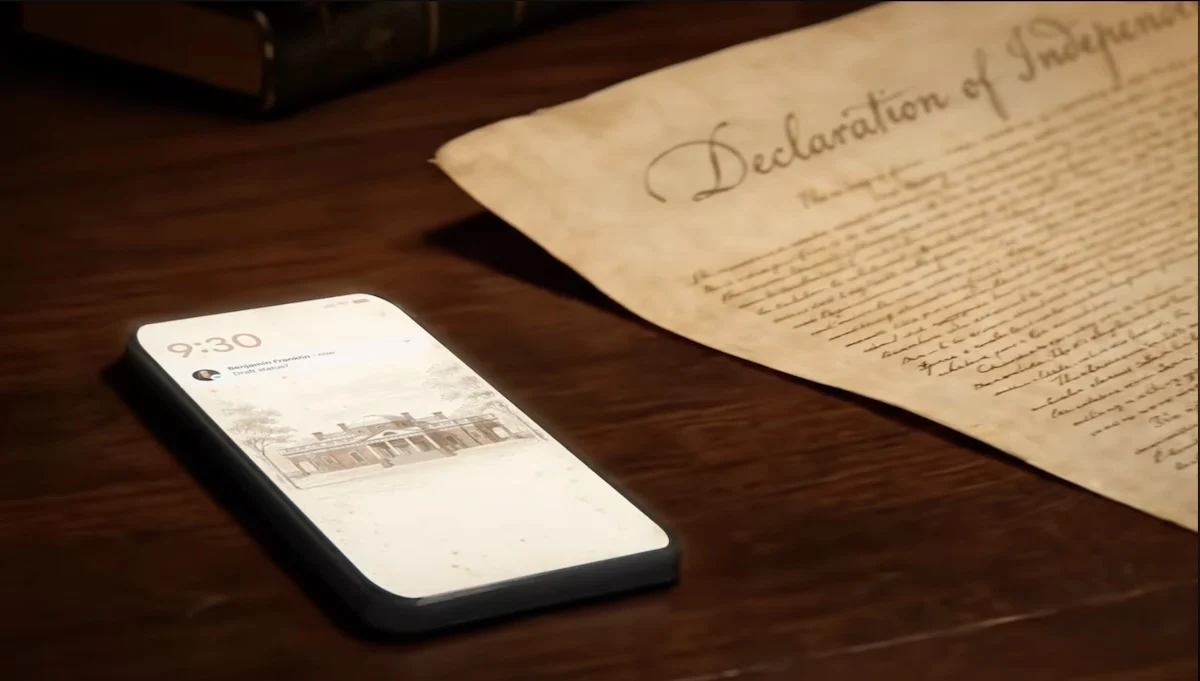
Two hundred and fifty years after the ink dried on the Declaration of Independence, the document remains the bedrock of American democracy. Yet, in a provocative new marketing campaign, Google has chosen to bridge the gap between the quill-and-parchment era and the silicon age. With the tagline “Group project, but make it 1776,” the tech giant has released a commercial that posits a singular, whimsical question: What would the Founding Fathers have accomplished if they had access to Google Workspace?
The ad, which has sparked immediate controversy across social media, depicts a digital-age version of the Continental Congress. Thomas Jefferson is seen struggling with a draft of the Declaration, only to be interrupted by a persistent text message from Benjamin Franklin. What follows is a whirlwind of modern productivity software: suggested edits in Google Docs, a Google Calendar invite for a committee meeting, and a remote session held via Google Meet—complete with the quintessentially modern detail of every participant keeping their cameras off.
The Chronology of a Digital Revolution
To understand the scope of the ad’s narrative, one must trace the fictionalized workflow presented by Google. The commercial operates on a premise of "anachronistic efficiency."
- The Drafting Phase: Thomas Jefferson is portrayed not as a solitary genius in a candlelit room, but as a remote collaborator. He shares a Google Doc, allowing peers to leave "suggested edits" in the margins, mirroring the modern workplace’s penchant for asynchronous revision.
- The Meeting: The Committee of Five is scheduled via Google Calendar. In a nod to the realities of post-2020 corporate life, the founders join a Google Meet, though the visual gag of darkened screens—signifying "camera off" fatigue—highlights the disconnect between historical gravity and modern malaise.
- The AI Integration: As the narrative progresses, the ad leans heavily into Google’s suite of generative AI tools. The founders use the “Help me visualize” feature to test various animals for the national seal, while Gemini is tasked with summarizing meeting transcripts. In a moment of digital defiance, the founders query the chatbot for advice on how to handle King George III’s request for document access, ultimately choosing to revoke his permissions.
- The Finalization: The process concludes with a formal e-signature, a flourish that triggers a display of virtual fireworks, cementing the union of 18th-century revolutionary zeal and 21st-century software-as-a-service (SaaS) utility.
AI Evangelism vs. Historical Satire
The commercial is explicitly tongue-in-cheek. When Sam Adams asks, “Can we settle this over beers?” the audience is reminded that the ad is intended as a lighthearted romp rather than a historical documentary. However, beneath the humor lies a strategic push for AI adoption.
Unlike previous, heavily criticized campaigns—most notably the infamous Google commercial featuring a father using Gemini to draft a fan letter for his daughter—this iteration is more restrained. It avoids the suggestion that the actual text of the Declaration of Independence would be "improved" by machine learning. The founders are depicted as the authors, while AI serves merely as their administrative assistant.
Despite this caution, the footage itself has drawn scrutiny. To the discerning eye, the video possesses that subtle, uncanny glow synonymous with AI-generated or AI-enhanced cinematography. This creates a meta-commentary: the ad is selling AI using the very tools that have become a point of contention in the creative industries.
A Tale of Two Responses: Public Sentiment
The reception of the campaign has been starkly polarized, reflecting the broader societal divide regarding the role of AI in creative and historical contexts.
On platforms like YouTube and Instagram, the sentiment remains largely positive. Casual viewers appear to appreciate the high-production value and the humor of seeing historical icons navigating the modern digital workspace. For these audiences, the ad succeeds as a piece of brand marketing—a relatable, funny look at the tedious nature of group projects, regardless of the century.
However, on the decentralized network Bluesky, the reception has been significantly colder. Critics have characterized the campaign as “cringey” and “stunningly tone-deaf.” The primary critique is that by trivializing the founding of the nation through the lens of productivity software, Google is cheapening a moment of profound political significance.
Historian Angus Johnston provided one of the most astute observations regarding the technical nature of the ad. “It is amazing how little of this is actually AI,” Johnston noted. His critique, however, went deeper than the technical implementation: “Even in a corny fantasy joke, it’s impossible to make the case that AI is a useful tool for political organizing, writing, or human collaboration.”
Implications for the Future of Brand Messaging
The controversy surrounding the "1776" commercial serves as a microcosm of the current challenges facing Big Tech.
1. The Burden of Historical Weight
When brands tether their products to historical milestones, they invite scrutiny that goes beyond marketing metrics. The Declaration of Independence is not merely a document; it is a symbol of revolution, sacrifice, and deep ideological struggle. By reframing it as a "group project," Google risks alienating audiences who view such historical events with reverence rather than irony.
2. The Uncanny Valley of Advertising
The use of AI-generated or AI-assisted video production creates a "meta-marketing" problem. When an ad for AI tools is itself constructed using those same tools, it creates a feedback loop that some consumers find unsettling. The "uncanny glow" noted by critics suggests that audiences are becoming increasingly sensitive to the artificiality of the media they consume.
3. The Limits of AI Utility
The pushback against the commercial suggests a growing "AI fatigue." Consumers are being bombarded with advertisements that claim AI can optimize every facet of existence—from writing emails to managing historical rebellions. The backlash suggests that there is a limit to how much "AI-washing" the public is willing to tolerate. When AI is applied to creative or historical contexts, the expectation for authenticity rises, and tools that were designed to save time may actually be costing brands their reputation.
Conclusion: A Lesson in Context
Google’s foray into 18th-century satire illustrates the fine line between clever marketing and institutional hubris. While the goal was clearly to showcase the versatility of Google Workspace and the helpfulness of Gemini, the campaign serves as a reminder that not all historical contexts are suitable vessels for product placement.
As we move toward the quarter-millennial celebration of the United States, brands will undoubtedly continue to attempt to leverage the "founding" narrative. Google’s experience suggests that while the tools of the future are powerful, they should be used with a keen awareness of the past. For now, the "Group project, but make it 1776" ad will likely be remembered as a bold, if divisive, experiment in brand identity—a case study in how the silicon age struggles to reconcile itself with the parchment age.
Disclaimer: When you purchase through links in our articles, we may earn a small commission. This does not affect our editorial independence.
About the Author: Anthony Ha is TechCrunch’s weekend editor. He brings years of experience in tech journalism and corporate communications to his analysis of the intersection between emerging technology and culture. For inquiries, contact [email protected].











