Nila Kartika Wati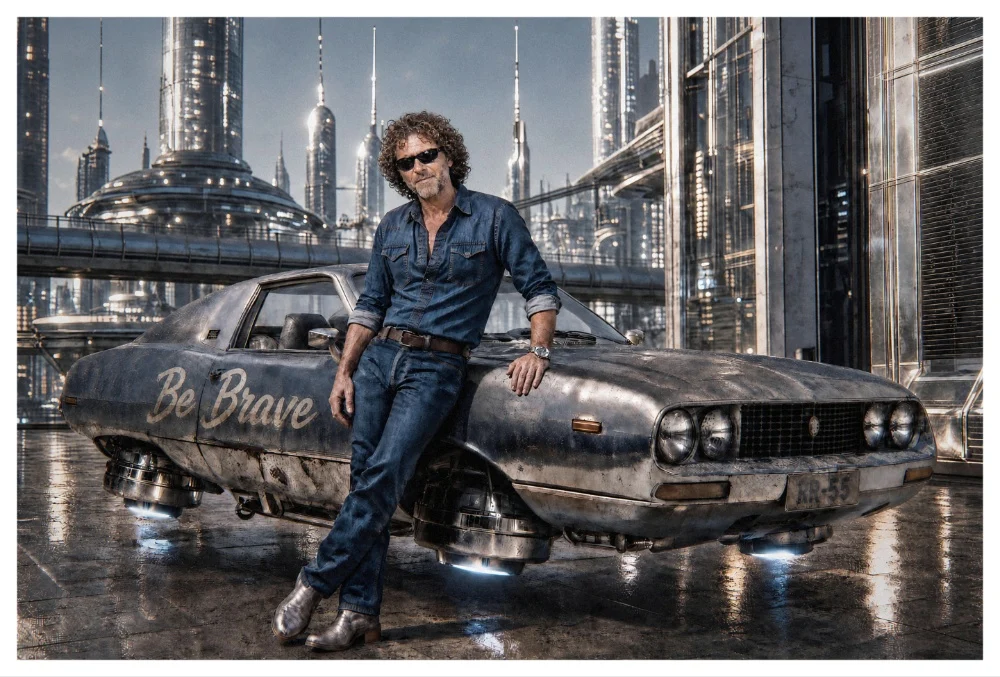
As the Venice Film Festival returns to the historic Lido, one project is generating more conversation—and curiosity—than any other. "Be Brave," an 85-minute documentary portrait of Diesel founder Renzo Rosso, marks a pivotal moment in cinematic history. Directed by New York-based Italian filmmaker Francesco Carrozzini, the film is not merely a biography of a fashion mogul; it is a bold, high-stakes experiment that uses generative Artificial Intelligence to reconstruct the life of a man without filming a single frame of its protagonist.
By utilizing AI to simulate Rosso at various stages of his life, Carrozzini has positioned "Be Brave" as one of the first feature-length AI-driven projects to debut at a top-tier international film festival. It is a technical feat that challenges the traditional boundaries of documentary filmmaking, raising existential questions about the role of the creator in an era where technology can synthesize reality itself.
The Genesis of an AI Portrait
The project began as an unconventional pitch from producer Lorenzo Mieli, who approached Carrozzini with the idea of chronicling the life of Renzo Rosso. Initially, Carrozzini was hesitant. Having established his reputation with personal, emotionally resonant works like Franca: Chaos and Creation—a deeply intimate documentary about his late mother, Franca Sozzani, the legendary editor-in-chief of Italian Vogue—he had been looking to pivot away from the fashion world.
"Lorenzo is very effective when he wants to sell an idea," Carrozzini admits. The hook was the opportunity to experiment with AI, though the exact methodology remained a blank slate. The necessity for this approach soon became clear: while the archives were overflowing with broadcast footage of Rosso, they lacked the intimate, candid moments required for a compelling narrative. There were no "fly-on-the-wall" glimpses into his private life. To bridge this gap, the team turned to AI, effectively writing and directing a "fictionalized documentary" that reconstructs the pivotal chapters of Rosso’s rise from a childhood of poverty to the helm of a global fashion empire.
A Chronology of Technical Evolution
The making of "Be Brave" was a year-and-a-half-long marathon of trial and error, defined by the blistering pace of technological advancement. Carrozzini notes that the field of AI evolved so rapidly during production that segments completed at the start of the process were rendered obsolete by newer, more powerful tools.
Phase 1: The Conceptual Framework
The team began by crafting a full script, moving away from the traditional fly-on-the-wall documentary style. They employed a meta-narrative device: the director "chasing" the elusive Rosso through time and space. This allowed for a structure where the AI-generated scenes were not just filler, but central to the film’s theme.
Phase 2: The Workflow Nightmare
The technical pipeline was a "nightmare" of integration. To create a believable version of Rosso, the team used photographic archives, mapping his features onto synthetic models. Beyond visual likeness, they had to synthesize his voice, ensuring the cadence and tone shifted appropriately as the character aged. The most difficult hurdle, however, was not the image or the audio, but the behavior. "You can get the voice perfect," Carrozzini explains. "But it’s the behavior that was really challenging."
Phase 3: The Post-Production Upscale
Working with AI meant dealing with inherent quality limitations. Much of the raw AI output was low-resolution, requiring extensive upscaling and manual refinement. The film was treated with the same post-production intensity as a major CGI-heavy blockbuster, involving specialists like AI artist Roberto Beragnoli to handle the heavy lifting.
Supporting Data: The Human-First Philosophy
Despite the heavy reliance on algorithms, "Be Brave" is explicitly not a thesis on the capabilities of AI. Instead, it serves as an invitation for filmmakers to consider how these tools might augment, rather than replace, human storytelling.
When asked about the potential for audiences to distinguish between reality and synthesis, Carrozzini is philosophical. He posits that if the film manages to make the viewer laugh, cry, or empathize with the protagonist, the specific method of production becomes secondary. The "human element," he argues, is the anchor. Even in a project defined by technology, he insists that the human perspective must remain the primary driver of narrative choices.

This is particularly evident in how the film treats its "talking heads." While the younger and middle-aged versions of Rosso are synthetic, the film integrates interviews with real-world figures, grounding the narrative in the physical, lived experience of those who know him.
Official Responses and Festival Reception
Venice Film Festival chief Alberto Barbera has championed the project, citing it as a landmark moment for the medium. "I want to put this forward as an invitation for everyone to think about how AI as a tool can open up new creative possibilities for filmmakers," Barbera stated during the festival’s program announcement. By including "Be Brave," the Venice Film Festival is signaling its readiness to engage with the technological disruption currently sweeping through the entertainment industry.
The production, led by Lorenzo Mieli, Mario Gianani, and Gabriele Immirzi of the Rome-based company Our Films (a Mediawan company), represents a collaborative effort to push the boundaries of what is possible in nonfiction storytelling. Their willingness to premiere the film at such a prestigious venue demonstrates confidence in the emotional efficacy of their experiment.
The Implications for Cinema
The arrival of "Be Brave" raises profound questions about the future of film. If we can perfectly simulate a human being, what happens to the sanctity of the "performance"?
Carrozzini is cautious about the implications for fiction. He distinguishes between his documentary approach—which explores the life of a real person—and a potential fiction film that would eschew actors entirely. He expresses skepticism regarding the latter, noting that audiences possess an innate ability to detect the absence of human empathy. "The moment you know that it’s not human… the empathy is lacking," he observes.
The Ethical Threshold
There is an implicit ethical line being drawn here. In "Be Brave," the AI is used to interpret and dramatize a factual life. In a work of pure fiction, replacing actors with synthetic characters remains a contentious issue. Carrozzini suggests that for now, the industry is in a transitional period where we haven’t yet overcome the "uncanny valley" of scripted material. We are still in the stage of testing—learning how to control the medium rather than being controlled by its limitations.
The Ever-Changing Medium
Perhaps the most striking takeaway from the production is the volatility of the technology. Carrozzini candidly admits that the version of "Be Brave" premiering in Venice may feel "old" by the time it hits wider distribution. This creates a strange paradox: the filmmaker is working with a medium that is, by definition, constantly "dying" and being reborn with each software update.
However, rather than viewing this as a frustration, Carrozzini sees it as an inherent part of the creative excitement. The collaboration between the director, the AI artist, and the producers has turned the film into a living document of the current AI explosion.
Conclusion: A New Frontier
"Be Brave" is more than a documentary about Renzo Rosso; it is a signal flare in the dark. It challenges the audience to confront their own perceptions of truth, memory, and performance in an age where the barrier between the real and the synthetic is becoming increasingly porous.
As the credits roll at the Lido, the success of the film will not be measured by the sophistication of its algorithms, but by the resonance of its story. Carrozzini has gambled on the idea that even when the camera is replaced by code, the fundamental desire for human connection—the "Be Brave" spirit—remains the true North Star of cinema. Whether this heralds a new era of AI-enhanced storytelling or serves as a cautionary tale remains to be seen, but one thing is certain: the future of film is being rewritten, one line of code at a time.

 Pevita Pearce