The American automotive landscape has undergone a seismic transformation over the last decade. The industry has witnessed a wholesale migration away from the traditional sedan and small-car segments, favoring the high-margin, high-utility dominance of pickup trucks and SUVs. Simultaneously, legacy manufacturers embarked on an ambitious, often turbulent, transition toward full electrification—a strategic pivot that saw its early 2020s hype cycle eventually meet the harsh realities of consumer demand and infrastructure limitations.
Ford Motor Company has been at the epicenter of this shift. In a move that signaled the end of an era for driving enthusiasts, the Blue Oval systematically pruned its catalog, retiring storied nameplates like the Focus and the Fiesta to make room for a fleet dominated by SUVs and the rugged utility of the F-Series. While Ford currently navigates a $19.5 billion restructuring effort aimed at refining its EV strategy, the present-day lineup—while successful—often lacks the visceral, mechanical soul that defined the company’s mid-2010s zenith.
For the performance aficionado, 2017 stands out as a singular moment in time. It was a year when Ford managed to balance high-volume utility with a breathtaking array of enthusiast-focused machinery, ranging from track-devouring supercars to accessible, grin-inducing hot hatchbacks.
The 2017 Chronology: A Snapshot of Engineering Brilliance
To understand why 2017 represents a "high-water mark," one must look at the specific convergence of products available in showrooms that year. It was a rare moment where the Ford portfolio spanned every conceivable enthusiast niche.
1. The Mustang Shelby GT350: A Return to Naturally Aspirated Purity
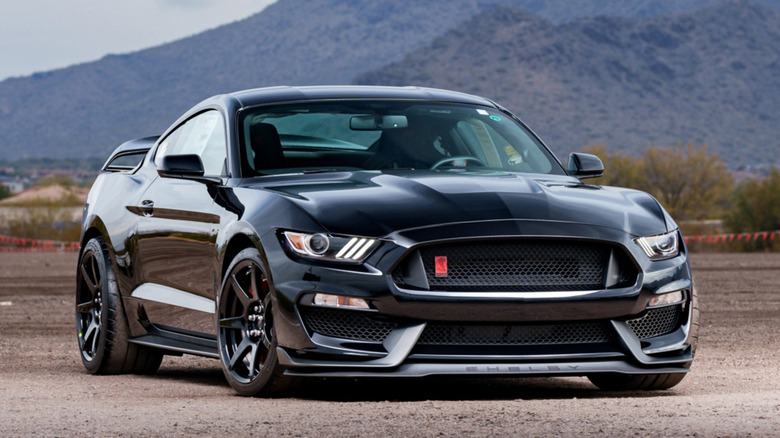
By 2017, the S550-generation Mustang had fully matured. At the apex sat the GT350 and GT350R, machines that eschewed the forced induction of their predecessors in favor of something far more exotic. At its heart sat the "Voodoo" 5.2-liter V8, a masterpiece of engineering featuring a flat-plane crankshaft. Capable of screaming to an 8,250-rpm redline, the engine produced 526 horsepower and possessed a melodic, high-pitched wail that drew more comparisons to Italian exotics than American muscle cars. Coupled exclusively with a six-speed manual transmission, the GT350 remains a masterclass in driver engagement.
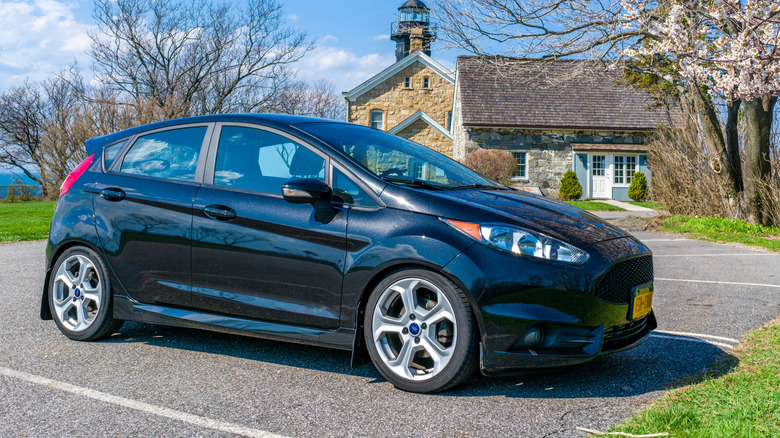
2. The Ford Fiesta ST: The Accessible Icon
In 2017, the Fiesta ST was arguably the greatest value-for-money performance car on the market. With a base price hovering around $22,000, it provided a masterclass in chassis tuning. It wasn’t the fastest car in the world, but its punchy 1.6-liter turbocharged engine and agile, flickable handling made it an instant classic. It proved that Ford didn’t need to build a $100,000 car to create a legendary driving experience.
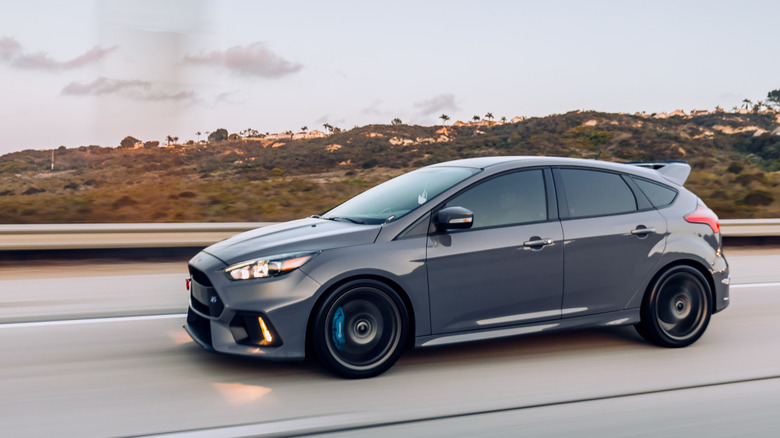
3. The Ford Focus RS: The Rally-Bred Monster
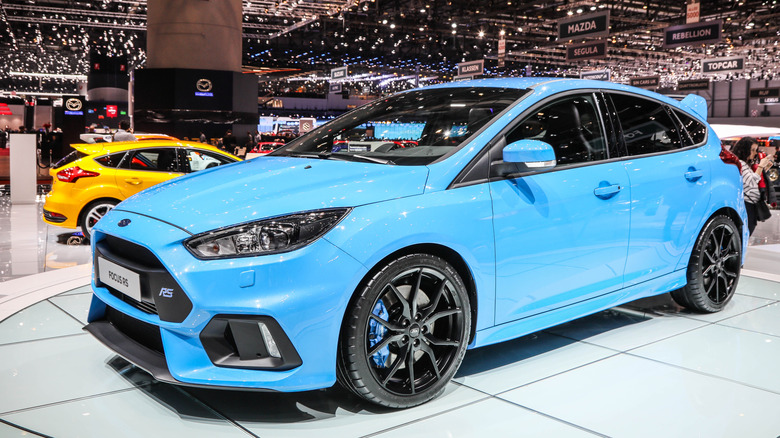
If the Fiesta ST was the entry-level enthusiast choice, the Focus RS was the heavy-hitting, all-wheel-drive rally monster. Arriving in North America for the 2016 model year and in full swing by 2017, the RS featured a 2.3-liter EcoBoost engine pushing 350 horsepower. With its sophisticated torque-vectoring AWD system and a dedicated "Drift Mode," the Focus RS was a technological tour de force. It represented the pinnacle of Ford’s hot-hatch philosophy.
4. The Ford Fusion Sport: The Unlikely Sleeper
Perhaps the most surprising entry in the 2017 lineup was the Fusion Sport. While the rest of the midsize sedan market was focusing on fuel economy and comfort, Ford dropped a 325-horsepower twin-turbo 2.7-liter V6 into its family sedan. With all-wheel drive and adaptive dampers, it was a legitimate "sleeper" capable of sub-five-second 0–60 mph sprints, proving that Ford’s performance DNA was permeating even its most pragmatic vehicles.
5. The Ford GT: The Halo of the Modern Era
Finally, there was the Ford GT. Reviving a legendary name, this mid-engine supercar was built with a singular focus on dominating Le Mans. Eschewing a massive V8 for a compact, twin-turbocharged V6, the car was a triumph of aerodynamics and lightweight carbon-fiber construction. It wasn’t just a marketing exercise; it was a race car for the road, solidifying Ford’s status as a global performance powerhouse.
Supporting Data: The Cost of Progress
The decline of these models is not merely anecdotal; it is a reflection of shifting market metrics. In 2017, the average transaction price for a new vehicle was significantly lower, and the "hot hatch" segment was still viewed as a viable volume strategy.
| Vehicle | Primary Performance Metric | Status |
|---|---|---|
| Mustang Shelby GT350 | 526 HP / 8,250 RPM Redline | Discontinued (2020) |
| Fiesta ST | 197 HP / 2,700 lbs curb weight | Discontinued (2019) |
| Focus RS | 350 HP / Drift Mode AWD | Discontinued (2018) |
| Fusion Sport | 325 HP / 380 lb-ft torque | Discontinued (2019) |
| Ford GT | 647 HP / 216 mph top speed | Discontinued (2022) |
The financial data underscores a difficult reality: while these cars earned immense brand equity and critical acclaim, the shift toward higher-margin SUVs and the capital-intensive pivot toward battery-electric vehicles (BEVs) necessitated their exit. The $19.5 billion restructuring fund mentioned in Ford’s recent financial disclosures is the direct fiscal successor to the era that birthed the Focus RS and the GT350.
Official Responses and Strategic Shifts
Ford’s leadership, including CEO Jim Farley, has been vocal about the necessity of this transition. In various investor calls, the company has framed the discontinuation of these performance sedans and hatchbacks as a "capital efficiency" move. By consolidating manufacturing lines toward the F-150, Bronco, and the Mustang—the latter being the only traditional car remaining in the lineup—Ford claims it is better positioned to compete with the likes of Tesla and emerging Chinese EV manufacturers.
However, the company has not completely abandoned its enthusiast base. Ford Performance has pivoted toward the "Mustang GTD," a $300,000-plus super-Mustang that incorporates the DNA of the Ford GT into the familiar silhouette of the Mustang. While impressive, it represents a shift from "attainable performance" to "bespoke hyper-performance," leaving a void where the affordable, daily-drivable performance car used to reside.
Implications: The Legacy of 2017
The implications of 2017’s departure are twofold. First, we are seeing a "classic car" premium forming around the late-2010s Ford lineup. Models like the Focus RS and the GT350 are already holding their value—and in some cases, appreciating—because they represent the final generation of analog, internal-combustion-engine (ICE) performance cars from an American manufacturer before the full-scale transition to software-defined, electrified vehicles.
Second, the loss of these models has created a vacuum in the automotive culture. The "Ken Block era" of Ford performance, which celebrated the accessibility of the Focus and Fiesta, has been replaced by an era of heavy, high-tech EVs like the Mustang Mach-E Rally. While the Mach-E Rally is a competent off-roader, it lacks the tactile, mechanical soul that made the 2017 lineup so resonant.
Conclusion: A Look Back to Move Forward
The year 2017 was not merely a collection of fast cars; it was a demonstration of Ford’s engineering confidence. It was a time when the company felt comfortable exploring the fringes of automotive passion. Today, as Ford pours billions into the electrification of its fleet, the 2017 lineup serves as a reminder of what the company is capable of when it balances pragmatism with performance.
As we move deeper into the 2020s, the vehicles of 2017 are likely to be remembered as the last "golden age" cars of the Blue Oval—a fleeting window of time where every enthusiast, regardless of their budget, could find a Ford that made them want to drive just for the sake of driving. Whether or not Ford can capture that lightning in a bottle again in the electric era remains the industry’s most compelling question. For now, we look back at the Voodoo V8s and the drift-happy hatchbacks as the standard-bearers of a legacy that, for one brief, glorious year, set the world on fire.