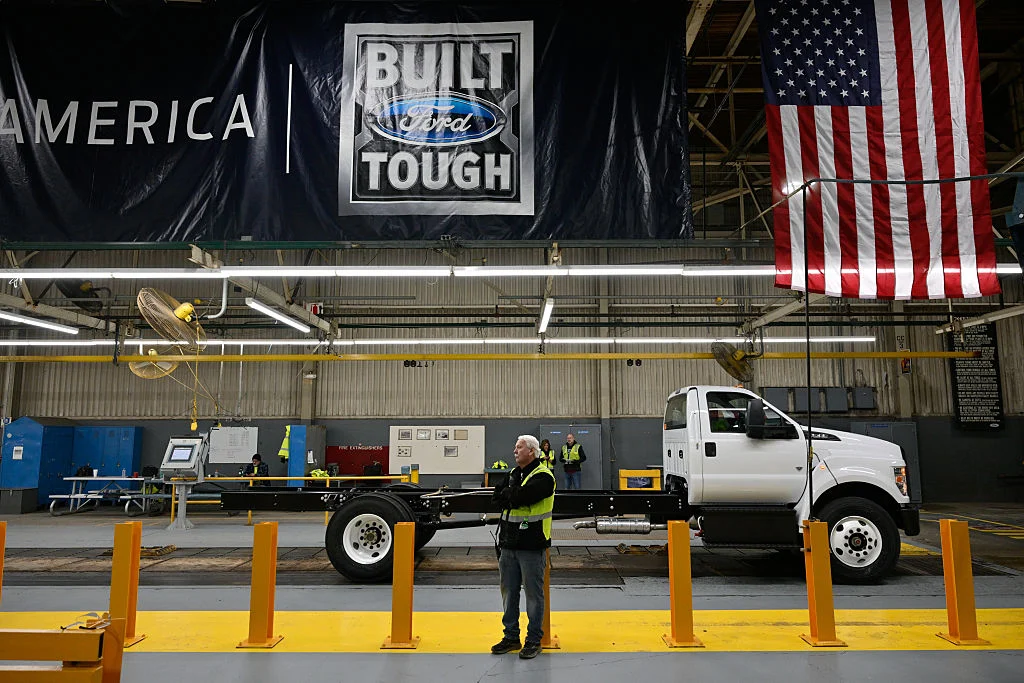
In a striking reversal of the industry’s headlong rush toward total automation, Ford Motor Company has publicly acknowledged a significant pivot in its manufacturing and quality control strategy. After leaning heavily into artificial intelligence and automated inspection systems, the automotive giant discovered that algorithms alone were insufficient to maintain the high standards required for modern vehicle production.
In a move that has sent ripples through the tech and manufacturing sectors, Ford has hired 350 veteran engineers—a mix of former employees and industry experts poached from suppliers—to reclaim the human oversight lost in the transition to AI-driven processes. This “human-in-the-loop” approach, which emphasizes the intuition of seasoned professionals over the cold logic of machine learning, is already yielding measurable financial and operational gains.
The Limits of Algorithmic Quality Control
For years, the automotive industry has been sold on the promise of Industry 4.0: a future where interconnected AI systems, predictive sensors, and automated quality checks would eliminate human error, slash production times, and drive quality to unprecedented heights. Ford, like many of its competitors, embraced this narrative, automating segments of its design and inspection pipelines under the assumption that feeding design requirements into an AI model would inherently output a flawless product.
However, the reality proved far more complex. Chief Operating Officer Kumar Galhotra recently admitted to journalists that the company’s over-reliance on these automated systems led to disappointing results. While AI excels at pattern recognition and data processing, it often lacks the nuanced understanding of mechanical integration—the "gut feeling" that a veteran engineer develops after decades of working with steel, electronics, and assembly lines.
The automated systems failed to anticipate real-world failure points that were not clearly mapped in their training data. As Charles Poon, Ford’s vice president of vehicle hardware engineering, candidly stated: "Mistakenly we thought that by just introducing artificial intelligence and ingesting the design requirements that we had, that that would produce a high-quality product." The admission serves as a humbling reminder that complex physical engineering remains a domain where human expertise is often irreplaceable.
A Chronology of the Quality Crisis and Correction
The internal shift at Ford did not happen overnight. It was the culmination of a multi-year realization that the company’s quality metrics were slipping despite the implementation of cutting-edge technology.
- 2023–2024 (The Peak of Automation): Ford accelerates the deployment of AI-driven design tools and automated quality monitoring across its North American plants. The goal is to reduce the "design-to-delivery" cycle time.
- Late 2024 (The Quality Gap Emerges): Internal reports indicate a plateau in quality improvement. While production efficiency remains high, warranty claims begin to climb, signaling that defects are slipping past the automated gatekeepers.
- Early 2025 (The Strategic Pivot): Ford leadership begins quietly identifying key retired engineers and industry specialists—affectionately dubbed "gray beards" for their decades of experience—to bring back into the fold.
- Mid-2025 (The Integration Phase): The new hires are deployed not just to inspect parts, but to "reprogram" the AI. They are tasked with teaching the systems how to recognize the failure points that human eyes would instinctively catch.
- June 2026 (The Results): Ford reports a significant turnaround, culminating in the company securing the top spot in the JD Power Initial Quality Survey. CEO Jim Farley confirms the strategy has resulted in hundreds of millions of dollars in cost savings.
Supporting Data: The Cost of Experience
The financial implications of this move are substantial. Ford’s decision to re-staff with veteran engineers is not merely a nostalgic gesture; it is a hard-nosed financial calculation. Warranty and recall costs—traditionally a "hidden tax" on automotive profitability—have seen a marked decline as a direct result of the new human-led quality protocols.
CEO Jim Farley has touted these savings as a "tailwind" for the company’s bottom line, citing "hundreds and hundreds of millions of dollars" saved. In the automotive industry, where margins are notoriously thin and recall campaigns can cost billions in a single quarter, these savings provide the capital necessary for further R&D in electrification and autonomous software.
Furthermore, the J.D. Power Initial Quality Survey (IQS) serves as a key performance indicator (KPI) that investors watch closely. Ford’s ascension to the top of the mainstream rankings is a powerful validation that the "gray beard" strategy is resonating with consumers. By shifting the focus from "how fast can we build this?" to "how well is this built?", Ford has successfully managed to balance the scales between modern innovation and traditional craftsmanship.

Official Responses and the New Hybrid Model
The leadership at Ford is keen to clarify that this is not an "anti-AI" stance. The company is not abandoning the millions of dollars invested in its digital infrastructure. Instead, it is shifting the role of AI from a primary decision-maker to a supporting tool.
"We are using the rehired employees to train younger staff and reprogram our AI tools," explained a company spokesperson. The strategy is to create a hybrid workforce. Younger engineers, who are digital natives, work alongside the veterans to bridge the gap between legacy knowledge and modern software capabilities.
The "gray beards" act as mentors, ensuring that the intuitive wisdom—such as understanding how a specific metal alloy might react to thermal stress in a way a sensor might overlook—is codified into the AI’s training sets. This creates a feedback loop: the veterans identify a problem, the AI is updated to detect it, and the next generation of engineers learns the logic behind both the problem and the solution.
Implications for the Automotive Industry
Ford’s experience offers a cautionary tale for the broader manufacturing sector. The "AI-first" mentality, while revolutionary, is prone to blind spots. When industry leaders attempt to automate away the "craft" of engineering, they risk losing the institutional memory that keeps products safe and reliable.
The success of Ford’s pivot suggests that the future of manufacturing is not a binary choice between human and machine. Rather, the winners of the next decade will be companies that can successfully synthesize the two. The "human-in-the-loop" model ensures that while AI handles the repetitive data analysis and simulation, human experts remain the final authority on product integrity.
The Rise of "Human-Centric" AI
This trend is likely to spread to other sectors, including aerospace, medical device manufacturing, and semiconductor production. Industries that have been aggressively automating are now hitting the same "complexity wall" that Ford encountered. We are likely to see a renewed valuation of veteran expertise, with companies actively creating "knowledge transfer" programs that prioritize the mentorship of junior staff by those with decades of experience.
Rethinking the Cost of Automation
Ford’s pivot also forces a re-evaluation of how companies measure the "cost" of employees. For years, the move to automate was often framed as a way to reduce headcount and labor costs. Ford’s recent success suggests that highly skilled, veteran labor is not a "cost" to be minimized, but an asset that drives down the total cost of ownership by preventing the catastrophic expenses associated with recalls and brand damage.
Conclusion: Lessons from the Factory Floor
Ford’s recent journey is a testament to the fact that in high-stakes engineering, there is no substitute for wisdom. As the automotive industry moves toward an increasingly electrified and software-defined future, the temptation to rely entirely on digital models will only grow. However, Ford has demonstrated that the most sophisticated AI is only as good as the human intuition that guides it.
By welcoming back the "gray beards," Ford has not stepped backward; it has stepped forward into a more balanced and sustainable model of innovation. As the company continues to climb the ranks of quality and reliability, the rest of the industry would be wise to take note: the future of manufacturing isn’t just about better machines—it’s about better integrating the people who know how to build them.