

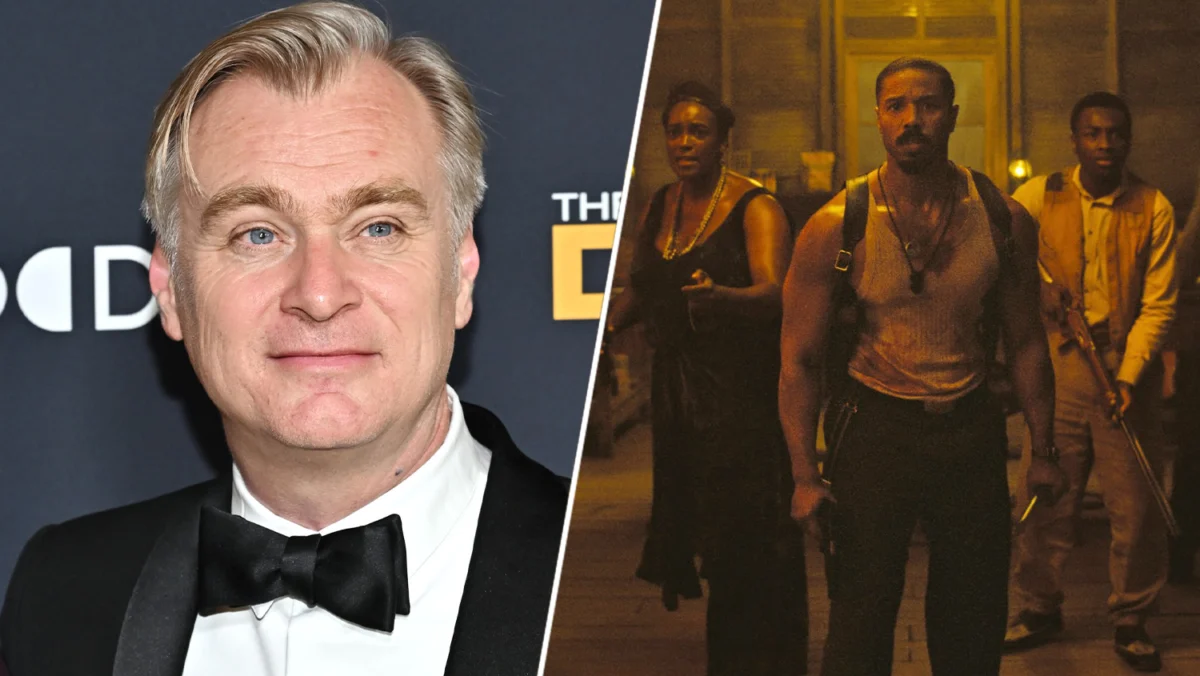
In the high-stakes world of contemporary filmmaking, few technical choices carry as much weight—or as much prestige—as the decision to shoot on IMAX. For two-time Academy Award winner Christopher Nolan, the format is not merely a tool; it is a philosophy. As he continues to push the boundaries of what is possible on the silver screen, Nolan has transitioned from a solitary practitioner of the large-format craft into a mentor, actively encouraging the next generation of visionary directors to embrace the visceral, immersive power of IMAX.
The latest testament to this influence involves Ryan Coogler, the acclaimed director behind the 2025 hit Sinners. In a recent conversation with The New York Times, Nolan revealed the behind-the-scenes dialogue that led to Coogler’s decision to utilize the demanding, high-resolution format for his vampire-themed epic, which famously garnered an Oscar for Best Cinematography for Autumn Durald Arkapaw.
The Evangelist’s Role: Encouraging the Bold
The relationship between Nolan and Coogler regarding the technical aspects of filmmaking dates back years. Nolan, who has long been a vocal proponent of film prints and the unparalleled clarity of IMAX, recalls a specific moment during the production cycle of his 2017 war epic Dunkirk.
"I think Dunkirk was the first time I dragged him to a screening of an original-made film print of IMAX," Nolan explained. "I love to show filmmakers the potential of the format."
This mentorship culminated in a pivotal phone call while Coogler was in the early stages of prepping Sinners. Faced with the logistical complexities and the sheer creative pressure of mounting such an ambitious project, Coogler sought out the industry’s foremost expert on the format. He wasn’t necessarily looking for technical advice alone; he was looking for validation.
"Ryan called me before he committed to IMAX," Nolan shared. "He was sort of looking for someone to tell him it wasn’t crazy to shoot his vampire film that way. I was like, ‘No, I’d love to see that.’"
This exchange highlights a crucial shift in Hollywood: IMAX is no longer reserved exclusively for historical epics or space operas. By encouraging filmmakers like Coogler to apply the format to genre-bending, character-driven narratives, Nolan is expanding the vocabulary of large-format cinema.
Chronology of a Format: From "The Dark Knight" to "The Odyssey"
To understand the gravity of this shift, one must look at the trajectory of Nolan’s own career. His obsession with the format did not happen overnight; it was a slow, deliberate integration that changed the way audiences consume blockbuster entertainment.
The turning point was 2008’s The Dark Knight. While many directors had used 70mm cameras for specific scenic shots, Nolan was the first to integrate them into a major action feature, using the cameras for key sequences to create a sense of scale that felt genuinely dangerous and immersive.
Following that success, the progression was steady:
- 2010 (Inception): Nolan began testing the limits of what could be achieved with large-format cameras in tight, psychological spaces.
- 2012 (The Dark Knight Rises): The scope of the finale utilized the format to ground the urban warfare in a tangible, massive reality.
- 2014 (Interstellar): The format became an essential tool for rendering the vast, indifferent beauty of space.
- 2017 (Dunkirk): A masterclass in tension, where the IMAX frame was used to isolate characters against the backdrop of an overwhelming conflict.
- 2020 (Tenet): An exercise in structural complexity, using the camera to capture temporal shifts with crystalline precision.
- 2023 (Oppenheimer): A landmark for biographical cinema, proving that the human face, when captured in IMAX, possesses the same grandeur as a nuclear explosion.
Now, with the release of The Odyssey—premiering July 17—Nolan has reached the logical conclusion of his lifelong technical experiment. It is the first film in history to be shot entirely with IMAX cameras, marking a watershed moment for the medium.
The Odyssey: A Mythic Undertaking
The Odyssey is arguably the most ambitious project of Nolan’s career. An adaptation of one of the foundational stories of Western literature, the film promises to be a visceral, unflinching look at the human cost of war and the desperate, decade-long journey home.

The narrative follows Odysseus, played with gravitas by Matt Damon, as he navigates the mythical trials that stand between him and his wife, Penelope. While the source material is ancient, the execution is entirely futuristic. By utilizing IMAX for the entirety of the runtime, Nolan intends to remove the barrier between the viewer and the myth.
The scale of the production is reflected in its ensemble cast, which serves as a "who’s who" of contemporary talent. Alongside Damon, the film features Tom Holland, Anne Hathaway, Zendaya, Lupita Nyong’o, Robert Pattinson, Charlize Theron, Jon Bernthal, Benny Safdie, John Leguizamo, Elliot Page, Himesh Patel, Bill Irwin, Samantha Morton, Jesse Garcia, Will Yun Lee, Rafi Gavron, Shiloh Fernandez, and Mia Goth.
Supporting Data: The Technical Challenge
The move to shoot an entire feature in IMAX is not a decision to be taken lightly. The cameras are notoriously heavy, loud, and difficult to move, and the film stock itself is incredibly expensive and requires specialized processing.
For a director to commit to this for 100% of the film, they are effectively abandoning the flexibility of standard 35mm or digital workflows. However, the result is a resolution that digital projectors, even the best ones, struggle to replicate. The "IMAX look"—characterized by a deep color depth, immense dynamic range, and a clarity that feels almost hyper-real—is the byproduct of this technical rigor.
When asked about the satisfaction of completing The Odyssey, Nolan’s response was remarkably humble. He views his work not as a personal triumph, but as a contribution to a larger "evolutionary process."
"One of the great satisfactions of my career has been being part of an evolutionary process of a [filmmaking] system," Nolan noted. "My excitement for having finished the film entirely in IMAX is: what other filmmakers might want to do that? I just want to go see somebody else’s film when they do it this way."
Implications: The Future of the Theater
Nolan’s advocacy for IMAX carries significant implications for the exhibition industry. In an era where streaming platforms are vying to dominate the attention economy, the "theatrical experience" is under immense pressure to justify its existence.
By pushing the technical boundaries of what is possible in a theater, Nolan is making a powerful argument for the necessity of the big screen. When a film is designed for the largest possible canvas, it creates an event-based incentive for audiences to leave their homes.
Furthermore, by mentoring directors like Coogler and championing the format among his peers, Nolan is building a community of filmmakers who are committed to preserving the "event" nature of cinema. If Sinners and The Odyssey represent the vanguard, the future of the medium looks to be defined by high-resolution, high-fidelity experiences that prioritize the director’s vision over the constraints of traditional distribution.
The success of The Odyssey will likely be measured not just by its box office returns, but by its influence on future productions. If it inspires a new generation of directors to pick up the IMAX mantle, Nolan will have succeeded in his goal: not just to make a great film, but to ensure that the language of cinema continues to evolve, grow, and command the attention of the world.
As July 17 approaches, the industry watches with bated breath. Whether it is a vampire saga or a Homeric epic, the message is clear: when the canvas is large enough, the possibilities for storytelling are endless. Christopher Nolan has shown us the way; now, it is up to the rest of the industry to see if they can follow.










