

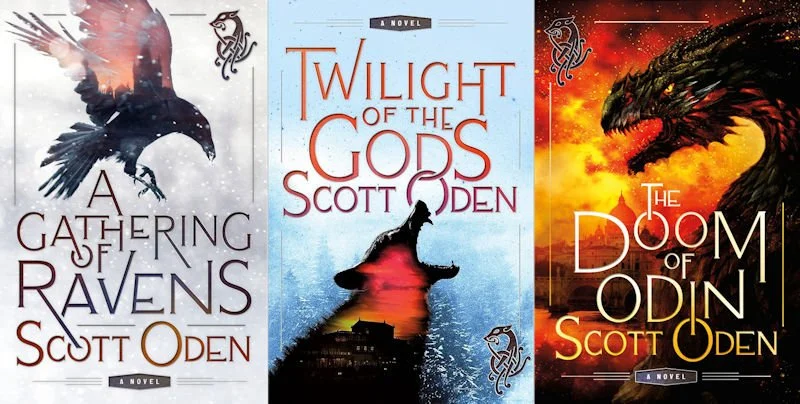
In the landscape of modern grimdark fantasy, few voices resonate with the primal, bone-chilling clarity of Scott Oden. With his acclaimed trilogy, The Grimnir Saga, Oden has crafted a visceral tapestry that weaves together the decaying echoes of Norse mythology with the encroaching, often violent, dawn of the medieval Christian era. At the heart of this saga stands Grimnir—an entity known by many names: Corpse-maker, Life-quencher, the Son of the Wolf, and the last of his kind.
As the series reaches its climactic conclusion, it serves as a haunting meditation on the nature of extinction, the weight of faith, and the inevitability of change. This report examines the structure, thematic resonance, and critical reception of a work that is increasingly recognized as a masterpiece of dark historical fantasy.
The Main Facts: Defining the Saga
The Grimnir Saga is a three-volume epic comprising A Gathering of Ravens, Twilight of the Gods, and the concluding The Doom of Odin. The narrative centers on Grimnir, an orc—or huorco, as he calls his own kind—who serves as a bridge between the ancient, magical past of the North and the hardening, iron-clad reality of the Middle Ages.
Grimnir is not a traditional hero; he is an anti-hero of the highest order. He is bitter, volatile, and deeply rooted in a world that is fast outgrowing him. The saga’s primary conflict is not merely one of clashing armies, but of competing cosmologies. As the "hymn-singers" of the burgeoning Church expand their influence across the Viking heartlands, the old, monstrous, and magical denizens of the world find their domains shrinking. Oden utilizes this friction to propel a narrative that is both an intimate character study and a sweeping historical tragedy.
Chronology of the Decline
The narrative arc of the trilogy is a slow, rhythmic descent into an inevitable conclusion, meticulously paced across the three novels.
A Gathering of Ravens (Book I)
The saga begins with the introduction of Grimnir, a creature of shadow and ancient blood. Here, the reader is introduced to the "new and terrifying" reality of the world. Grimnir is forced into an uneasy alliance with Etain, a young hymn-singer. This initial volume establishes the baseline for the series: a world where the brutality of the Dark Ages is punctuated by the sudden, terrifying intervention of the supernatural. It is here that the reader learns that Grimnir is not merely a monster, but a remnant—a living relic of an age that the gods themselves have abandoned.
Twilight of the Gods (Book II)
As the conflict intensifies, the narrative shifts toward the political and religious upheaval of the era. Grimnir’s journey brings him into contact with Disa, a fierce shield-maiden. The contrast between his first companion, Etain, and this warrior-woman highlights Oden’s skill in character development. Through these relationships, Grimnir undergoes a transformation; he is forced to act as a mentor, a role that extracts human—or at least empathetic—qualities from a character who was ostensibly created only for destruction. This book also introduces the antagonist Konráðr the White, a Christian fanatic whose inner demons mirror the darkness within Grimnir, creating a fascinating psychological parallel.
The Doom of Odin (Book III)
The finale serves as the crucible. The pace accelerates as the conflict reaches a breaking point. Grimnir is thrust into the literal and metaphorical underworld, forced to confront the remnants of his own kin. This final volume provides the most profound insights into the orcish race, showcasing the sheer, unadulterated savagery of his people. The saga concludes with the resolution of Grimnir’s quest for vengeance and the final, definitive fate of the "Corpse-maker."
Supporting Data: Why the Saga Resonates
The strength of The Grimnir Saga lies in its refusal to adhere to the tropes of high-fantasy comfort. Instead, it relies on a "brutal meditation" that keeps the reader engaged through three specific pillars:
- Setting and World-Building: Oden does not overwhelm the reader with "lore-dumping." Instead, the magical elements of the world—the ancient, dark mysticism—are introduced with surgical precision. The atmosphere is consistently thick with the scent of wet earth, iron, and blood.
- Moral Ambiguity: In the realm of grimdark, characters are often either black or white. Grimnir is a shade of grey that shifts with the light. His actions are often "vile," yet his motivations remain rooted in a desperate, understandable drive for survival and vengeance.
- The Dynamics of Relationship: The evolution of Grimnir from a solitary, misanthropic survivor to a figure capable of trust is the emotional anchor of the series. Whether through his interactions with Etain or the mutual respect forged with Disa, Oden proves that even the most "monstrous" beings are defined by their connections to others.
Official and Critical Perspectives
While The Grimnir Saga has perhaps not yet received the mainstream, global recognition of giants like George R.R. Martin or Joe Abercrombie, it has garnered a cult-like following among genre purists. Critics often point to Oden’s prose as a primary strength; his ability to balance internal monologue with visceral, high-stakes action sequences is cited as a benchmark for modern writers.
Literary analysts have noted that the saga functions as an allegory for the transition of power in Europe—the supplanting of pagan, folkloric belief systems with organized, institutionalized religion. The "fanatics" depicted in the books are not merely straw men; they are complex figures burdened by their own rigid moralities, which serves to heighten the tragedy of the inevitable clash.
Implications: The Legacy of the Last Orc
The implications of The Grimnir Saga extend beyond its status as a piece of historical fiction. It challenges the reader to consider the "cost of progress." When a world shifts its paradigm, what is lost? What monsters do we create when we try to civilize the wild?
By centering the narrative on the "last of his kind," Oden forces a confrontation with the idea of obsolescence. Grimnir is a creature of the old ways, and his refusal to fade quietly into the night is a testament to the stubbornness of the past.
For the reader, the saga offers more than just violence. It offers a reflection on:
- The nature of vengeance: Is it a cleansing fire or a corrosive acid?
- The necessity of faith: Whether in the Old Gods or the New, how does it shape the actions of the protagonist?
- The complexity of character: Proving that an "anti-hero" can be more sympathetic and deeply human than the shining knights of traditional fantasy.
Conclusion
The Grimnir Saga stands as an exceptional entry in the dark fantasy canon. It is a rare work that succeeds in being simultaneously a visceral, pulse-pounding read and a deeply philosophical exploration of change. Scott Oden has not only written a story about the last orc; he has written a requiem for the ancient world. For those who seek a narrative that is drenched in blood yet defined by its intimate, human connections, the saga remains an essential, albeit haunting, addition to any library. As the final pages of The Doom of Odin close, the reader is left with the lingering, chilling realization that while the world may have moved on, the shadows remain—and they remember the names of the things they have lost.










No comments yet. Be the first to join the conversation!