Muslim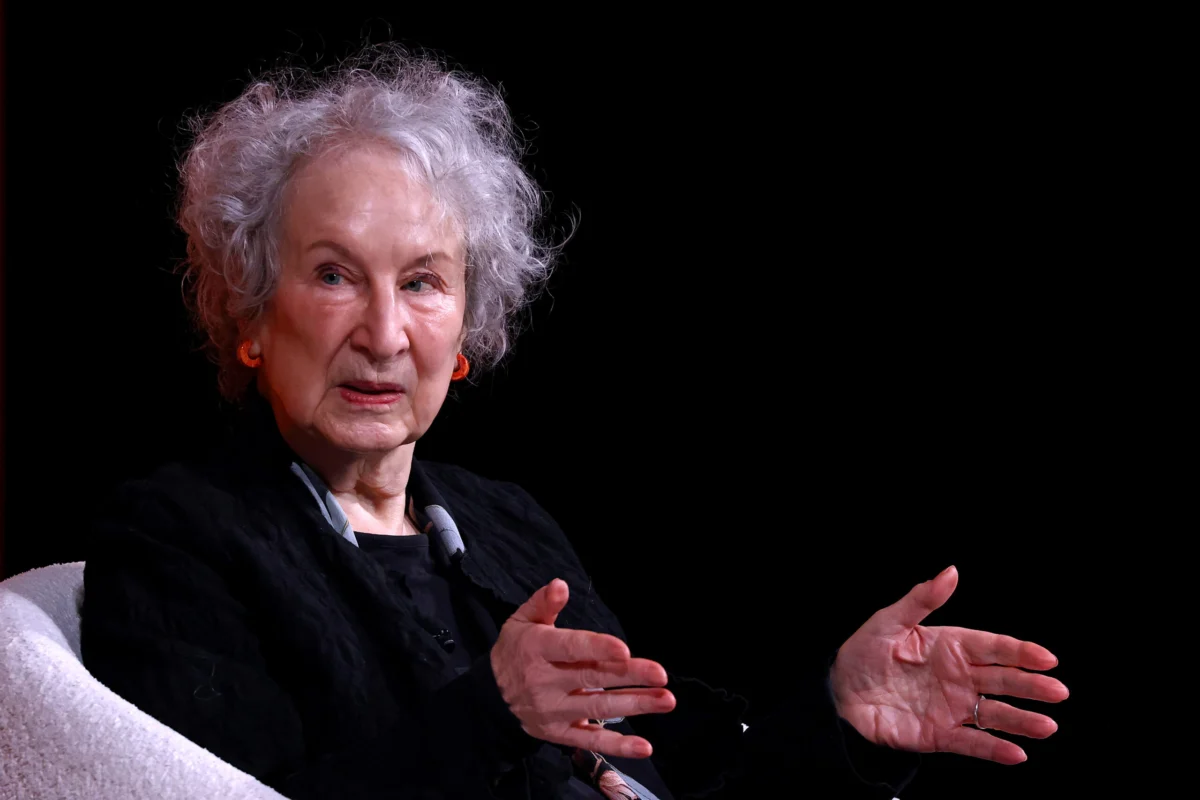
By [Your Name/Editorial Staff]
In the sun-drenched streets of Porto, Portugal, where the Douro River meets the Atlantic, the inaugural Babell Literary and Cultural Festival opened its doors this week to an international audience of bibliophiles and cultural observers. Yet, the true centerpiece of the festival was not the architecture or the wine, but the biting, crystalline intellect of Canadian literary icon Margaret Atwood.
During a wide-ranging career retrospective Q&A, the author of The Handmaid’s Tale offered a masterclass in modern cultural critique. While she was ostensibly in attendance to discuss her recent memoir, Book of Lives (published by Penguin), the conversation inevitably drifted toward the existential anxieties of the 21st century: the unbridled rise of Artificial Intelligence and the perennial, cyclical nature of political censorship. With her characteristic sardonic wit, Atwood dissected these phenomena, offering a stark warning about the intersection of technology, human ambition, and the erosion of democratic discourse.
The "Garbage In, Garbage Out" Paradigm
Atwood’s assessment of the current AI boom was blunt: “The thing about AI is that it’s garbage in, garbage out.” Her critique stems from a fundamental distrust of the data integrity inherent in Large Language Models (LLMs). Rather than viewing these tools as sophisticated creative partners, she views them as mirrors reflecting the chaotic, often inaccurate, and biased output of the internet at large.
The author illustrated this point with a humorous, albeit telling, anecdote about her own limited foray into the technology. Atwood recounted using Anthropic’s Claude—not to draft a novel or construct a plot outline, but to solve a personal curiosity regarding the British detective series Father Brown.
"Claude gave me the wrong answer, or it lied," Atwood remarked to the rapt audience. "Of course, it didn’t know it was lying because it’s not a human being; it’s a large language model. It had skimmed and sampled a lot of television reviews, but they never give away the ending in online criticism, so it was misled by the things it had read about the show."
This failure of synthesis—where the AI attempted to infer facts from a corpus of data that was specifically designed to obscure them—serves as a metaphor for the broader risks of relying on algorithmic intelligence. For Atwood, the incident highlights the "hallucination" problem that plagues the industry. Because these models are trained on the "scraped" detritus of the human web, they inherit the gaps, biases, and logical fallacies of their sources. As she noted, the technology is simply not reliable enough to serve as a bedrock for human decision-making, particularly in fields where precision and accountability are required.
A History of Opportunism
Beyond the technical limitations, Atwood voiced a deeper concern regarding the human element. "Human beings are not robots, but they are opportunists," she observed. "If there’s an easy way to cheat and it’s hard to detect, people will do it."
This insight into the human condition is consistent with the themes that have defined her bibliography for over half a century. Whether in the dystopian reality of Gilead or the near-future scenarios of the MaddAddam trilogy, Atwood has long explored how systems of control—and the individuals who exploit them—manipulate the truth for power. Her concern is that the deployment of AI in business and creative sectors is less about innovation and more about the "easy way out." By automating the creative process or substituting human judgment with statistical probability, we risk creating a feedback loop of mediocrity.
Her warning is clear: even if AI becomes more sophisticated, the necessity of human oversight remains absolute. "Even people who use it for business reasons have to check it because it makes mistakes," she cautioned. In her view, the human "check" is not merely an optional step; it is the only thing preventing the world from drowning in a sea of synthesized inaccuracies.
The Cycle of Censorship: From Gilead to the Classroom
The conversation then pivoted to a topic with which Atwood is intimately familiar: the weaponization of literature through censorship. When asked about the recurring efforts to remove her works from school libraries, Atwood framed the issue with historical perspective. "It’s a very old story in world history," she said, dismissing the moral panic surrounding her books with a wave of her hand.
The Marketing Power of the Ban
Atwood’s reaction to her status as a frequent target of book bans—notably with The Handmaid’s Tale appearing on the PEN America list of most-banned books—was surprisingly pragmatic. "It’s a good sales gimmick," she joked. "Don’t read this book. It’s too hot to read. And then people rush off to buy it and think, ‘Where are the depraved parts?’"
This cynical take on censorship reveals a fundamental truth about the Streisand Effect: efforts to suppress literature often serve only to ignite curiosity, particularly among younger generations. However, while she treats the "gimmick" with humor, she is acutely aware of the underlying motivations of those who would see her work banned.
Political Dissent and the Path to Dictatorship
Atwood noted that while she enjoys the relative safety of living in Canada—a nation she characterized as having a robust, albeit imperfect, commitment to free speech—the current political climate in the United States causes her significant alarm.
"What’s happening in the United States right now is that they’re attempting to stifle political dissent, and as we know, that’s the lead-up to a dictatorship," she warned. She pointed to the consolidation of media ownership as a primary catalyst for this instability. "The billionaire pro-Trumpers are buying up legacy television stations and newspapers. That’s what they’re trying to do."
Yet, Atwood remains a cautious optimist. She pointed to the rise of independent, decentralized digital media as a "counter-movement" that is successfully distributing information outside the traditional gatekeepers. "It’s something to be watched," she remarked, acknowledging that the fight for the narrative is no longer confined to the pages of books or the broadcast towers of major networks, but is being waged in the wild, ungoverned spaces of the internet.
Implications for the Future of Discourse
The implications of Atwood’s commentary at the Babell Festival are profound for both the literary world and the broader public square.
- Epistemic Crisis: We are entering an era where the boundary between human-verified fact and machine-generated fiction is blurring. As LLMs become more integrated into our search tools and news-gathering processes, the risk of a "garbage in, garbage out" cycle threatens the collective understanding of reality.
- The Persistence of Resistance: Atwood’s career demonstrates that the most "dangerous" ideas are those that challenge power structures. The fact that The Handmaid’s Tale remains a lightning rod decades after its publication suggests that the core of the book—the fragility of women’s rights and the ease with which democracy can be dismantled—remains as urgent as ever.
- The Media Landscape: Her observation regarding the acquisition of legacy media by billionaire interests underscores the importance of media literacy. As the established outlets undergo seismic shifts in ownership and editorial direction, the responsibility for verifying truth rests increasingly on the reader.
Conclusion: A Legacy of Reflection
As the session drew to a close, the moderator asked the inevitable question: of all the worlds she has created, which one does she consider her favorite? True to form, Atwood deflected the question with a touch of the macabre humor that has made her one of the most beloved figures in contemporary literature.
"I never make such choices," she replied, "because the others will hear about it and they’ll get their revenge."
In that final quip, Atwood captured the essence of her work: a deep, abiding respect for the power of narrative. Her characters, her settings, and her themes do not simply exist on the page; they possess a vitality that continues to haunt and challenge the reader.
As the Babell Literary and Cultural Festival continues through June 29, the echo of Atwood’s warning remains: whether we are dealing with the algorithmic illusions of artificial intelligence or the reactionary impulses of political censors, the duty of the individual is to remain vigilant, to question the source, and to never settle for the "garbage" that is so easily fed to us. In an age of synthetic answers, Margaret Atwood remains a testament to the enduring, irreplaceable power of the human voice.

 Asep Darmawan
 Ali Ikhwan