

The silent, majestic expanse of geosynchronous orbit (GEO)—a narrow belt 22,000 miles (36,000 kilometers) above Earth’s equator—is no longer a sanctuary of peaceful telecommunications. It has transformed into the world’s highest-stakes chessboard. Once reserved for stationary satellites broadcasting television and routing global data, GEO has become a theater of "inspector" satellites, robotic prowlers, and a nascent, shadow-filled arms race.
As of May 2026, the United States, China, and Russia are actively engaged in a sophisticated game of "cat-and-mouse." With the recent arrival of Russia’s Kosmos 2589, the orbital belt is now crowded with maneuverable spacecraft capable of proximity operations—moving close enough to other satellites to photograph them, eavesdrop on their transmissions, or potentially disable them in a future conflict.
The Strategic Importance of GEO
To understand why major powers are fixated on this specific altitude, one must look at the laws of physics. At 22,000 miles, the orbital period of a satellite matches the Earth’s rotation. This allows a spacecraft to appear "stationary" over a specific longitudinal point on the globe. This makes GEO indispensable for military command and control, missile warning systems, and secure communications for NATO and other global alliances.
For decades, these satellites were "sitting ducks"—large, expensive, and relatively immobile. Today, however, the paradigm has shifted. Military planners now view GEO as a tactical environment, prompting a move toward "proliferated architectures" and maneuverable reconnaissance platforms.
A Chronology of Escalation
The shift toward active orbital inspection began in earnest over a decade ago.
- 2014: The United States launched the first of its Geosynchronous Space Situational Awareness Program (GSSAP) satellites. Designed to provide a "neighborhood watch" for the US military, these satellites have spent years performing maneuvers to observe potential threats.
- 2018: Recognizing the strategic value of proximity operations, China began launching its own inspection-capable satellites, such as the TJS-10, which has recently been spotted hovering near critical US nuclear-hardened communications and missile warning platforms.
- 2025–2026: The arrival of Russia’s Kosmos 2589 marks the latest evolution in this high-altitude rivalry. Launched in June 2025, the satellite spent months in a highly elliptical orbit, performing intricate rendezvous operations with a smaller companion, Kosmos 2590, before circularizing its orbit in GEO this past April.
The Dance of the Inspector Satellites
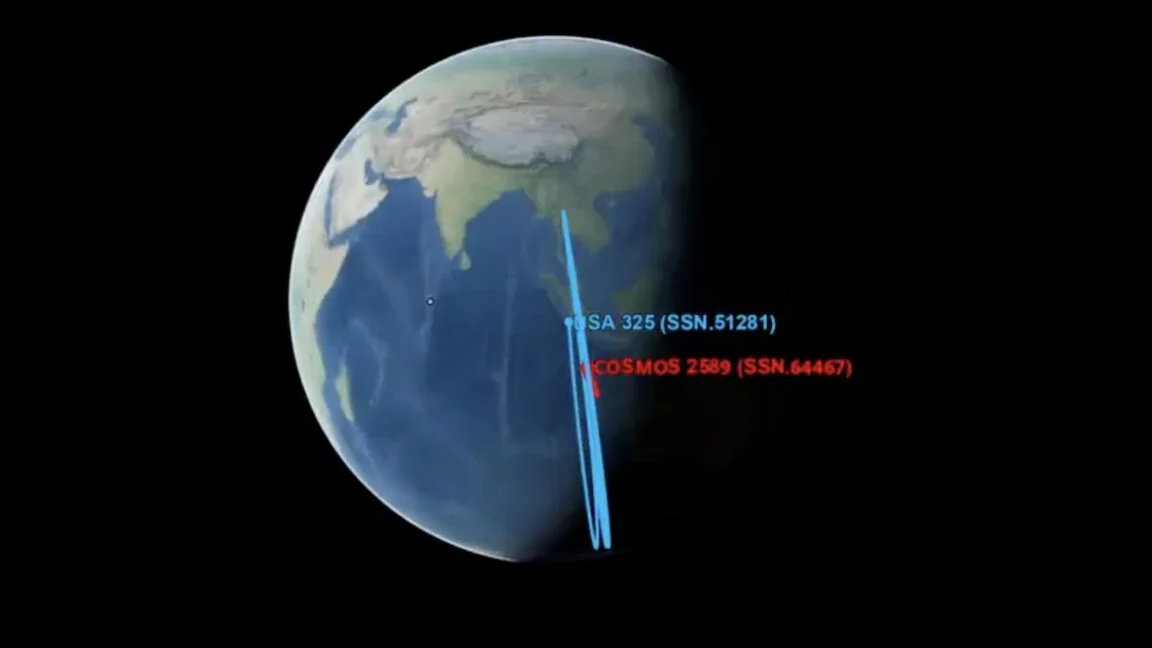
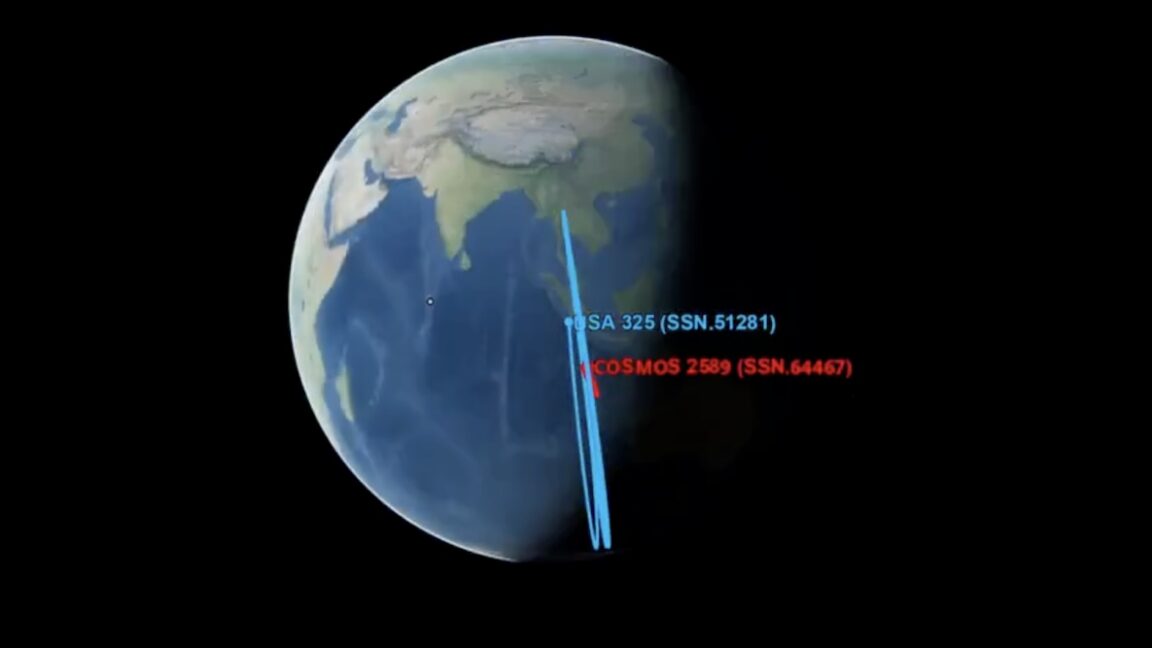
The most striking manifestation of this new era is the "orbital dance" between US and Russian assets. According to data provided by COMSPOC, a commercial space situational awareness firm, the US GSSAP-6 satellite (USA-325) has been shadowing Kosmos 2589 since its arrival. By May 1, 2026, the US satellite was swinging near the Russian newcomer twice daily, coming within a mere 8 miles (13 kilometers) at its closest point.
Unlike the Cold War era, where submarines relied on stealth and acoustic silence, modern satellite espionage is highly visible. These metallic, highly reflective objects stand out against the absolute blackness of space. "One of the dynamics of the current geosynchronous cat-and-mouse activity is your desired imaging target may try to run away from you," notes retired Lt. Gen. John Shaw, former deputy commander of US Space Command. "And as it goes away from you, it may even turn around and get a good look at you."
This observation underscores the psychological and tactical volatility of the environment. When a new satellite arrives, it is at its most vulnerable—still undergoing post-launch testing and orbital adjustments. Major powers now make it a standard operating procedure to "greet" these new arrivals with an inspection mission, essentially performing a digital and optical audit of the adversary’s capabilities.
Official Responses and Tactical Evolution
The US military is acutely aware that its current fleet of GSSAP satellites is aging and limited by fuel capacity. Northrop Grumman, the contractor behind the GSSAP program, designed these craft for endurance, but the rapid increase in "maneuver warfare" in space is pushing them to their limits.
General Stephen Whiting, commander of US Space Command, recently articulated the shift in philosophy at a Mitchell Institute for Aerospace Studies event. "The Marines have a great definition of maneuver warfare—that it’s about shattering your enemy’s will and cohesion through rapid and disruptive acts, spatially, temporally, psychologically," Whiting stated.
The goal, according to General Whiting, is to move beyond the current "conservative" mode of satellite operations. He wants operators to be able to "fly that satellite like you stole it" for tactical advantage, rather than adhering to slow, predictable orbit-keeping maneuvers. The current constraint of limited fuel, however, remains a primary bottleneck to this vision.
The Future: The RG-XX/Andromeda Program
To address these limitations, the US Space Force has initiated the RG-XX, or "Andromeda" program. This next-generation initiative aims to deploy a larger, more affordable, and crucially, refuelable fleet of patrol satellites.
The Space Force is currently evaluating a massive array of potential suppliers, including heavyweights like Lockheed Martin and Northrop Grumman, alongside agile newcomers such as Anduril Industries, True Anomaly, and Turion Space. The intent is to move toward a "proliferated architecture"—a strategy where dozens or even hundreds of smaller, modular satellites replace the fewer, more fragile assets of the past.
The stated goal of the Andromeda program is "predictive battlespace awareness." By maintaining a persistent, high-fidelity view of the GEO belt, the Space Force intends to stay ahead of adversary strategies and ensure space superiority well into the 2030s.

The Implications for Global Stability
The militarization of geosynchronous orbit carries profound implications for international law and global security. As satellites move closer to one another, the risk of accidental collision—or, more concerningly, intentional interference—grows.
While Western analysts suggest that Russian satellites like Kosmos 2589 may be high-altitude versions of the "Nivelir" anti-satellite system (designed to neutralize or disable Western comms), the ambiguity of these missions creates a dangerous "gray zone." In this environment, a simple inspection maneuver could be misinterpreted as an act of aggression, potentially triggering a rapid escalation.
Furthermore, the rise of commercial space situational awareness (SSA) companies means that this "shadow war" is no longer the sole purview of intelligence agencies. Amateur astronomers and private researchers are now tracking these maneuvers in real-time, effectively democratizing the surveillance of military assets. This transparency creates a unique pressure on governments; they can no longer conduct "co-orbital" operations in total secrecy.
Conclusion
The black void of geosynchronous orbit has been illuminated by the glare of high-tech sensors and the political friction of competing superpowers. As the US, China, and Russia continue to refine their ability to maneuver, watch, and potentially disrupt, the space domain is rapidly evolving from a scientific and commercial frontier into a critical, contested military theater.
Whether this trend leads to a new era of deterrence or a series of unpredictable and dangerous incidents remains to be seen. What is clear is that the "neighborhood watch" in the sky is becoming increasingly crowded, and the rules of the road are being written—or perhaps ignored—in real-time, 22,000 miles above our heads.












No comments yet. Be the first to join the conversation!