Nana Muazin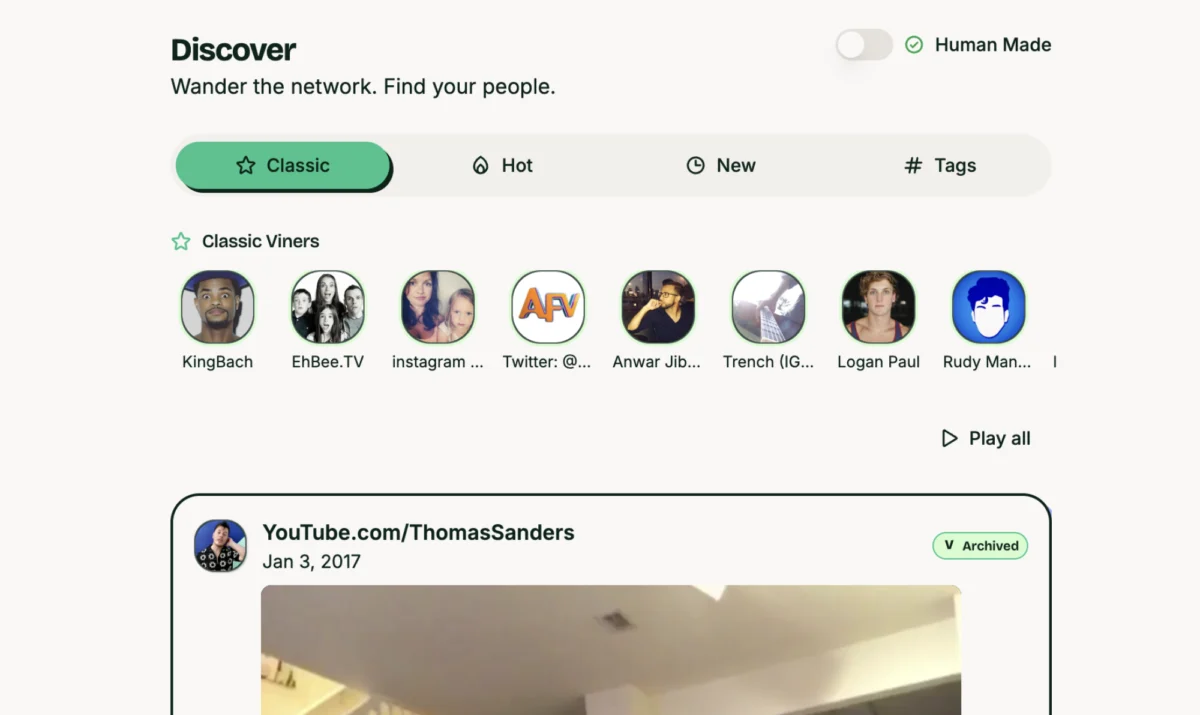
It is a sentence that feels like a glitch in the timeline of the internet: Vine is back. In the year 2026, a platform that was ceremoniously laid to rest nearly a decade ago has been exhumed, rebranded, and relaunched. This time, however, the digital landscape looks drastically different from the one that existed when the original short-form video app was shuttered by Twitter in 2017.
The revival, known as Divine, carries the weight of history and the baggage of its predecessor. Perhaps most ironically, the project is being bankrolled by Jack Dorsey, the former Twitter CEO who presided over the original Vine’s demise. As Divine emerges into a market now dominated by the algorithmic juggernauts of TikTok, Instagram Reels, and YouTube Shorts, it is positioning itself not as a competitor to these titans, but as an antithesis to the culture they have cultivated. Its core promise? A sanctuary for human-centric content, free from the creeping tide of “AI slop.”
A Chronology of a Digital Phoenix
To understand the significance of Divine, one must revisit the short, meteoric life of the original Vine. Launched in 2013, Vine revolutionized mobile consumption with its strict six-second loop format. It became a cultural touchstone, launching the careers of digital icons like Logan Paul and King Bach, and fostering a unique brand of rapid-fire, surrealist comedy that defined the mid-2010s.
At its peak, Vine boasted 100 million monthly active users. Yet, in early 2017, the platform was discontinued by Twitter. The decision was widely viewed as a failure of vision, with the app’s creative community scattering to Instagram and, eventually, the rapidly rising TikTok.
The path to Divine began in the shadows. The project is led by Evan Henshaw-Plath, a former Twitter employee and developer known in tech circles as "Rabble." Initially, the project began as a labor of love—an attempt to create a permanent, archival home for the hundreds of thousands of classic Vines that risked being lost to digital rot. However, with backing from Dorsey’s nonprofit organization, and Other Stuff—a venture dedicated to supporting open-source social media—the project evolved from a museum into a living, breathing social platform.
Following a successful beta test in November 2025, which garnered significant industry attention for its radical "human-only" verification protocols, Divine officially opened its digital doors to the public in May 2026.
The Mandate Against the Machine
Divine enters the arena with a distinct ideological chip on its shoulder. While competitors rely on complex, engagement-driven algorithms to feed users an endless stream of content—much of which is increasingly synthesized, filtered, or generated by artificial intelligence—Divine is betting on the allure of authenticity.
“Freedom from AI slop” is more than a marketing slogan for Divine; it is an architectural requirement. To enforce this, the platform has implemented a rigorous verification system. Users who wish to post content on Divine must either record their videos directly within the application’s native interface or submit their pre-recorded files through a validation process powered by the Guardian Project, a human rights nonprofit focused on digital security and provenance.
This verification tool serves as a digital gatekeeper, designed to detect and flag content generated by large language models or AI video-synthesis tools. It is a bold, albeit friction-heavy, approach to content moderation. In an era where deepfakes and automated "engagement farming" have diluted the value of social media, Divine is essentially attempting to turn back the clock to an era where the creator was undeniably, physically present.
Official Responses and the Vision of Ownership
Jack Dorsey, in a rare public statement regarding the venture, has acknowledged the failures of the original Vine. The relaunch is not merely a nostalgic exercise, but an attempt to rectify the structural shortcomings that led to the original platform’s death.
“The core principle here is ownership,” Dorsey stated in a briefing with The Guardian. “Creators should not just be tenants on a platform. On Divine, users will own their content, their audience, and their ability to monetize. They aren’t just fuel for an advertising engine; they are the stakeholders.”

This philosophy aligns with the broader "Fediverse" movement, where social media is decentralized, and users aren’t locked into the proprietary silos of Big Tech. By leveraging open-source protocols, the Divine team hopes to ensure that if the platform ever does decide to close its doors, the users’ digital history—their videos, their archives, and their follower relationships—remains theirs to take elsewhere.
Evan Henshaw-Plath echoed these sentiments during his 2025 TechCrunch interview. "We want to recapture the feeling of 2013, not the technology," he explained. "Back then, social media was built around people, not algorithms. We want to return to a model where your feed is a reflection of the people you choose to follow, not what a machine thinks will keep you addicted for three more minutes."
The Competitive Landscape: A David vs. Goliaths Scenario
The challenge facing Divine is monumental. The short-form video landscape of 2026 is a far cry from the experimental environment of 2013.
- TikTok: The incumbent king, which has successfully weaponized the algorithmic feed to capture the attention of billions.
- YouTube Shorts: A behemoth that leverages the world’s largest video repository to feed users, consistently generating upwards of 200 billion daily views.
- Instagram Reels: The primary vehicle for Meta’s short-form engagement, deeply integrated into a social graph that keeps billions of users tethered to its ecosystem.
Against this backdrop, six seconds of human-made video seems like a quaint, almost defiant, proposition. Critics argue that the "no-AI" mandate may alienate professional creators who rely on AI-assisted editing tools for efficiency. Furthermore, the friction of human verification could deter the casual, mass-market user who prefers the "path of least resistance" offered by TikTok’s frictionless, infinite scroll.
However, the team behind Divine argues that the market is reaching a saturation point of artificiality. As users grow increasingly fatigued by "brainrot" content and hyper-synthetic imagery, the demand for genuine, unpolished human expression may be on the rise.
Implications for the Future of Social Media
The relaunch of Vine as Divine is an experiment in digital sociology. If it succeeds, it could prove that there is a viable, sustainable market for "slow" or "authentic" social media. It challenges the prevailing industry belief that growth must be maximized at all costs through algorithmic manipulation.
Furthermore, the integration of the Guardian Project’s verification tools sets a new precedent for platform responsibility. If a niche app can successfully keep AI slop off its feed, it places pressure on the tech giants—Meta, Google, and ByteDance—to answer for the flood of synthetic content on their own platforms.
The irony, of course, is not lost on the public: the man who killed Vine is now the man trying to save it from the very forces he helped unleash. By funding a platform that prioritizes human agency over machine efficiency, Dorsey is attempting a rare feat of atonement.
Whether Divine becomes a true competitor or remains a niche haven for purists, its mere existence is a testament to our collective nostalgia for a simpler, more human internet. As of today, the app is available on the Google Play Store and the Apple App Store, inviting a new generation—and a few nostalgic veterans—to record their six seconds of truth.
In a world drowning in synthetic noise, Divine is betting everything on the idea that the most radical thing you can do is simply be yourself, unedited and unautomated. Whether that is enough to survive the brutal economics of modern social media remains to be seen, but for the first time in nearly a decade, the loop has finally started again.

 Basiran
 Nana
Nana