

By Editorial Staff
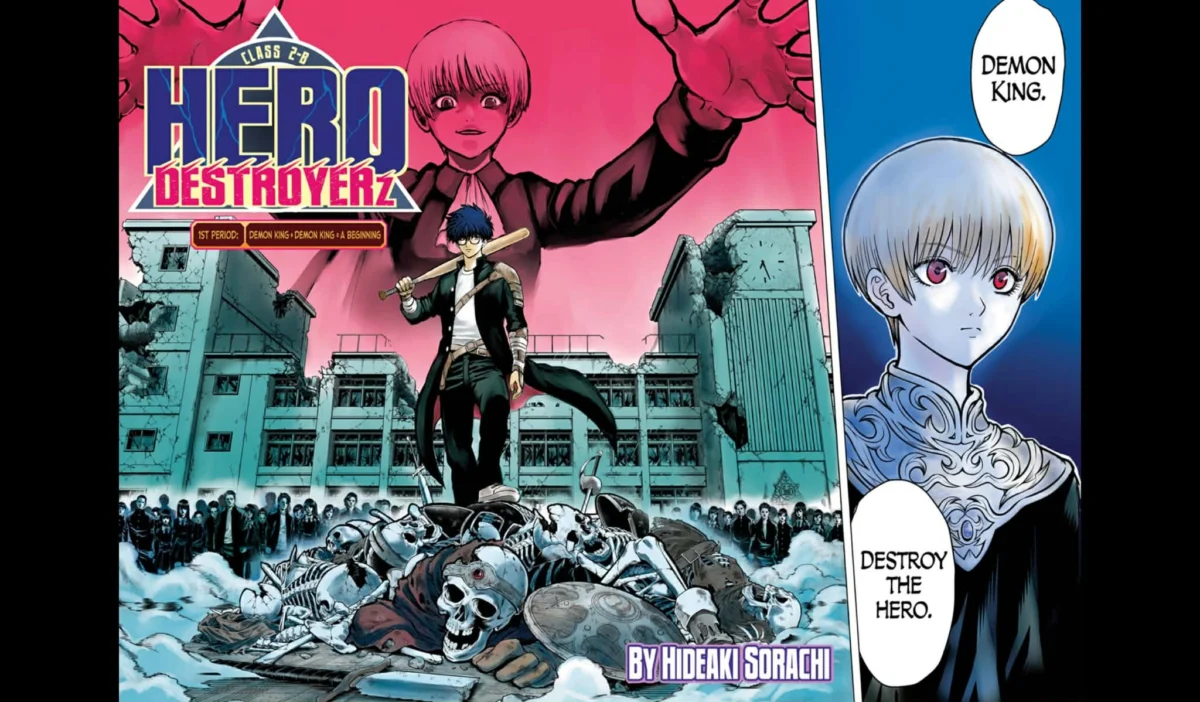
After a silence lasting more than half a decade, the manga industry’s most beloved provocateur has returned. Hideaki Sorachi, the creative force behind the legendary Gintama, has officially re-entered the weekly serialization fray with his latest work, Class 2-B Hero Destroyerz. Published via Shonen Jump, this new series serves as a stark reminder that while the industry evolves, the singular, absurdist voice of Sorachi remains as sharp, messy, and unapologetically chaotic as ever.
For fans who have spent the last several years mourning the end of the Yorozuya’s adventures, Class 2-B Hero Destroyerz is not merely a new title; it is a homecoming. With translation duties handled by Adrienne Beck and lettering provided by Thom Kilcourse, the series has hit the ground running, promising a return to the high-octane, meta-fictional humor that defined a generation of manga readers.
Main Facts: A Bold New Era of Nonsense
At its core, Class 2-B Hero Destroyerz is a masterclass in the "reverse isekai" genre—a premise that Sorachi treats with the exact amount of disrespect it deserves. The narrative hook is immediate and intentionally ridiculous: The Demon King Valaris, having suffered a crushing defeat at the hands of a traditional fantasy hero, manages to transfer their essence into a clone, Valaris III. Through an underground tunnel, this clone emerges in the most mundane location imaginable: the bathroom of a modern-day Japanese high school.
This setup functions as the bedrock for the series’ tone. By dropping a high-fantasy villain into a toilet stall, Sorachi establishes the series’ identity: it is a work that thrives on the friction between grand, epic stakes and the pathetic, banal realities of human existence. The protagonist of this narrative is not the Demon King alone, but the interplay between them and Akira Kumon, a transfer student who acts as the perfect, deadpan foil to the insanity unfolding around him.
The primary conflict is not merely one of magic versus reality, but of a character who refuses to engage with the absurdity of his own existence. When Akira encounters Valaris III’s magical illusions, he does not tremble in fear; he treats the Demon King like an awkward foreign exchange student navigating a culture gap. This refusal to acknowledge the supernatural is a recurring comedic engine that elevates the chapter from a simple gag manga to a sophisticated satire of the "hero’s journey."
Chronology: The Evolution of a Master of Chaos
To understand the weight of this return, one must look at the trajectory of Sorachi’s career. His previous masterwork, Gintama, ran for fifteen years, successfully navigating the transition from a pure episodic comedy to a series with deep, character-driven emotional arcs. Sorachi became known for his ability to break the "fourth wall" with surgical precision, often mocking the very medium of manga, the editorial policies of Shonen Jump, and his own status as a creator.
The chronology of Class 2-B Hero Destroyerz begins with this legacy. The first chapter functions as a condensed version of everything that made Gintama a success. Readers are immediately thrust into the established rhythm of the author: the toilet humor, the visual gags, and the rapid-fire shifts in tone.
The chapter unfolds as follows:
- The Defeat: The rapid dispatch of the traditional "Hero vs. Demon King" trope, signaling that the fantasy genre is merely a playground for the author.
- The Incursion: The arrival of Valaris III in the Japanese school system, turning the "isekai" trope on its head by forcing the fantasy element to adapt to the rules of modern society.
- The Introduction: The meeting between Akira and the Demon King, establishing the dynamic that will likely drive the series forward.
- The Humiliation: A sequence of gags where the Demon King, a being of immense power, is defeated by everyday hazards—stairs, sports equipment, and the structural design of a school building.
Supporting Data: The Anatomy of the Sorachi Style
What makes Class 2-B Hero Destroyerz work—and why it has already garnered a strong critical reception—is the consistency of Sorachi’s craft. The art remains instantly recognizable: thick, bold line work, highly exaggerated facial expressions that shift from "normal" to "grotesque nightmare" in a single panel, and an energetic flow that makes the pages feel as though they are moving.

Supporting the narrative are the technical contributions of the English localization team. Adrienne Beck’s translation maintains the natural, conversational flow that is vital for comedy, ensuring that even when the jokes are inherently ridiculous, they land with precision. Thom Kilcourse’s lettering is equally vital; in a series where character voices vary from high-fantasy arrogance to teenage apathy, the lettering must convey the manic energy of the script without overwhelming the reader.
Statistically, the reception has been overwhelmingly positive for the intended audience. The chapter sits at a strong 7.7/10 rating among early reviewers, with the consensus being that it is "messy, stupid, and unmistakably Sorachi."
Official Responses and Industry Context
The return of a creator of Sorachi’s stature is a significant event for Shonen Jump. In an industry increasingly dominated by high-stakes, action-oriented "battle manga," a pure gag series serves as a necessary palate cleanser. Editorial commentary from the Jump offices has remained characteristically sparse, letting the work speak for itself, but the decision to bring back such a high-profile creator signals a confidence in the series’ ability to bridge the gap between long-time Gintama fans and a new generation of readers.
Critics have noted that while the series is proudly immature, it is self-aware enough to recognize its own limitations. The series is not trying to reinvent the wheel; it is trying to break it and laugh at the pieces. This "proud immaturity" is exactly what the author’s base has been waiting for, proving that even after half a decade away, the "Gorilla"—a nickname affectionately given to Sorachi by his fanbase—has lost none of his bite.
Implications: Where Does the Demon King Go from Here?
The final stretch of the first chapter provides a critical insight into the future of the series. While the premise is intentionally thin, Sorachi drops just enough hints regarding the stakes to suggest that the story will evolve beyond simple gags.
Historically, Sorachi has a proven ability to pivot from nonsense to genuine, gut-wrenching emotion. The implication here is that Class 2-B Hero Destroyerz may eventually follow the Gintama template: starting as a series of disconnected, hilarious vignettes before coalescing into a narrative with profound emotional depth.
For the reader, the question is simple: Are you willing to go along for the ride?
If you are a fan of The Disastrous Life of Saiki K., Sakamoto Days, or Gintama, the answer is a resounding yes. This is not a series designed for everyone; it is loud, chaotic, and intentionally abrasive toward those who prefer their stories to take themselves seriously. However, for those who appreciate the intersection of high-concept fantasy and low-brow, rapid-fire humor, Class 2-B Hero Destroyerz is the most important manga debut of the year.
The "Gorilla" is back, the toilet is the new battlefield, and for the first time in a long time, the weekly grind of manga reading feels like it has regained its sense of humor. Whether this series will ultimately reach the heights of its predecessor remains to be seen, but the first step is a confident, messy, and triumphant leap into the unknown. We will be watching to see if the chaotic magic holds, but for now, it is enough to simply enjoy the return of one of the medium’s most unpredictable voices.









No comments yet. Be the first to join the conversation!