

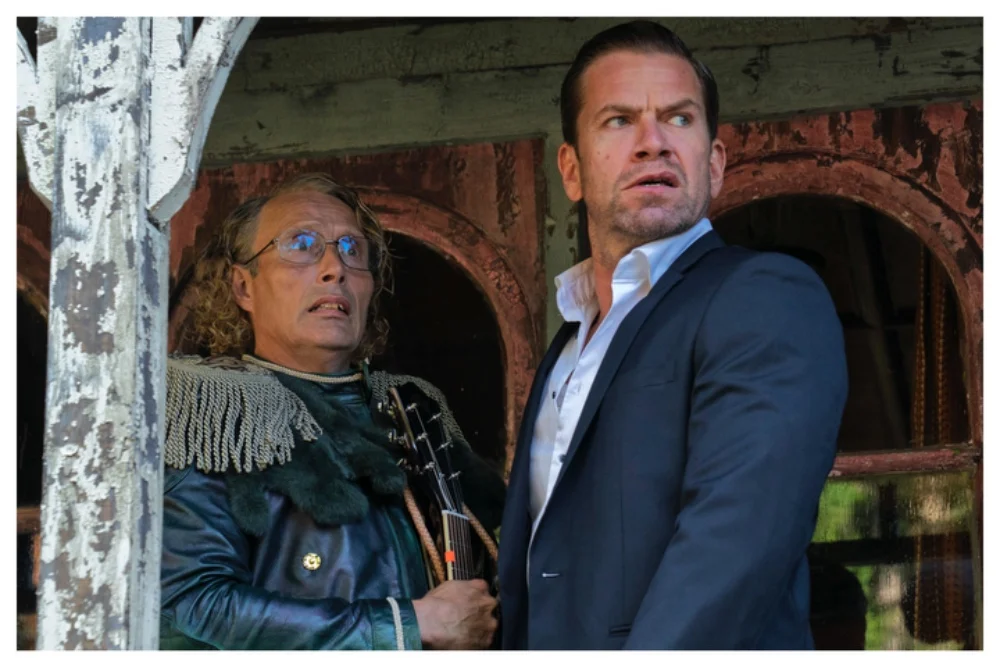
Anders Thomas Jensen is a name that resonates with a specific, cult-like fervor in the corridors of international arthouse cinema. A screenwriter of immense prestige—responsible for the sharp, humanistic edges of After the Wedding, In a Better World, and the sweeping historical scope of The Promised Land—Jensen operates with a dual identity. When he steps into the director’s chair, the prestige evaporates, replaced by a singular, chaotic vision that fuses antic, absurdist comedy with the cold, hardboiled realities of the crime thriller genre.
His latest directorial effort, The Last Viking, which hits Stateside theaters this week, serves as the most recent, and perhaps most volatile, testament to this idiosyncratic brand of filmmaking. Featuring his perennial collaborator, the chameleonic Mads Mikkelsen, the film is a masterclass in tonal whiplash. While it offers a visual and performative experience that is undeniably captivating, it also poses a difficult question: can a film sustain its own weight when its extremes are actively working against one another?
The Anatomy of the Jensen Formula
To understand The Last Viking, one must understand the "Jensen Formula." It is a recipe that has defined films like Riders of Justice and Men and Chicken. It relies on a high-stakes, violent premise—often involving criminal underworlds or deep-seated trauma—and destabilizes it with characters who exist in a state of heightened, often delusional, reality.
In The Last Viking, this tension is palpable from the opening frames. The film arrived in U.S. markets following an out-of-competition premiere at the Venice Film Festival, where it was met with a mixture of awe and bewilderment. In Denmark, the film was a runaway commercial success, outgrossing Jensen’s previous directorial endeavors. Yet, the film remains a contentious subject for critics and industry insiders alike. Notably, despite its massive domestic popularity, it was snubbed by Danish Oscar selectors in favor of Mr. Nobody Against Putin for the Best International Feature category. This rejection highlights a broader skepticism regarding whether Jensen’s specific brand of "Danish noir-farce" possesses the necessary crossover appeal for global awards circuits.
A Chronology of Chaos: From Viking Lore to the Fab Four
The film opens with an eccentric animated sequence, rendered in the style of a medieval picture book. It recounts the legend of an ancient king who, mourning the loss of his son’s arm in battle, demands that every one of his subjects sacrifice an arm in a grotesque display of solidarity. While this fable is bookended at the film’s conclusion, its immediate relevance is obscured by the rapid-fire introduction of the primary narrative.
The plot shifts abruptly to the present day, introducing Anker (Nikolaj Lie Kaas), a hardened thief caught in the middle of a botched heist. With the authorities closing in, Anker entrusts his naive, vulnerable brother, Manfred (Mikkelsen), with the location of the stolen loot.
The timeline jumps 15 years into the future. Anker, finally released from prison, seeks out his brother, expecting to retrieve his fortune. Instead, he discovers that Manfred has undergone a radical transformation. Following a diagnosis of dissociative identity disorder, Manfred has fully inhabited the persona of John Lennon. He is not merely a fan; he is, in his own mind, the late Beatle, living and breathing in a state of blissful, sometimes violent, denial. Any attempt to address him by his birth name is met with volatile, physical outbursts—at one point, Manfred hurls himself from a moving vehicle to avoid the indignity of his own identity.
The quest for the hidden money takes the brothers on a road trip to their childhood home, now a trendy Airbnb. The property is managed by an unsuspecting, bickering couple (Sofie Gråbøl and Søren Malling) who serve as the "straight men" to the absurdity unfolding on their doorstep. They are joined by Manfred’s therapist, Lothar (Lars Brygmann), and two additional patients who have been convinced that they, too, are members of the Beatles, intended to round out a therapeutic tribute band.
Supporting Data: The Performative Heavyweight
At the heart of this "overstuffed" narrative is Mads Mikkelsen. His portrayal of Manfred is a departure from the stoic, menacing, or morally gray roles that have defined his international career. Donning a greasy, unflattering wig and adopting a jerky, arrhythmic physicality, Mikkelsen delivers a performance of startling commitment.
Supporting Mikkelsen is Nikolaj Lie Kaas, who provides the necessary, if slightly exhausted, anchor for the film. While Kaas plays the role of the "straight man" with commendable stoicism, the film’s structure often leaves him relegated to the background of his own story. Other characters—most notably the brothers’ sister, Freja (Bodil Jørgensen)—are left to wander through the periphery, their arcs often feeling like afterthoughts in a film that is fundamentally obsessed with the psychological breakdown of its lead.
Official Responses and Industry Reception
The critical reception of The Last Viking has been as divided as the film’s own tonal shifts. While some critics have lauded Jensen for his "bravura strangeness," others have pointed to the jarring juxtaposition of violence and comedy as a major point of failure.
Industry analysts suggest that the film’s reliance on extreme, often gender-disproportionate violence, acts as a barrier to wider empathy. When the film attempts to shift toward emotional catharsis—using the Beatles as a metaphor for healing and connection—the transition feels unearned to many viewers. One prominent critic noted, "When the film most actively reaches for the heart, one wonders if they are about to be pranked."
This "prank" factor is an inherent risk in Jensen’s work. By constantly subverting the audience’s expectations, he risks alienating viewers who seek a cohesive narrative emotional arc. However, proponents argue that the film’s refusal to adhere to standard storytelling beats is exactly what makes it a necessary addition to the contemporary cinematic landscape.
Implications: The Future of "Jensen-esque" Cinema
What does The Last Viking imply for the future of Danish cinema and international arthouse production? It suggests a continued appetite for high-risk, high-reward filmmaking. Even as the film drifts "off-the-rails" in its third act, its singularity remains its strongest asset.
The film’s commercial success in Denmark indicates that local audiences are deeply invested in Jensen’s evolution. However, the international market remains a different beast. The film’s failure to secure an Oscar nomination, combined with its polarized reviews, suggests that the "Jensen Formula" may have reached a threshold. To continue to grow, the director may need to find a way to reconcile the "silly and the grisly" without allowing them to cannibalize one another.
Ultimately, The Last Viking is a film that demands to be seen, if only to witness the sheer audacity of its creation. It is not a perfect film, nor is it a particularly comfortable one. Yet, it is a testament to a filmmaker who refuses to play it safe, even when the ground beneath him is shifting. Whether this marks the zenith of Jensen’s style or the beginning of a necessary pivot remains to be seen. One thing is certain: the world of cinema would be a significantly more boring, and perhaps a more "sane," place without the calculated madness of Anders Thomas Jensen.
In conclusion, while The Last Viking may not satisfy those looking for a balanced thriller or a coherent character study, it offers a visceral experience that lingers long after the credits roll. It is a work of pure, unadulterated creative ego—a trait that, in an era of sanitized, formulaic blockbusters, is becoming an increasingly rare and valuable commodity. As audiences continue to digest this latest entry in the Jensen-Mikkelsen canon, the conversation will likely continue to center on the thin, permeable line between genius and the absurd.











No comments yet. Be the first to join the conversation!