

TikTok has officially unveiled its "Agentic Hub," a centralized platform designed to fundamentally alter how brands approach digital advertising. By integrating third-party artificial intelligence tools directly into its advertising ecosystem, TikTok is shifting the paradigm from simple automated ad-buying toward an "agentic" workflow—where AI doesn’t just execute commands but functions as an active participant in campaign strategy, creative production, and performance analysis.
This move marks a significant evolution in the platform’s business model, positioning TikTok not just as a content destination, but as a sophisticated software-as-a-service (SaaS) environment for global marketers.
1. The Main Facts: What is the Agentic Hub?
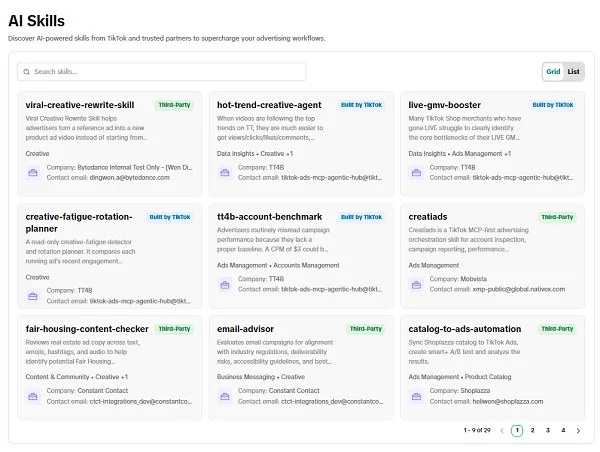
At its core, the Agentic Hub serves as a marketplace and command center for "AI Skills." These are specialized software modules—developed both by TikTok and its external partners—that plug directly into the TikTok Ads Manager.
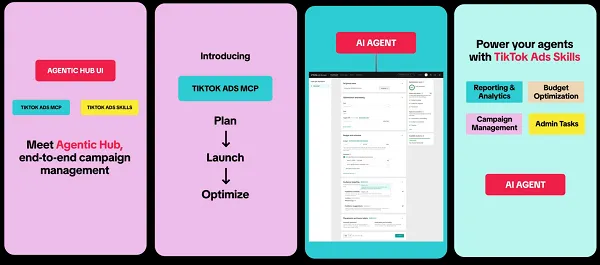
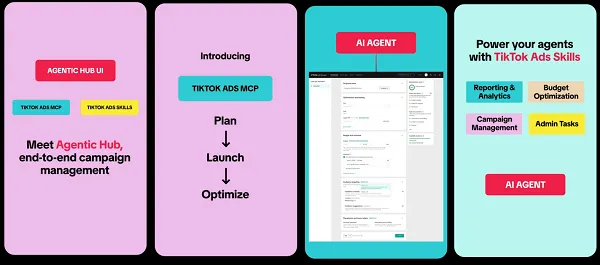
Unlike traditional ad tools that require manual input for every adjustment, "agentic" AI is designed to perform autonomous or semi-autonomous tasks. The hub is built upon the Model Context Protocol (MCP), an open standard that allows the TikTok advertising platform to communicate seamlessly with third-party AI models. This interoperability ensures that data from a brand’s CRM (like HubSpot) or web builder (like Wix) can inform TikTok’s ad engine in real-time.
Key functionalities currently available in the hub include:
- Creative Generation: Automating the production of ad visuals and video assets.
- Catalog Management: Syncing product inventories to ensure ads reflect current availability.
- Performance Analysis: Synthesizing complex data sets into plain-English recommendations.
- Audience Insights: Utilizing machine learning to identify high-converting micro-segments.
2. Chronology: The Road to AI Integration
TikTok’s path to the Agentic Hub reflects the broader industry trend of integrating generative AI into marketing stacks.
- 2022-2023 (The Foundations): TikTok began introducing "Smart Performance Campaigns," which used basic machine learning to optimize ad delivery. During this period, the focus was primarily on algorithmic bidding.
- Early 2024: As generative AI (LLMs and diffusion models) exploded in popularity, TikTok launched various creative suite tools, allowing users to generate ad copy and basic video templates. However, these tools remained siloed within the TikTok interface.
- Mid-2024: TikTok began exploring the "Agentic" model—a concept where AI agents are granted the autonomy to complete multi-step tasks.
- Late 2024 (The Launch): The official rollout of the Agentic Hub signifies the maturation of this strategy. By adopting the Model Context Protocol, TikTok signaled that it is no longer interested in building every tool in-house; instead, it is building an ecosystem where external experts can provide specialized "Skills."
3. Supporting Data: Why AI Agents Matter for ROI
The shift toward AI-driven advertising is backed by the urgent need for efficiency in an increasingly fragmented digital landscape. Data from recent industry reports suggests that marketers spend upwards of 60% of their time on manual campaign management—tasks like updating audience lists, adjusting budgets, and A/B testing ad copy.
TikTok’s internal benchmarks suggest that the Agentic Hub can drastically reduce this overhead. By automating the "grunt work," marketers are reportedly able to:
- Decrease Time-to-Market: The time required to launch a new campaign can be reduced by as much as 40% through the use of template-driven AI creative generation.
- Improve Conversion Rates: Because the AI agents can ingest "real-world engagement insights," they make optimization decisions faster than a human analyst, often leading to a reported 15–20% increase in ROAS (Return on Ad Spend) for early beta testers.
- Scale Personalization: For brands with massive product catalogs, AI agents can dynamically generate thousands of variations of an ad, each tailored to specific user personas, a task that would be logistically impossible manually.
4. Official Responses and Industry Integration
TikTok has framed the Agentic Hub as a strategic partnership between the platform and the developer community. The launch includes high-profile support from major industry players:
- HubSpot: Integration allows for seamless lead management, where TikTok campaign data flows directly into CRM workflows.
- Wix: Enables small-to-medium businesses (SMBs) to push website content and products into the TikTok ad environment without leaving their Wix dashboard.
- Constant Contact & Mobvista: These partners provide specialized tools for email marketing synergy and performance-based user acquisition, respectively.
In an official statement, TikTok emphasized that these tools "go beyond automation." The company stated, "By analyzing vast quantities of data and synthesizing insights into actionable recommendations, these AI Skills help advertisers make smarter decisions, execute more efficiently, and focus on strategic priorities."

Essentially, TikTok is promising that the Agentic Hub will liberate marketers from the spreadsheet-heavy aspects of their jobs, allowing them to return to the "art" of brand storytelling.
5. Implications: The Future of Digital Advertising
The launch of the Agentic Hub has profound implications for the advertising industry at large.
The Rise of the "AI-First" Marketer
We are entering an era where a marketer’s value is no longer defined by their ability to manually manage a campaign, but by their ability to curate the right AI agents. The role of the "Campaign Manager" is evolving into that of an "AI Orchestrator." Brands will need to hire talent that understands how to prompt, supervise, and optimize these agentic workflows.
The Commoditization of Creative
With the Agentic Hub lowering the barrier to high-quality creative generation, the market will likely see a massive influx of ad volume. This creates a "content arms race." As everyone gains access to the same AI-powered creative tools, the competitive advantage will shift from who has the tools to who has the most distinct brand identity and who provides the most relevant data for the agents to analyze.
The "Walled Garden" Expansion
By integrating third-party tools through the Model Context Protocol, TikTok is effectively tightening its grip on the marketing funnel. By making it easier for brands to keep their entire workflow inside the TikTok ecosystem, the platform reduces the friction associated with cross-platform advertising. For competitors like Meta or Google, this represents a significant challenge: TikTok is becoming a "one-stop-shop" that is increasingly difficult to leave.
Small Business Democratization
Perhaps the most positive implication is the democratization of advanced ad tech. Historically, only large agencies had the resources to employ data scientists and analysts to optimize campaign performance. The Agentic Hub provides the same, if not superior, analytical power to the local bakery or the independent e-commerce startup. By leveling the playing field, TikTok is likely to see an increase in ad spend from the SMB sector, which is critical to the platform’s long-term financial health.
Conclusion: A Strategic Pivot
TikTok’s Agentic Hub is more than just a new feature set; it is a clear declaration of intent. The platform is betting that the future of advertising lies in the intersection of generative AI and autonomous agents.
As brands continue to navigate a landscape defined by privacy restrictions and algorithm changes, the ability to leverage intelligent, data-informed agents will be the deciding factor between brands that thrive and those that get lost in the noise. For marketers, the message is clear: the era of manual optimization is coming to an end, and the era of the AI-powered "agentic" workflow has officially begun.
Whether this leads to a more creative, efficient, or simply more cluttered digital landscape remains to be seen. However, one thing is certain: TikTok has once again forced the advertising world to adapt, and those who embrace these new tools early will likely hold a significant advantage in the months and years to come.










