

The rollout of Microsoft’s Windows 11 operating system, while highly anticipated, has hit a significant technical hurdle for a large segment of the PC enthusiast community. Following the initial launch earlier this week, users running modern AMD Ryzen processors began reporting unexpected performance degradation. These reports have now been officially validated by AMD, which has confirmed that Windows 11 is currently failing to optimize performance for a wide range of its compatible hardware.
The issues, which appear to stem from improper L3 cache latency management and inefficient core-scheduling protocols, have prompted AMD to acknowledge the problem publicly via a formal support bulletin. While Microsoft and AMD are currently collaborating on a fix, the current state of the OS has left many high-end PC users—particularly gamers—facing a tangible dip in system responsiveness and frame rates.
Chronology of the Discovery and AMD’s Response
The technical friction between the new operating system and AMD’s architecture was identified almost immediately after the Windows 11 public launch. Early adopters on forums such as Reddit and the official AMD community support boards began noting discrepancies between benchmark scores taken on Windows 10 versus Windows 11.
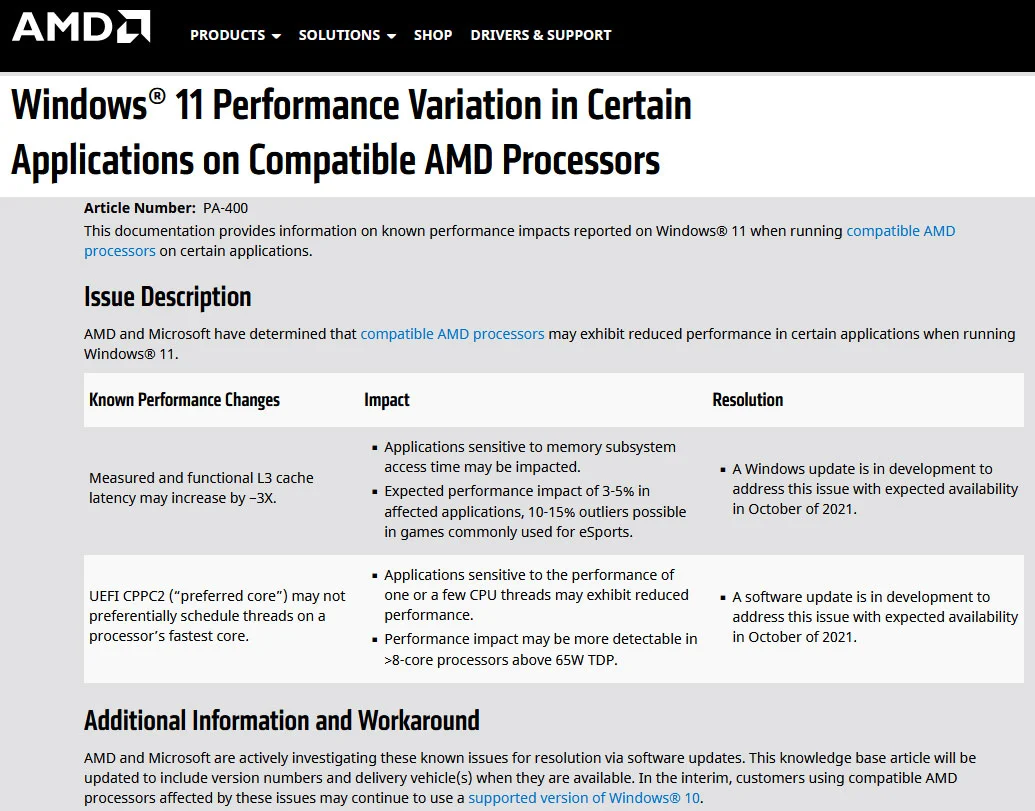
By mid-week, the discourse reached a level of critical mass that necessitated an official acknowledgment. On October 6, 2021, AMD published a formal support article titled "Windows 11 performance variation in certain applications on compatible AMD processors."
In this document, AMD explicitly stated that they were investigating two distinct "known issues." The company confirmed that it is working in close cooperation with Microsoft to develop a software-based resolution. According to internal roadmaps, the fix is expected to be delivered via a Windows Update, likely scheduled for later this month. For those unwilling to wait for the patch, AMD’s current advice is to either accept the performance hit or, for the most affected power users, revert to the more stable environment of Windows 10.
Deep Dive: The Technical Roots of the Performance Decline
To understand why a simple operating system upgrade would cause such a significant disparity in performance, one must look at how the Windows scheduler interacts with modern CPU architectures. The issues identified by AMD are primarily software-side implementation bugs within the Windows 11 kernel’s interaction with the processor’s hardware abstraction layer.
The L3 Cache Latency Crisis
The most severe issue identified by AMD involves the L3 cache. In modern CPU architecture, the L3 cache serves as a vital staging ground for data that needs to be accessed quickly by the processor cores. Under normal operating conditions, this cache should provide near-instantaneous access times.
On Windows 11, however, testing has shown that the latency of the L3 cache on affected AMD processors can triple. When the latency increases, the processor is forced to wait for data to be fetched from slower memory tiers, creating a bottleneck that ripples through the entire system. AMD has noted that "memory-sensitive applications" are the most severely affected by this discrepancy. In practical terms, these applications—which include high-end productivity software, data-intensive compression tools, and complex simulation programs—are seeing a processing slowdown in the order of 3 to 5 percent.
The UEFI CPPC2 ‘Preferred Core’ Scheduling Bug
The second, and perhaps more nuanced, issue involves the UEFI CPPC2 (Collaborative Processor Performance Control) technology, often referred to as "preferred core" technology.
Modern AMD processors do not treat all cores as equal. Through binning and silicon quality assessment, some cores are capable of higher clock speeds and better power efficiency than others. The CPPC2 technology is designed to inform the operating system which cores are the "fastest" so that single-threaded or light-threaded tasks are routed to those specific cores for maximum performance.
On Windows 11, this communication channel is currently unreliable. The OS is failing to consistently prioritize the fastest cores for performance-demanding tasks. This "hit-or-miss" scheduling approach is particularly detrimental to users with processors featuring more than eight cores and a TDP (Thermal Design Power) exceeding 65W. In these high-core-count environments, the performance disparity between the fastest core and the slowest core is significant; when the operating system misallocates tasks to the "slower" cores, the user experiences a noticeable drop in performance during everyday tasks that should feel instantaneous.

Supporting Data and Real-World Implications
While a 3 to 5 percent slowdown might seem negligible in a spreadsheet-heavy environment, the implications for the gaming community are far more severe.
The Impact on the Gaming Ecosystem
Gaming relies heavily on high-frequency, low-latency performance. Because games are frequently sensitive to both cache latency and core scheduling, they have become the primary victims of these Windows 11 bugs. AMD’s internal testing and independent telemetry reports have indicated that eSports titles—which prioritize high frame rates and minimal input lag—are seeing performance degradation in the range of 10 to 15 percent.
For a gamer playing at high refresh rates, a 15 percent drop can be the difference between a smooth, competitive experience and a stutter-prone session. While this does not render the systems "broken" in the traditional sense, it does negate the architectural gains that many users purchased these high-end processors to achieve.
The Scope of Affected Hardware
The issues are not limited to a single generation of Ryzen processors. The bugs appear to affect a broad spectrum of "compatible" AMD hardware, ranging from the Ryzen 2000 series up to the latest Ryzen 5000 series desktop processors. Because the issue lies in the Windows kernel’s ability to communicate with the processor’s microarchitecture, it is an issue of software compatibility rather than a hardware defect.
Implications and The Path Forward
The situation serves as a stark reminder of the complexities involved in modern operating system development. With Windows 11, Microsoft attempted to streamline the way the kernel manages task scheduling and hardware resources. In doing so, it appears they inadvertently bypassed or misconfigured the specific hooks required for AMD’s unique "chiplet" architecture and cache structure.
The "Wait and See" Approach
For the vast majority of users, the most pragmatic advice remains to "sit tight." Because the identified fixes are confined to the software level, users will not need to engage in the tedious process of updating their motherboard BIOS or adjusting complex UEFI settings.
When the Windows Update is eventually deployed by Microsoft, it will likely function as a seamless update to the scheduler, effectively patching the communication protocol between the OS and the processor. This is a best-case scenario for the average user, as it minimizes the risk of bricking motherboards or causing further system instability.
Reflections on the Launch
This incident highlights the inherent risks of "Day One" adoption for power users. While Windows 11 introduces a host of new security features and a redesigned UI, the performance regressions serve as a warning that operating system stability is a multifaceted challenge.
For the professional, the gamer, and the enthusiast, these weeks of performance degradation represent a lost opportunity to enjoy the full potential of their hardware. However, the collaborative response from AMD and Microsoft suggests that this is a temporary setback. The fact that the issue was identified and documented within a week of launch is a testament to the transparency of modern hardware-software support.
As we look toward the remainder of the month, the industry will be watching closely for the release of the promised Windows Update. Until that patch is verified and installed, those who rely on their AMD-powered machines for performance-critical work or competitive gaming might find that the best way to experience Windows 11 is to wait for the version that works as efficiently as the one they left behind.
In summary, the Windows 11 transition has proven to be a learning experience. It reinforces the importance of thorough driver and kernel-level testing before major OS shifts. While AMD users are currently feeling the strain, the path to resolution is clear, and for those who have already made the jump, patience is the only viable commodity until the software can catch up to the silicon.










No comments yet. Be the first to join the conversation!