

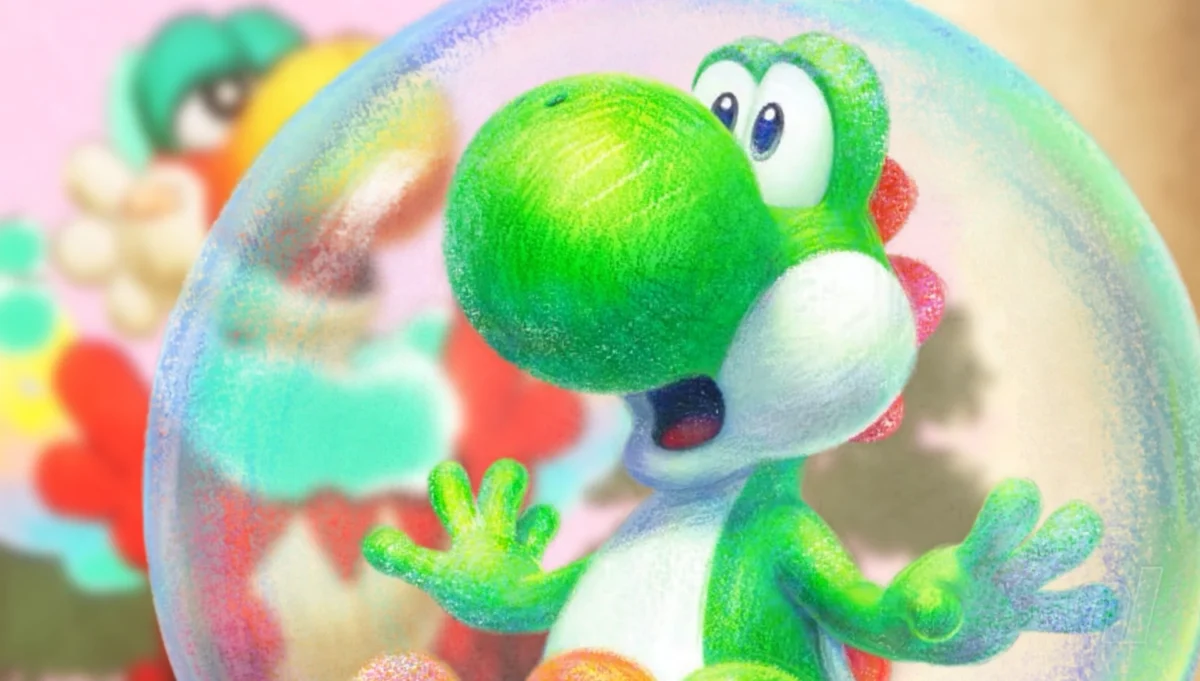
Nintendo Switch’s latest Yoshi adventure, Yoshi and the Mysterious Book, has been met with a mixed reception. While praised for its charming aesthetic and imaginative world-building, a significant design flaw emerges late in the game, leaving many to question the developer’s ambition and the missed opportunities for true innovation.
Initially, Yoshi and the Mysterious Book presents itself as a delightful, albeit familiar, entry in the beloved Yoshi series. Players are guided through a whimsical world, encountering a menagerie of unique creatures, each possessing distinct abilities designed to aid in environmental navigation and puzzle-solving. This formula, while enjoyable, quickly settles into a predictable rhythm, leading to a sense of artistic confinement. However, a singular, groundbreaking mechanic introduced in the latter half of the game offers a tantalizing glimpse of what Yoshi and the Mysterious Book could have been – a truly revolutionary experience. This article delves into the game’s design, focusing on the pivotal introduction of the Bewilder Bird and the subsequent disappointment of its underutilization, exploring the potential for a more expansive and experimental gameplay loop.
The Unfolding Narrative and Familiar Framework
Yoshi and the Mysterious Book casts players in the role of the ever-popular Yoshi, embarking on a quest to uncover a mysterious magical book. The overarching narrative involves a race against the nefarious Bowser Jr. and Kamek, who also seek to harness the book’s power. From the outset, the game embraces a signature Yoshi charm, characterized by its vibrant visuals, whimsical sound design, and accessible gameplay.

The core gameplay loop revolves around discovering and utilizing various creatures. These creatures are not mere cosmetic additions; they are integral to progression. For instance, the Snurfboard allows Yoshi to glide across water, the Swirm enables him to catapult across vast chasms, and the Stickiwick grants him the ability to swing from platforms like a reptilian Spider-Man. Each level is meticulously crafted to showcase the specific utility of these companions. This approach, while effective in guiding the player, inadvertently contributes to a feeling of linear progression, where the game dictates the player’s actions rather than fostering true player-driven exploration and problem-solving.
The game’s structure, therefore, can be described as a series of carefully curated challenges. While these challenges are often engaging and visually appealing, the underlying pattern of discovery and application becomes repetitive. The initial wonder of encountering a new creature and learning its ability gradually gives way to a predictable expectation. This repetitive, overly-simplified structure, as noted by early reviewers, curtails the imaginative potential that the game so clearly possesses. The illusion of freedom and creativity is present, but once the player understands how to trigger discoveries and exploit creature abilities, a somewhat tedious rhythm emerges.
The Revelation: The Bewilder Bird Arrives
The narrative trajectory of Yoshi and the Mysterious Book takes a significant turn with the introduction of the Bewilder Bird, a creature whose existence and abilities were initially under embargo. This pivotal moment occurs in World 6, a point in the game where the established gameplay mechanics are challenged and ultimately redefined, albeit temporarily.

The Bewilder Bird is not just another creature with a singular function. Its unique power lies in its ability to instantly transform into any creature that Yoshi has previously discovered. This revelation marks a profound shift in the game’s design philosophy. Prior to this, the player was beholden to the specific abilities of the creature they had at hand. The Bewilder Bird, however, introduces a layer of strategic depth and player agency previously unseen.
The impact of this discovery is described by many as a "lightbulb moment." Suddenly, the seemingly disparate abilities of the preceding creatures coalesce into a powerful, interconnected toolkit. The levels designed to showcase individual creature skills are recontextualized. What was once perceived as a series of isolated puzzles now appears as a grander, more intricate design, where the player can experiment with a multitude of solutions. The game, in essence, transitions from a guided tutorial to a playground of possibilities.
Unleashing Potential: A World of Options
The immediate aftermath of discovering the Bewilder Bird exemplifies the game’s latent potential. Consider the scenario presented: a towering waterfall with no obvious path forward. In the pre-Bewilder Bird era, the player would consult their Creature Index, likely finding a creature like the Glubbit, whose bubble-blowing ability allows for a buoyant ascent. Alternatively, the Goonie’s short diagonal bursts could also serve the purpose, albeit less elegantly.

However, with the Bewilder Bird, a myriad of approaches become viable. The player can choose to ascend using the Glubbit’s bubbles, or perhaps opt for a more direct approach with the Goonie. But the possibilities extend far beyond these initial considerations. Upon reaching the summit, a vast body of water presents itself. While Yoshi could traverse it alone, the Snurfboard offers a quicker, more stylish passage. Yet, the Bafloonder provides an entirely different experience, allowing for swift underwater exploration and efficient collection of lingering collectibles.
This is where the game’s surface-level creativity is finally unleashed. The ability to seamlessly switch between any discovered creature opens up a dynamic gameplay experience. Players are no longer confined to a single solution; they are empowered to experiment, to strategize, and to discover the most efficient or enjoyable way to overcome obstacles. This freedom of choice and the potential for emergent gameplay are what draw comparisons to open-world titles like The Legend of Zelda: Breath of the Wild or, as some suggest, the more puzzle-oriented The Legend of Zelda: Echoes of Wisdom. In these games, player agency and the exploration of multifaceted mechanics are paramount.
The Crushing Reality: A Fleeting Glimpse
The euphoria of this newfound freedom, however, is tragically short-lived. The game’s most significant failing lies in the fact that this paradigm-shifting mechanic, the Bewilder Bird’s transformative ability, is largely confined to a single level. While it makes a brief reappearance later in the game, its true potential for open-ended exploration and experimental problem-solving is never fully realized.

Once World 6 concludes, the gameplay reverts to the familiar, albeit less dynamic, structure. Players once again encounter new creatures and are expected to utilize their singular abilities to progress. The intricate tapestry of interconnected creature powers, so brilliantly showcased in that one pivotal level, unravels. The opportunity to tackle obstacles and puzzles in multiple ways, to truly experiment with the game’s mechanics, evaporates.
This abrupt return to the status quo leaves many players, including the author of the original piece, feeling a profound sense of disappointment, even anger. The realization that such a potent and innovative gameplay mechanic was introduced only to be largely sidelined is frustrating. It suggests a lack of ambition from the developer, Good-Feel, in fully exploring this groundbreaking concept.
The Question of Ambition and the Future
The underutilization of the Bewilder Bird’s ability raises pertinent questions about the development process of Yoshi and the Mysterious Book. Was the limited scope a result of time constraints? Was there an obligation to maintain a certain level of simplicity, perhaps to cater to a younger audience? These are questions that linger, leaving players to speculate on the "what ifs."

The author posits that an entire game could have been built around the Bewilder Bird’s transformative capabilities. Imagine a sprawling world designed to accommodate a multitude of approaches to every challenge. Levels could be crafted with interconnected pathways and hidden secrets, rewarding players for their ingenuity and experimentation. Such a game would not necessarily need to be overtly difficult; rather, its complexity would stem from the freedom it offers players to express their creativity.
The hope for a more expansive utilization of this mechanic lies in the realm of downloadable content (DLC). A DLC expansion could provide the opportunity to delve deeper into the Bewilder Bird’s potential. This could involve the introduction of larger, sandbox-style levels that encourage players to experiment with different creature combinations and push the boundaries of what’s possible within the game’s engine. It wouldn’t require a fundamental shift in the game’s core appeal, but rather an amplification of its most promising element.
Conclusion: A Masterpiece Unfinished
In its current form, Yoshi and the Mysterious Book is a game that genuinely could have been an all-time classic. It possesses the charm, the visual appeal, and the foundational elements of a truly exceptional experience. However, by showcasing such a brief and fleeting glimpse of its tremendous potential, the game inadvertently exacerbates its own shortcomings. The introduction and subsequent underutilization of the Bewilder Bird’s transformative ability serves as a poignant reminder of what might have been, leaving players to ponder the brilliant game that lies just beyond reach, a testament to the power of innovative design when fully realized. The question remains: will Nintendo and Good-Feel revisit this incredible mechanic in the future, or will it remain a tantalizing, yet ultimately unfulfilled, promise?











No comments yet. Be the first to join the conversation!