Suro Senen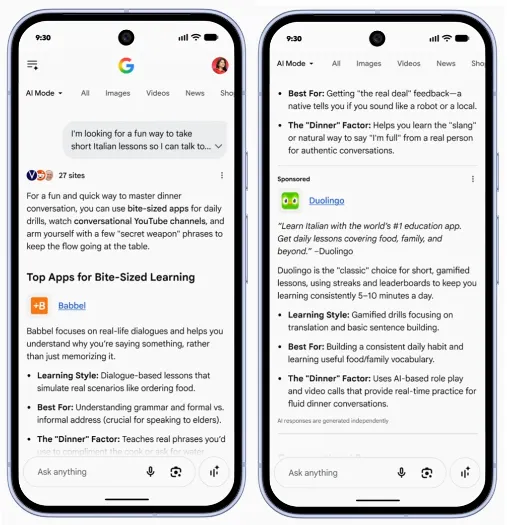
The landscape of digital marketing underwent a seismic shift during the second day of Google’s 2026 I/O conference. As the tech giant continues to pivot toward an “AI-first” ecosystem, its latest suite of advertising tools represents a fundamental transition from manual campaign management to automated, predictive, and highly conversational ad environments. By integrating generative AI into every facet of the marketing funnel—from audience discovery to asset creation—Google is aiming to redefine how brands interact with consumers who are increasingly relying on AI to navigate their shopping journeys.
Main Facts: A New Era of AI-Integrated Advertising
Google’s 2026 I/O announcements focused on three core pillars: granular transparency in AI-generated results, the unification of disparate data silos, and the introduction of new ad formats designed specifically for AI-driven interfaces.
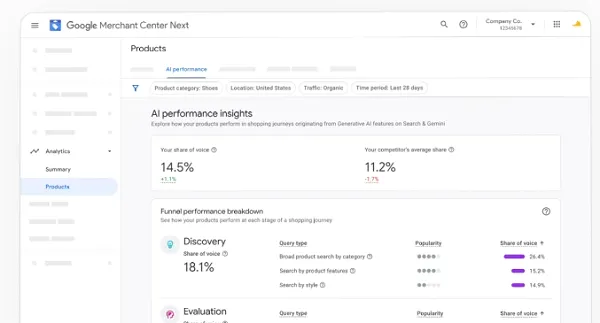
The most notable shift is the introduction of the AI performance insights tool within the Merchant Center. For the first time, brands will gain visibility into their "share of voice" on AI surfaces. Rather than operating in a black box, marketers can now see exactly how their products appear in response to consumer queries, how they stack up against competitors in the AI-generated landscape, and the specific consumer intents driving those appearances.
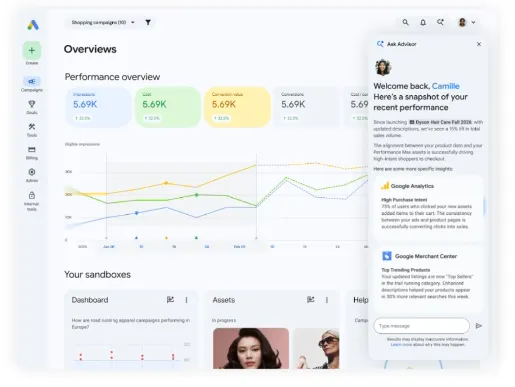
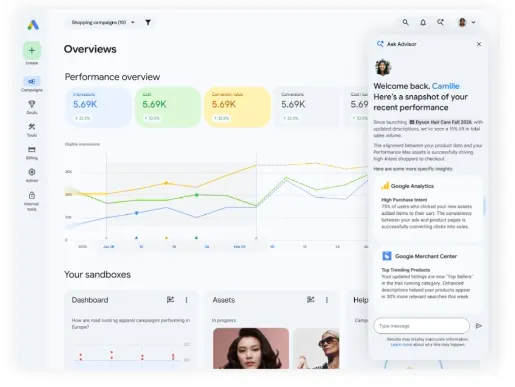
Furthermore, Google is breaking down internal data barriers by integrating its open-source Meridian marketing mix modeling tool directly into Google Analytics 360. This move is designed to provide a more holistic view of performance, allowing for smarter, data-backed predictive modeling. Complementing this is the rollout of Ask Advisor, an AI-driven agent that acts as a central orchestrator across the Google Ads and Marketing Platform ecosystem, designed to shorten the path from campaign ideation to launch.
Chronology of Google’s AI Advertising Strategy
The trajectory leading to these 2026 updates reveals a calculated, multi-year strategy to embed artificial intelligence into the advertising value chain:
- 2023–2024: The Foundation. Google began experimenting with Performance Max campaigns, signaling a move toward automated bidding and placement. This period focused on machine learning to optimize ad delivery across YouTube, Search, and Display.
- 2025: The Rise of Gemini. As Google fully integrated the Gemini model into its core products, it began testing AI-generated summaries and answers in Search. Advertisers expressed concerns regarding visibility, leading to the demand for the transparency tools unveiled today.
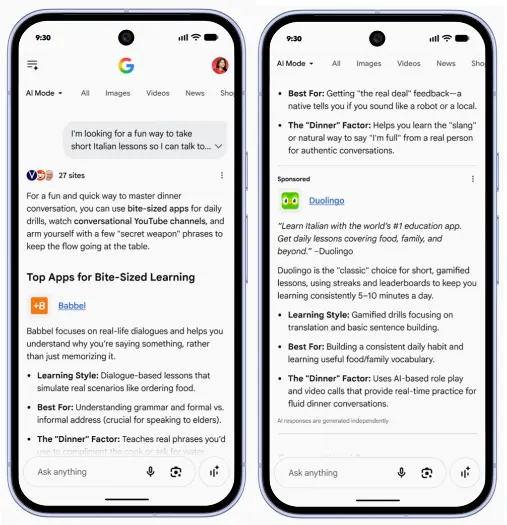
- 2026: Full Integration. At I/O 2026, Google shifted from testing to "full-scale deployment." By launching new ad formats like Conversational Discovery and Highlighted Answers, Google has effectively turned its AI chat interface into a prime piece of advertising real estate.
Supporting Data and Technical Architecture
To understand the scale of these changes, one must look at the technical integration of Google’s "Ask Advisor." Historically, an advertiser would need to manually navigate the Merchant Center to update product feeds, jump to Google Ads to create a campaign, and then switch to Analytics to measure success.
The new architecture integrates these disparate systems into a unified AI agent. By feeding data from Google Ads, Analytics, and the Google Marketing Platform into a singular LLM (Large Language Model) framework, Ask Advisor can identify gaps in campaign performance and suggest actionable pivots.
Key Technical Advancements:
- Cross-Platform Orchestration: Ask Advisor utilizes real-time data flow between the Merchant Center and ad-buying interfaces.
- Predictive Scenario Modeling: By leveraging Meridian’s open-source modeling, marketers can now run “what-if” scenarios, adjusting variables such as budget, target demographics, and creative formats to predict ROI before committing spend.
- Multimodal Asset Generation: The updated Asset Studio on YouTube allows advertisers to use simple text prompts to generate video content, drastically lowering the barrier to entry for high-quality, scalable video advertising.
Official Responses and Strategic Intent
Google’s leadership emphasized that these updates are not merely about selling more ads, but about enhancing the consumer experience during the shopping process. "Ask Advisor orchestrates a team of expert agents across Google products, serving as your always-on collaborator," a Google representative noted during the keynote.
The company’s focus is on "proactive assistance." By moving toward an environment where an AI can say, "I’ve identified that your hair care products are trending among users interested in organic ingredients; would you like me to launch a campaign targeting this segment?" Google is attempting to move the advertiser from a "tactical executor" to a "strategic director."
However, the response from the industry has been mixed. While smaller businesses have lauded the efficiency of automated campaign setup, larger agencies are carefully monitoring the "share of voice" data to ensure that the AI isn’t prioritizing Google-owned inventory or specific retail partners over others.
Implications: The Future of the Marketing Professional
The implications of these changes are profound and will ripple across the digital marketing industry for the remainder of the decade.
1. The Death of the "Manual" Marketer
The days of manual keyword bidding and daily campaign adjustments are effectively numbered. With tools like Ask Advisor taking over the heavy lifting of campaign orchestration, the role of the digital marketer is shifting toward strategy, creative direction, and data oversight. Professionals will need to become "AI whisperers"—experts at prompting these systems to get the best results, rather than experts at manual data entry.
2. The Rise of "Conversational" SEO and SEM
The introduction of Conversational Discovery ads and Highlighted Answers within AI responses means that SEO and SEM are merging. Brands can no longer optimize only for static search results; they must now optimize for the context of a conversation. If an AI agent recommends a product, the "copy" used in the product feed becomes the new meta-description.
3. The Democratization of Complex Analytics
By bringing the power of Meridian (marketing mix modeling) into the intuitive interface of Google Analytics 360, Google is essentially democratizing data science. Small to medium-sized enterprises (SMEs) that previously couldn’t afford dedicated data scientists can now leverage sophisticated predictive modeling to guide their investments.
4. Creative Scalability
The updates to YouTube’s Demand Gen features represent a major leap forward in creative production. By allowing for "multimodal video creation," Google is helping brands generate a vast library of assets that can be A/B tested in real-time. This ensures that the most resonant creative reaches the right user at the right time, minimizing ad fatigue.
A Critical Look: Challenges Ahead
While the vision presented at I/O 2026 is one of seamless efficiency, there are notable hurdles.
Brand Safety and Control: As AI takes more control over ad placement and creative, brands may worry about losing their unique voice. Ensuring that an AI-generated ad aligns with a brand’s specific tone and visual identity will be a significant challenge in the coming years.
The "Black Box" Problem: Even with the new transparency tools for brand mentions, the underlying algorithms of AI-generated responses remain proprietary. Advertisers will need to remain vigilant, ensuring that the "share of voice" data they receive is accurate and that the AI’s recommendations are not influenced by internal platform biases.
Geographic Limitations: The phased rollout—starting with Australia, Canada, India, New Zealand, and the U.S.—indicates that Google is still refining these models for different cultural and linguistic contexts. For global brands, managing a fragmented AI strategy where some regions have access to these tools and others do not will add a layer of complexity to their international campaigns.
Conclusion
The 2026 Google I/O announcements confirm a shift that has been brewing for years: the AI is no longer just a tool for the consumer—it is a central participant in the advertising process. From the granular insights offered by the Merchant Center to the orchestration power of Ask Advisor, Google is building a ecosystem where the barriers between product, data, and advertisement are dissolving.
For marketers, the message is clear: adapt to the AI-first world or risk being left behind in the static search results of yesterday. As these tools roll out over the coming months, the brands that succeed will be those that embrace this collaboration with AI, using it to drive deeper insights, faster creative iteration, and more meaningful connections with their customers. The future of advertising is not just digital; it is conversational, automated, and, above all, predictive.


 Lina Hope
 Siti Muinah