

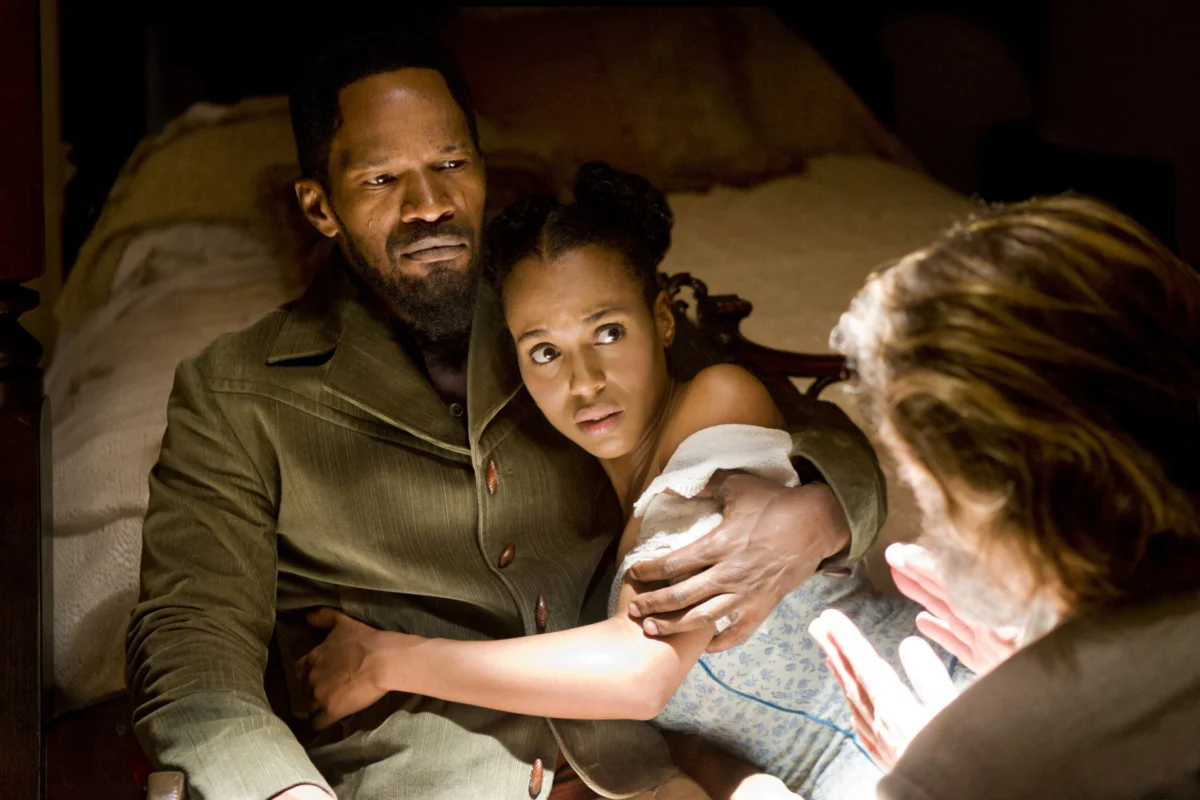
In the landscape of modern Hollywood, few actors have navigated the transition from television icon to cinematic force with as much grace and strategic brilliance as Kerry Washington. Last Friday, beneath the historic marquee of Quentin Tarantino’s New Beverly Cinema, Washington sat down for a candid career retrospective. The event, held ahead of a midnight screening of the 2012 masterpiece Django Unchained, offered a rare, intimate look at a performer who has spent over two decades meticulously crafting a legacy defined by risk, intellectual rigor, and an unwavering commitment to the nuance of Black womanhood.
The Defining Crucible: Django Unchained
The year 2012 remains the most pivotal chapter in Washington’s professional life. It was a year of binary extremes: she premiered Scandal, the Shonda Rhimes juggernaut that would transform her into a household name and a cultural touchstone, and she stepped into the role of Broomhilda von Shaft in Quentin Tarantino’s Django Unchained.
Reflecting on the latter, Washington admits that the initial reaction to the screenplay was one of profound terror. "When I first read the script, I was terrified," she confessed during the discussion. "I often feel like when I read something that both scares me and pulls me in, it’s the next thing I should be doing because it’s going to force me to grow."

The film, a stylized and controversial reimagining of 1850s American slavery, presented a unique challenge for the cast and crew. They were tasked with threading a needle—delivering an audience-pleasing, action-heavy feature while simultaneously acknowledging the brutal, dehumanizing reality of the era. "We all felt very passionately about telling this story in an audacious way, but also in a way that audiences would stay with us," Washington explained. "I understood from the beginning… that this film took place at a time when Black people were legally not allowed to be married and were considered three-fifths of a human being."
A Chronology of Artistic Evolution
Washington’s career has never been defined by linear choices. Instead, she has moved between platforms with a deliberate, almost architectural, sense of purpose. Her breakout performance in Ray (2004), where she played the indomitable Della Bea Robinson, established her ability to ground biographic portrayals in deep research.
It was during Ray that she first worked with Jamie Foxx, a connection that would prove vital years later. The camaraderie they established—and the shared trust—became a sanctuary during the grueling production of Django. Washington recalled a humorous anecdote from the Ray set: her insistence on "imperfect" cakes for a birthday scene, based on her research into the real-life habits of Della Bea Robinson. That same commitment to granular, lived-in authenticity defined her approach to Django.

While shooting in Louisiana, Washington sought to ground herself in the gravity of the location. "We were shooting on an actual plantation, and it felt like we were staring at trees that were rooted in the blood of our ancestors," she said. To manage the psychological toll, she adopted two methods: studying German—a nod to her character’s history—and learning to ride horses. These tasks provided the mental distance necessary to navigate the "hotbox" scenes and the visceral intensity of the film’s most violent sequences.
The Synergy of Power: From Broomhilda to Olivia Pope
Perhaps the most striking insight from the retrospective was Washington’s analysis of the connection between two of her most iconic roles: the passive, enslaved Broomhilda and the ultra-powerful political fixer Olivia Pope.
"Those two characters really informed each other," Washington remarked. She argued that playing Olivia Pope—the most powerful woman in Washington D.C.—immediately after or during the production of Django acted as a psychological tether. "I don’t know that I would have felt as comfortable playing the powerlessness and the lack of agency that Broomhilda has if it hadn’t been bookended with playing the most powerful Black woman in the country."

She views these roles not as disparate, but as a holistic representation of the Black female experience. "Olivia Pope was Broomhilda’s wildest prayers come true," Washington noted. For her, the evolution from the enslaved woman seeking freedom to the woman who commanded the White House is a narrative arc of resilience. The stark differences—the hair, the costumes, the monologues—served only to highlight the range she has cultivated in subsequent years.
Implications: The Shift Toward Production
Washington’s evolution has moved beyond acting. As she has matured, her desire for agency has pushed her behind the camera. Her current project, the Apple TV series Imperfect Women, sees her acting as both lead and executive producer.
"I really love producing because I’m a bit of a control freak," she admitted with a laugh. "As an actor, I never loved the feeling of being a pawn on a board. You feel like you’re sitting at home waiting for somebody to invite you to a party. I much prefer to throw my own parties, or at least be part of the party planning committee."

This shift is rooted in a desire for creative autonomy. She meticulously selects directors who challenge her, such as Lesli Linka Glatter, and ensures that her producing partners—like Pilar Savone, whom she met on the set of Django—share her "nerd-like" dedication to script analysis and character motivation.
The Legacy of Risk
The success of Django Unchained—which secured Academy Awards for Christoph Waltz and Tarantino—was not a guaranteed outcome in 2012. Washington remembers the palpable uncertainty on set. "I knew that being the lead actress in a Quentin Tarantino film could be a career-changing moment… but we were all terrified that this was not a guaranteed thing. I didn’t know if it would be a hugely terrible thing or a hugely wonderful thing."
Ultimately, the risk paid off, not just in accolades, but in personal transformation. When asked how she felt upon wrapping the film, her response was visceral: "There’s nothing I can’t do."

That sentiment has clearly propelled her through a decade of varied work—from stage productions like David Mamet’s Race to the complex psychological drama of Imperfect Women. Whether she is tackling the weight of history in a plantation drama or the intricacies of modern murder mysteries, Washington remains driven by the same core philosophy: "Do I want to see this? Does it scare me a little bit? Do I feel like I can be additive? Do I feel like I can be proud of it?"
As the lights dimmed at the New Beverly for the screening of Django, the audience was reminded that Kerry Washington’s journey is far from over. She has moved from the "princess in the tower" to the architect of her own narratives, proving that the most powerful tool an actor possesses is not just their voice, but their courage to step into the roles that scare them most.
Imperfect Women is currently available for streaming on Apple TV.











No comments yet. Be the first to join the conversation!