

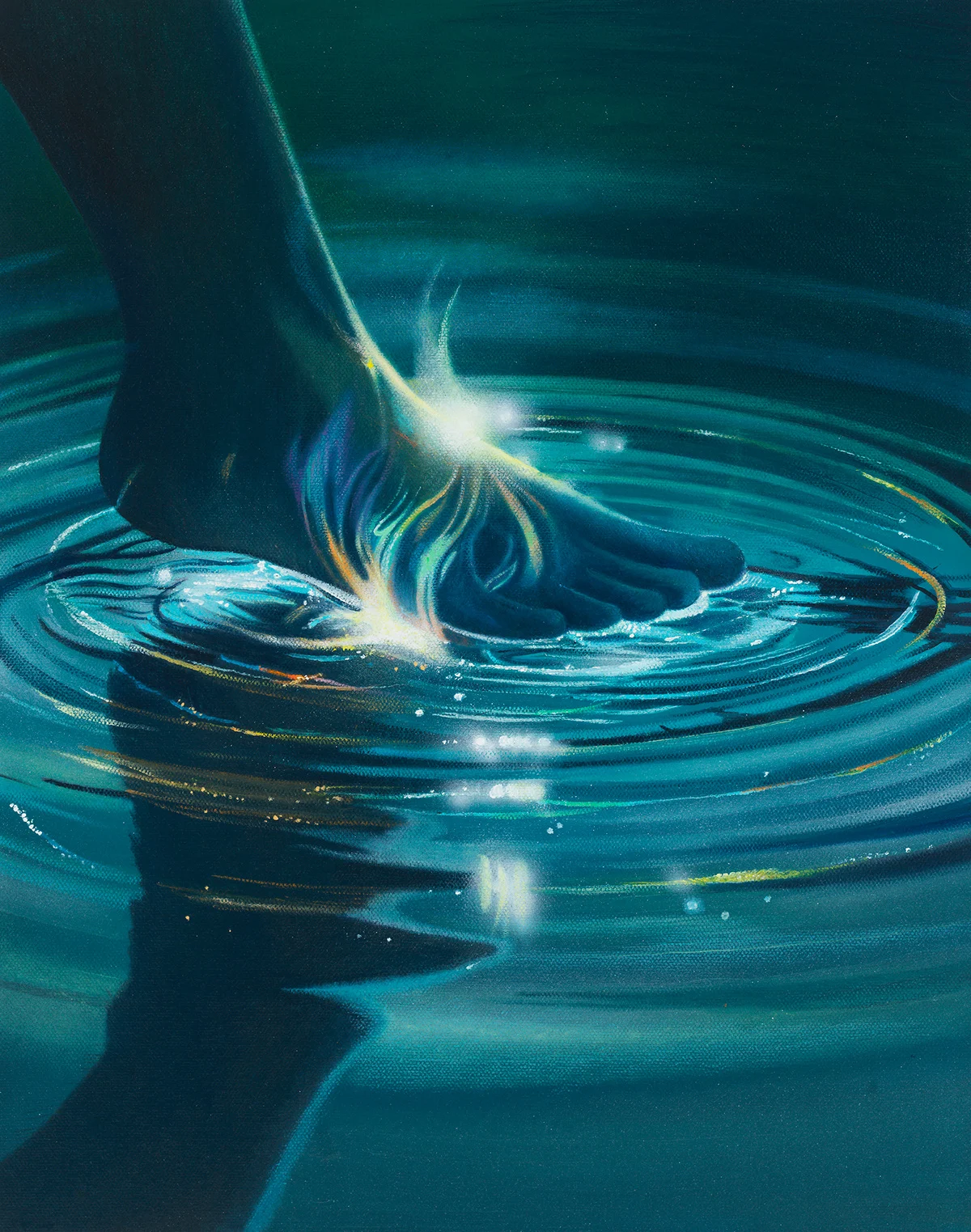
In an era defined by the relentless cadence of digital consumption, political volatility, and an ever-widening sense of existential fragmentation, the role of the artist as a conduit for spiritual inquiry has never been more vital. Chicago-based painter Cindy Bernhard has stepped into this crucible with her latest body of work, "Broken Vessels," a series of monumental, six-foot canvases that confront the precarious state of the human spirit. Currently on display at Plato Gallery, the exhibition serves as a profound meditation on how we—as fractured, wounded entities—might navigate the spectacle of contemporary life to find a sense of wholeness.
The Genesis of a Vision: Artistic Pedigree and Evolution
To understand the weight of Bernhard’s recent work, one must look at the academic and philosophical scaffolding upon which her practice is built. Bernhard’s journey toward the visceral abstraction of "Broken Vessels" began with a rigorous formal education. After receiving her BFA from the American Academy of Art in Chicago in 2011, she pursued an MFA at the Laguna College of Art and Design, graduating in 2014. These formative years provided her with the technical mastery required to execute large-scale figurative and abstract works, but it was her interest in the intersection of theology and contemporary anxiety that truly catalyzed her unique visual language.
Throughout her career, Bernhard has consistently explored themes of spiritual rupture and transcendence. Her earlier works flirted with the tension between the physical body—often depicted as a vulnerable, material entity—and the intangible, divine forces that suggest a reality beyond our own. "Broken Vessels" represents the maturation of these themes, moving away from explicit figurative representation toward a more symbolic, archetypal exploration of the human condition.
The Metaphor of the Vessel: A Chronology of Concept
The concept of the "vessel" is one of the oldest in human history, appearing across disparate cultures as a metaphor for the self. In Christian mysticism, the body is often described as an earthen vessel holding a divine light. Bernhard reclaims this ancient imagery, applying it to a 21st-century context.
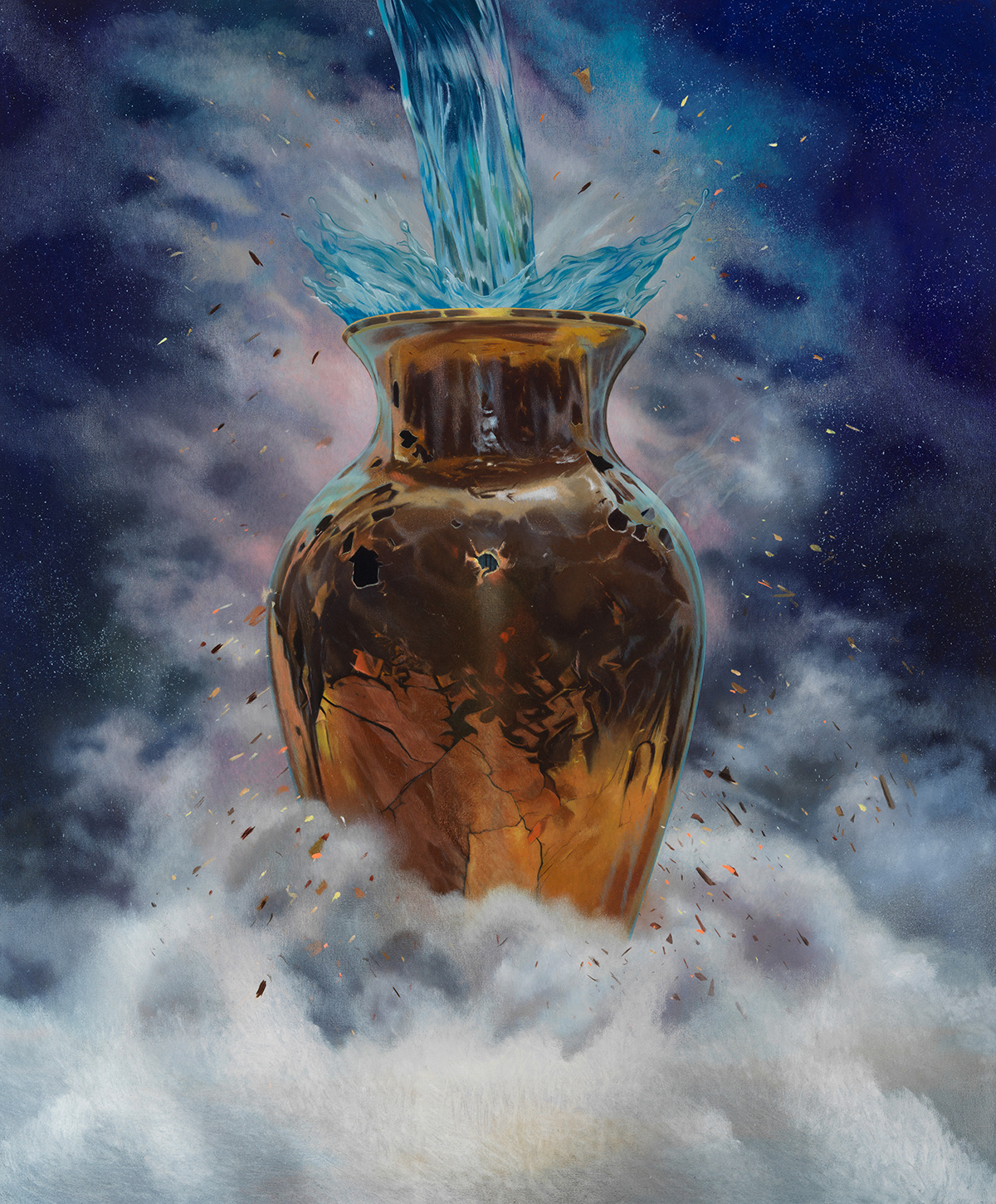
- The Initial Inquiry (2014–2018): Following her graduate studies, Bernhard began experimenting with the representation of the body not as a static form, but as a site of interaction between light and shadow. Her early sketches during this period focused on the "kintsugi" philosophy—the Japanese art of repairing broken pottery with gold, treating breakage and repair as part of the history of an object, rather than something to disguise.
- The Period of Intensification (2019–2023): As political and social anxieties surged globally, Bernhard’s work shifted toward a more monumental scale. She began using gold leaf and metallic pigments to create "fractured golden forms." This was a direct response to the increasing "spectacle" of digital life, which she felt was stripping humanity of its nuanced, messy reality.
- The Realization of "Broken Vessels" (2024–Present): The current exhibition is the culmination of this evolution. By utilizing six-foot canvases, Bernhard forces the viewer into a physical relationship with the work. The paintings do not merely sit on the wall; they tower over the observer, demanding an acknowledgment of their scale and their inherent flaws.
Supporting Data: The Symbolism of Transformation
At the core of "Broken Vessels" is a deliberate iconography. Bernhard utilizes four primary elements to navigate the dialogue between the secular and the sacred: light, water, fire, and smoke. These are not merely aesthetic choices; they function as a visual grammar for purification and divine presence.
- Gold as Divinity: Drawing from archetypal associations, gold represents the incorruptible. By applying gold to fractured forms, Bernhard suggests that the "break" is not the end of the vessel, but the point of entry for something higher.
- Light and Shadow: The interplay of light in her work mimics the flickering nature of belief in an age of skepticism. The light does not shine on the paintings; it seems to emanate from the cracks within them.
- The Scale of Presence: The decision to paint at a six-foot scale is intentional. It mirrors the human body, turning the canvas into a mirror for the viewer. When one stands before a Bernhard painting, they are not looking at a portrait of another; they are looking at a portrait of the self as a receptacle for experience.
Official Perspectives: The Philosophy of the Fragmented Self
In various artist statements and discussions surrounding the exhibition, Bernhard has articulated the necessity of her work in the face of what she calls "invisible pressures." These pressures—political extremism, the digital noise of the 24-hour news cycle, and the erosion of collective intimacy—act as forces that threaten to shatter the human spirit.
"We are living in an age of spectacle," Bernhard noted during a recent discussion about the exhibition. "We consume, we scroll, and we fragment. But if we look closely at the cracks—those spaces where we feel most wounded or most exposed—that is often where the most profound sense of transcendence emerges."
Her perspective is echoed by curators and critics who view "Broken Vessels" as a necessary corrective to the cynicism that dominates much of contemporary art. By refusing to offer easy answers or polished, perfect imagery, Bernhard invites the viewer into a space of "existential anxiety," which she ultimately transforms into a space of potential redemption.
Implications for Contemporary Art and Spirituality
The broader implications of Bernhard’s work touch upon the changing role of "the sacred" in contemporary life. In a world that is increasingly secularized, art has taken on the mantle of the cathedral. "Broken Vessels" suggests that even in a post-religious or post-traditional landscape, the human desire for transcendence remains undiminished.
The Re-Sacralization of the Material
Bernhard’s work argues that the material world—our bodies, our politics, our traumas—is not separate from the spiritual. By imbuing the "broken" with "gold," she posits that our wounds are not obstacles to grace, but the very mechanisms through which grace is experienced. This has significant implications for how we perceive our own mental health and societal struggles.
Resisting the Spectacle
The "spectacle" is defined by its demand for our constant attention and its superficial polish. Bernhard’s paintings, with their fractured surfaces, resist this consumption. They cannot be fully captured in a digital image; they require the slow, deliberate presence of the viewer in a physical space. This is an act of rebellion against the ephemeral nature of modern media.
The Path Ahead: Where the Light Gets In
As "Broken Vessels" remains on display at Plato Gallery until July 11th, it stands as a testament to the resilience of the human spirit. Bernhard’s paintings are not just objects; they are inquiries. They ask: What remains sacred when everything else is being torn apart?
For those who find themselves weary of the "relentless pace" of modern life, the exhibition offers a rare opportunity for stillness. It does not provide an escape from reality, but rather a different way of looking at it. Through the fractured forms and the shimmering, golden fissures, Bernhard offers a hopeful, if difficult, truth: we are all vessels, and we are all broken, but it is precisely through those cracks that we remain capable of transformation.
Whether one views the work through a theological lens or a purely existential one, the power of Cindy Bernhard’s contribution to the Chicago art scene is undeniable. She has created a space where the wounds of the present can be acknowledged without being the final word, suggesting that even in the most fractured of times, the light—and the sacred—still finds a way to manifest.
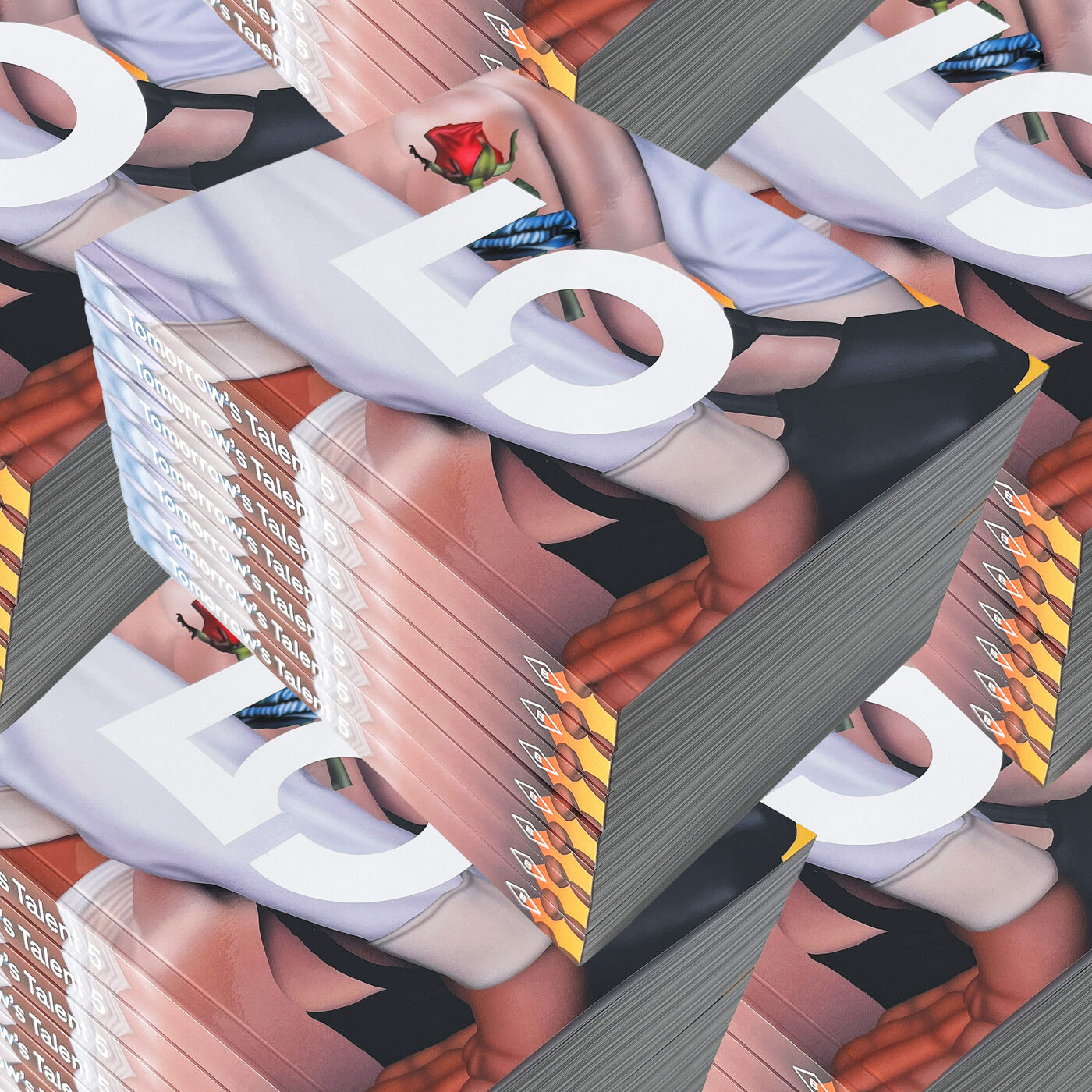
Cindy Bernhard’s "Broken Vessels" is currently on display at Plato Gallery through July 11th. For those interested in the broader discourse of emerging artists, further collections and critical essays can be found in the latest volumes of "Tomorrow’s Talent," a curation of over 60 artists pushing the boundaries of contemporary visual culture.









No comments yet. Be the first to join the conversation!