Lina Irawan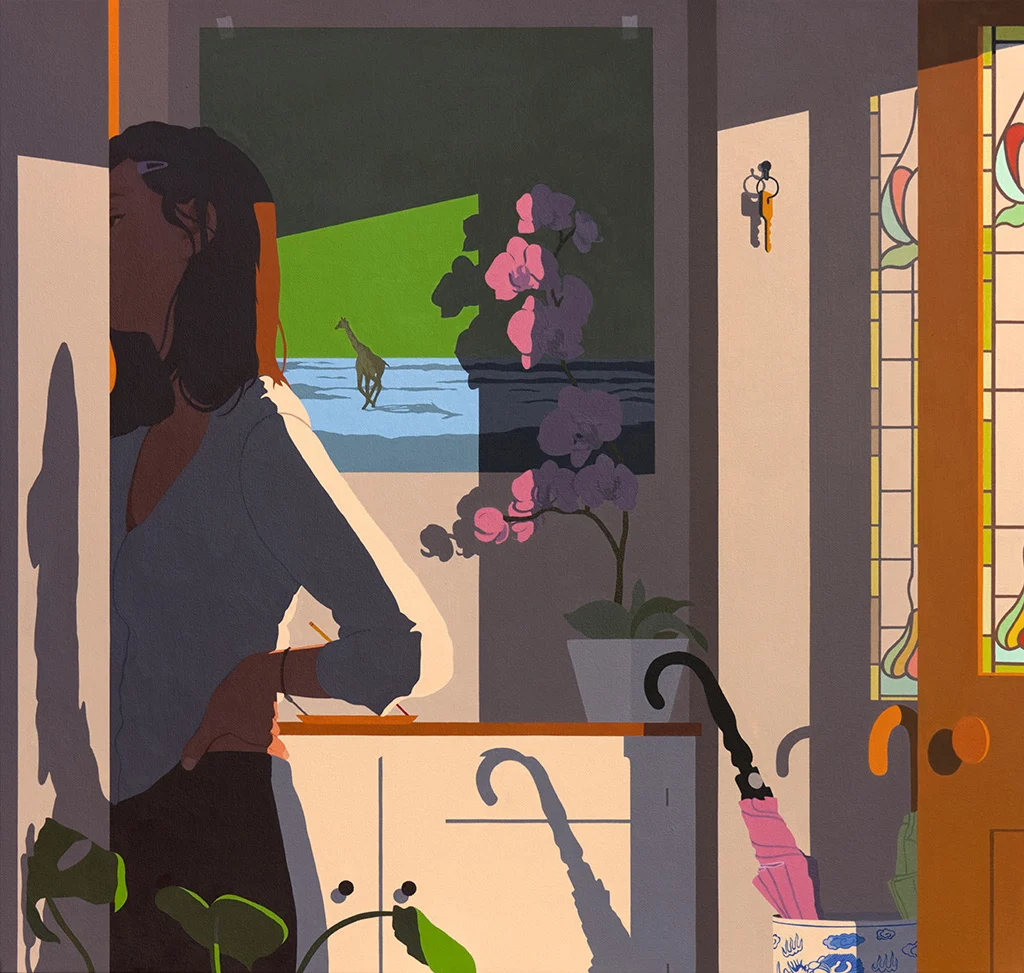
In the hyper-accelerated landscape of contemporary visual art, where grand gestures and provocative spectacle often dominate the conversation, the work of Los Angeles-based painter Adrian Kay Wong offers a deliberate, meditative counterpoint. His latest solo exhibition, In The Middle of Things, currently on view at Hashimoto Contemporary in New York City, acts as a quiet excavation of the everyday. Through carefully calibrated compositions and a palette that balances warmth with a sense of melancholic distance, Wong elevates the incidental to the monumental.
The Architecture of the Incidental: An Overview
Adrian Kay Wong’s practice is rooted in the meticulous observation of the human experience as it unfolds in domestic and public spaces. Born and raised in the San Francisco Bay Area and trained at The School of the Art Institute of Chicago, Wong has spent his career refining a visual language that oscillates between the objective reality of a scene and the subjective weight of memory.
In The Middle of Things is an exploration of the “in-between.” The exhibition’s title is a direct reference to the literary and cinematic technique of in media res—starting a story in the middle of the action rather than at the beginning. By depriving the viewer of a clear narrative trajectory, Wong forces us to confront the present moment as a site of infinite potential. His figures are often caught in states of transition: a hand reaching for a glass, a gaze drifting toward a window, or a body slumped in the quiet gravity of solitude.
A Chronology of Artistic Development
Wong’s journey toward this current body of work has been characterized by a steady evolution of perspective.
Early Foundations and Academic Influence
Wong’s formative years in the Bay Area provided the initial canvas for his interest in cultural identity and the subtle textures of urban life. His move to Chicago for his BFA at the School of the Art Institute (SAIC) acted as a catalyst for his technical rigor. It was during this period that Wong began to synthesize his personal memories with the broader cultural dualities he observed in his peers and surroundings.
The Shift Toward Narrative Ambiguity
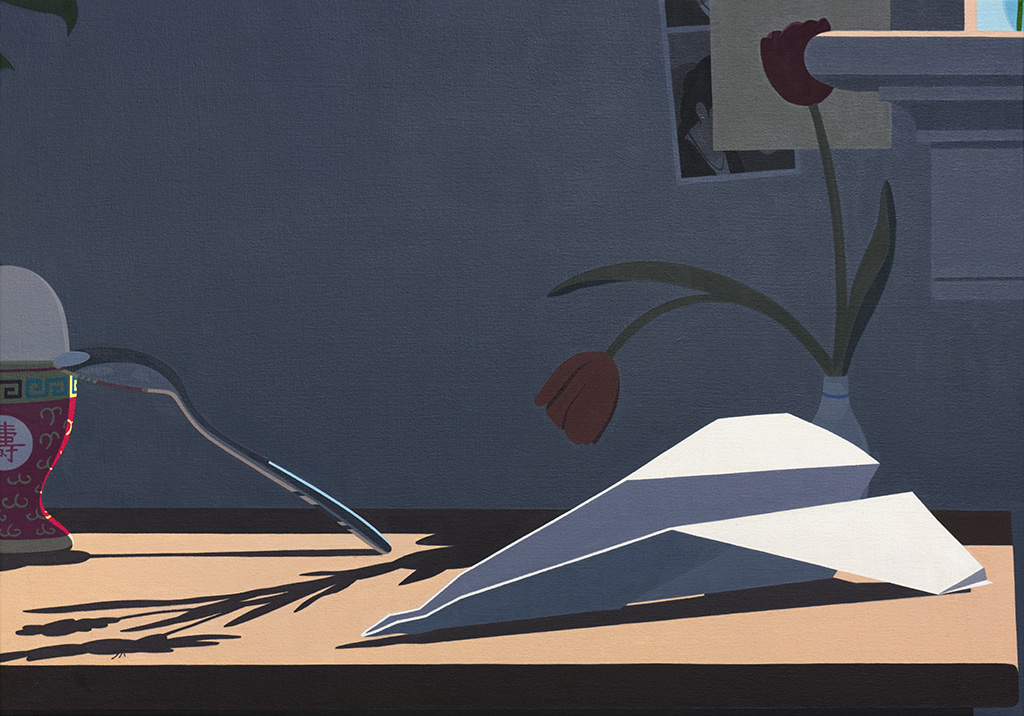
Following his graduation, Wong’s work began to lean heavily into the tension between intimacy and estrangement. Early works showed a preoccupation with the home as a psychological space—a theater where small, unnoticed dramas played out. Over the last several years, he has moved toward a more refined aesthetic, stripping away unnecessary visual clutter to focus on the interplay of light and geometry. This progression is evident in In The Middle of Things, where the environment itself feels like a protagonist, holding as much weight as the human subjects within it.
Supporting Data: The Anatomy of a Wong Painting
To understand the power of Wong’s work, one must examine the components that constitute his aesthetic vocabulary.
The Palette of Reflection
Wong’s color choices are rarely accidental. He utilizes a palette that feels simultaneously nostalgic and contemporary—muted earth tones punctuated by sharp, intentional highlights. These colors serve to ground the viewer in a specific mood, often one of quiet introspection. By utilizing color to dictate the "temperature" of a memory, Wong is able to suggest the passage of time without needing to explicitly state it.
Compositional Tension
The compositions in the new exhibition are deeply indebted to the history of cinematography. By framing scenes in ways that feel "un-posed," Wong mimics the candid nature of a snapshot. However, these are not snapshots; they are constructed, highly controlled environments. By cropping scenes to exclude context, he forces the viewer to focus on the micro-interactions—a subtle glance, the curve of a shoulder, the shadow cast by a discarded object. These elements create what critics call "narrative tension," where the viewer is tasked with completing the story.
Thematic Dualities
The core of Wong’s work rests on a series of persistent dualities:
- Intimacy vs. Estrangement: The subjects are often close to us, yet they seem unreachable, locked in their own private internal worlds.
- Transience vs. Permanence: His paintings capture fleeting seconds—a blink, a sigh—yet render them in oil paint, a medium defined by its longevity and physical permanence.
- Belonging vs. Isolation: Even when figures are placed in communal spaces, they exhibit a profound sense of solitude, questioning whether we are ever truly "together" in a shared space.
Official Perspectives: The Philosophy of the Artist
In discussions surrounding his practice, Wong has frequently emphasized that his work is not meant to provide answers, but to invite questions. In his own words, the artist views his canvases as "holding spaces" for the viewer’s own projections.
"I am interested in what happens when we stop looking at the world as a sequence of events and start looking at it as a collection of moments," Wong has noted in previous interviews. By focusing on the "middle," he rejects the need for a resolution. He argues that our lives are defined more by the periods of waiting, reflection, and minor occurrences than by the climactic moments that typically define traditional storytelling.
The exhibition at Hashimoto Contemporary serves as a homecoming of sorts for the ideas he has been developing over the past decade. It represents a maturation of his style—the lines are cleaner, the shadows are deeper, and the emotional resonance is far more profound.
Implications for the Contemporary Art Scene
The success of In The Middle of Things points to a wider trend in contemporary art: the "New Intimacy." Following years of digital saturation and global instability, there is a palpable shift in the art market and in critical discourse toward work that encourages slow looking.
The Resurgence of Figurative Realism
Wong is part of a generation of painters who are revitalizing figurative realism. Unlike the hyper-realism of the late 20th century, which sought to replicate the cold accuracy of a camera, this new wave of artists seeks to replicate the feeling of being present. By embracing the fallibility of memory and the subjectivity of the gaze, Wong’s work resonates with an audience that is increasingly tired of the "perfected" images presented on social media.
Art as a Psychological Mirror
The implication of Wong’s work is that the viewer is the final piece of the puzzle. When a spectator stands before a canvas, they bring their own history of isolation, longing, and domesticity. The painting acts as a psychological mirror. By leaving the narrative incomplete, Wong grants the viewer agency. This interactivity—intellectual rather than digital—is why his work has garnered significant attention from both institutional curators and private collectors alike.
Conclusion: The Quietude of the Now
As the world outside the gallery doors continues to rush toward an uncertain future, Adrian Kay Wong’s In The Middle of Things offers a sanctuary. It is a reminder that there is profound beauty in the mundane, and that our lives are composed of these seemingly insignificant fragments.
For those who have the opportunity to visit Hashimoto Contemporary in New York City before the exhibition concludes on July 11th, the experience is one of pause. It is an invitation to inhabit the "middle"—to dwell in the space between what has occurred and what is yet to be. Through his masterful use of color, light, and silence, Wong has cemented his place as a chronicler of the modern human condition, proving that the most powerful narratives are often the ones that are never fully told.
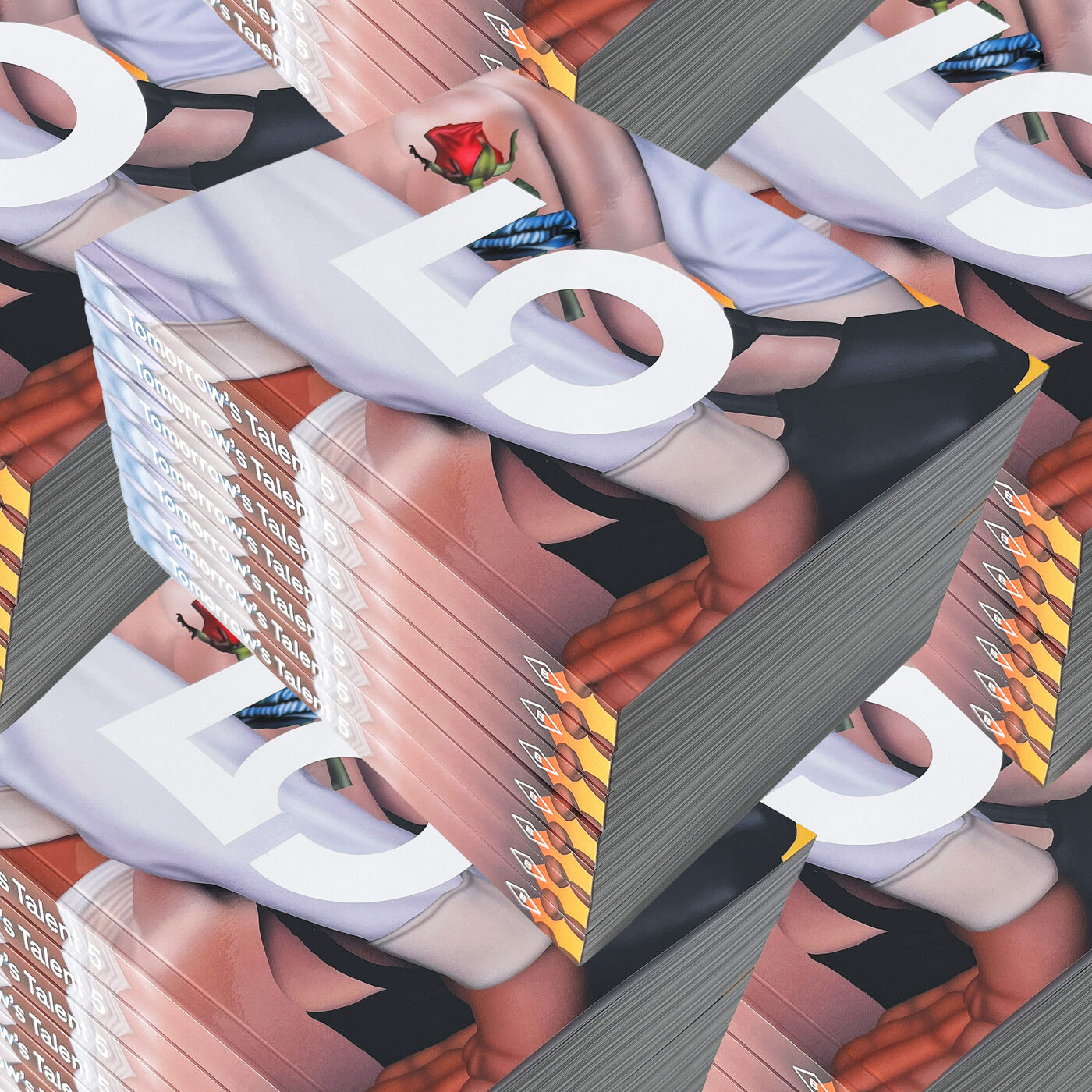
For those interested in exploring the broader context of contemporary art, including opportunities to publish their own work, the 2026 Booooooom Art & Photo Book Award is currently accepting submissions. Additionally, for a deeper dive into emerging voices, the "Tomorrow’s Talent 5" volume offers a comprehensive look at over 60 artists currently redefining the global art landscape.

 Laily UPN
 Basiran