Azzam Bilal Chamdy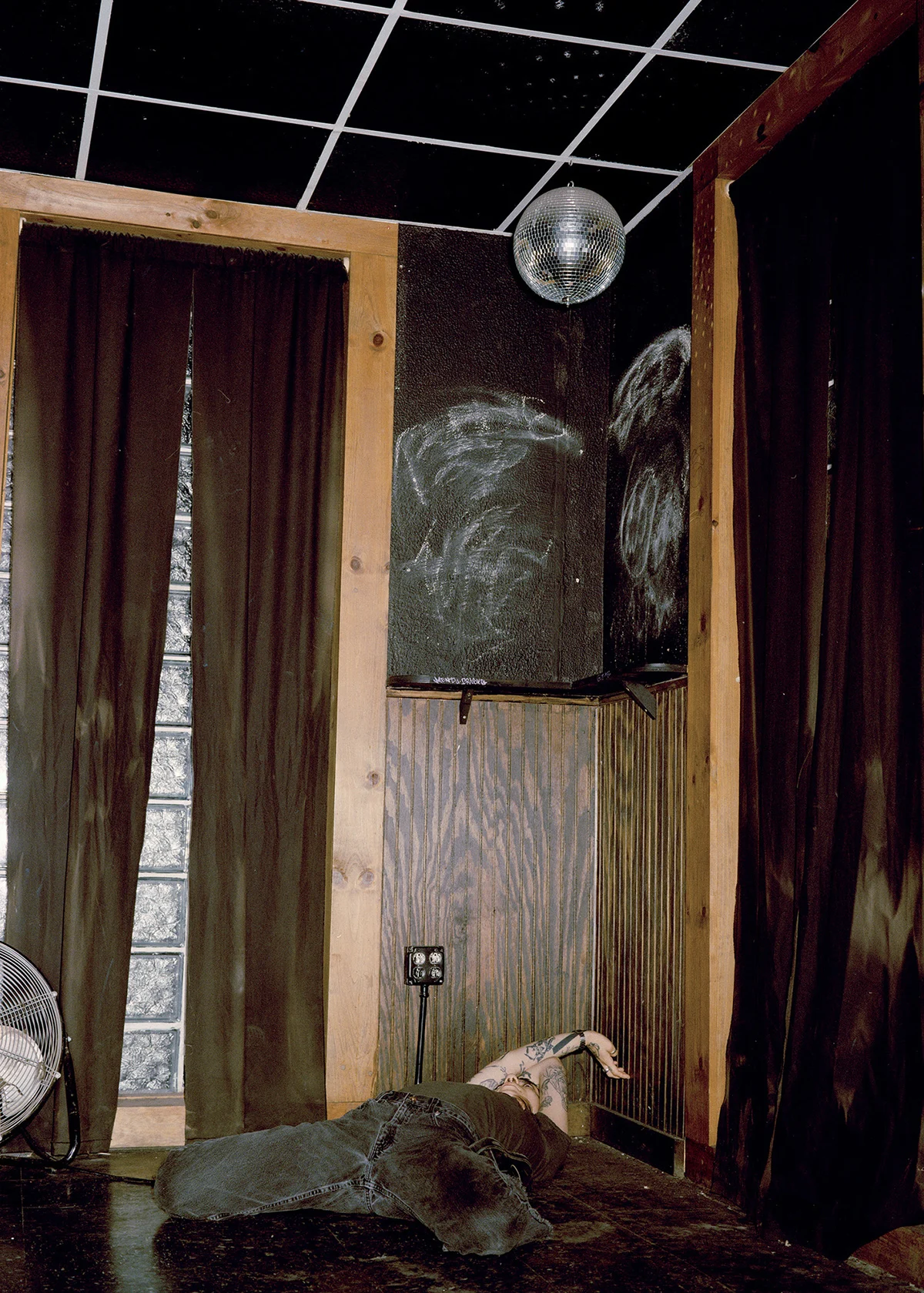
In the sprawling, often cacophonous landscape of contemporary photography, few artists manage to balance the rigorous demands of fine art theory with the raw, unvarnished pulse of daily life as effectively as Christopher Postlewaite. Currently operating out of Philadelphia, Postlewaite has emerged as a singular voice whose practice functions less as a traditional document of time and more as a psychological map of human connectivity.
Blending the staged sensibilities of classical portraiture with the fleeting, kinetic energy of observational photography, Postlewaite’s work navigates the fragile intersection of subculture, place, and the performative nature of the self. With an academic pedigree that includes a BA and BFA from SUNY Purchase and a prestigious MFA from the Yale School of Art, Postlewaite’s images are deeply informed by a profound intellectual rigor—yet they remain startlingly accessible, rooted in the familiar terrain of his own social circle.
Main Facts: A Convergence of Fiction and Reality
At its core, Postlewaite’s body of work is a meditation on the fluidity of identity. His subjects are not strangers found in the wild, but rather his spouse, his closest companions, and the broader, concentric circles of friends that populate his life in Philadelphia.
His artistic methodology is explicitly collaborative. By working within his immediate ecosystem, Postlewaite collapses the traditional hierarchy between the photographer and the subject. He views the act of taking a photograph as a "photobooth" encounter—a transient, sacred space where the subject’s desire for self-presentation meets the photographer’s desire for narrative.
Whether he is capturing the intimate quietude of a domestic interior or the weathered, "adhoc patinas" of a shuttered local business, Postlewaite’s gaze is transformative. He treats a transcendent puddle two blocks from his home with the same gravitas as he does a staged portrait, suggesting that the "truth" of a place is found not in its monumental architecture, but in the small, accumulated details that define an individual’s daily orbit.
Chronology: The Trajectory of an Artist
To understand the evolution of Postlewaite’s vision, one must look at the academic and geographic trajectory that brought him to his current station.
The Formative Years
Postlewaite’s formal education at SUNY Purchase provided the foundational technical and conceptual framework for his practice. It was here that he began to experiment with the dialectic between staged and candid imagery. His transition to the Yale School of Art marked a pivotal shift, pushing his work toward a more nuanced interrogation of contemporary social landscapes. Yale, known for its emphasis on theory and critical discourse, served as the crucible where Postlewaite refined his ability to frame the personal as a universal inquiry.
The Philadelphia Turn
Upon relocating to Philadelphia, Postlewaite’s work underwent a localized transformation. The city, with its dense history of industry and its evolving subcultural landscape, became a primary protagonist in his portfolio.
The Recent Pivot
The past eighteen months have proven particularly significant. The loss of local landmarks—such as the "Foto Club," a members-only after-hours bar that tragically burned down in April—has injected a new sense of urgency and elegy into his work. These events have moved his practice from mere observation to an act of historical preservation, capturing the ghost-traces of spaces that once anchored his community.
Supporting Data: The Anatomy of a Scene
Postlewaite’s work is characterized by its breadth of subject matter, yet it remains unified by a consistent visual language. His archives are a tapestry of the mundane and the profound:
- Human Subjects: His spouse and friends serve as anchors, representing the "performance" of self.
- The Vanishing Landscape: The "empty corner store" and the now-defunct "Cousin Danny’s" (a former strip club turned community space) serve as sites of collective memory.
- The Ephemeral: Objects such as the "letterboard as group portrait" or a simple, reflective puddle in South Philadelphia serve as microcosms of the artist’s broader philosophical inquiries.
The data points of his career—his degrees, his exhibition history, and his specific, localized focus—collectively argue for a photographer who is deeply embedded in the "here and now." Unlike artists who travel to exotic locales to seek "the other," Postlewaite finds the profound in the backyard, the living room, and the local bar.
Official Responses and Critical Reception
While Postlewaite is notoriously private about the minutiae of his process, his artist statements and exhibition materials reveal a man acutely aware of the weight of the medium.
"I’m interested in my work like that of a photobooth," Postlewaite explains. "As a space where performance and self-presentation dovetail, where fictions, realities and adhoc patinas orbit as one."
Critics have frequently noted the "un-staged" feeling of his staged work. By inviting his subjects to participate in the construction of their own images, Postlewaite removes the exploitative potential of the lens. Instead of capturing an image, he is effectively co-authoring a memory. Peers in the Yale community and the Philadelphia art scene have described his work as "deceptive," noting that while the images appear simple or casual, they are laden with heavy semiotic signals—the way a person holds their glass, the specific lighting of a hallway, or the deliberate choice to include the "dog of a new neighbor."
Implications: The Future of Observational Art
The implications of Postlewaite’s work extend far beyond the borders of Philadelphia. He represents a generation of photographers who are rejecting the "Grand Narrative" in favor of the "Micro-History."
The Death of Distance
Postlewaite challenges the notion that art requires distance. By turning his lens inward, he argues that the most intimate truths are found in the circles we inhabit. This shift is significant in an era of global photography, where high-definition travelogues have become the norm. Postlewaite’s return to the domestic and the local is a radical act of slowing down.
Performance in the Digital Age
Furthermore, his investigation of "self-presentation" is timely. In an age where digital identity is meticulously curated, Postlewaite’s photographs offer a counter-narrative. He shows us the messy, unpolished, and inherently human reality that exists behind the screen. His work suggests that even when we are performing for the camera, there is a leakage of truth—a "patina" of reality that cannot be scrubbed away.
The Archive of the Now
As cities continue to undergo rapid gentrification and cultural erasure, Postlewaite’s work becomes increasingly vital. By documenting spaces like Cousin Danny’s and the Foto Club, he is building an archive of a specific time and place. He is not merely taking photos; he is documenting the social infrastructure of a neighborhood that is constantly in flux.
Conclusion: The Quiet Resonance of the Everyday
Christopher Postlewaite is an artist who demands that we look closer at our own surroundings. Through his rigorous training and his deeply empathetic approach, he has created a body of work that is both an intimate diary and a sociological survey.
Whether he is capturing the play of light on a puddle or the weary smile of a friend, Postlewaite reminds us that photography is an act of love—a way to witness, a way to hold on, and a way to understand the complex fictions we inhabit. As he continues to document his life in Philadelphia, we are invited to consider our own spaces: the empty stores, the neighborhood haunts, and the people who populate our days.
In the work of Postlewaite, the ordinary is never just ordinary. It is a stage, a performance, and a testament to the enduring power of the human connection in a rapidly changing world. As the city changes and the shadows lengthen over South Philadelphia, Postlewaite remains a steady, watchful observer, ensuring that the stories of the "here and now" are not lost to the passage of time.


 Suro Senen
 Siti Muinah