Sagoh
Sagoh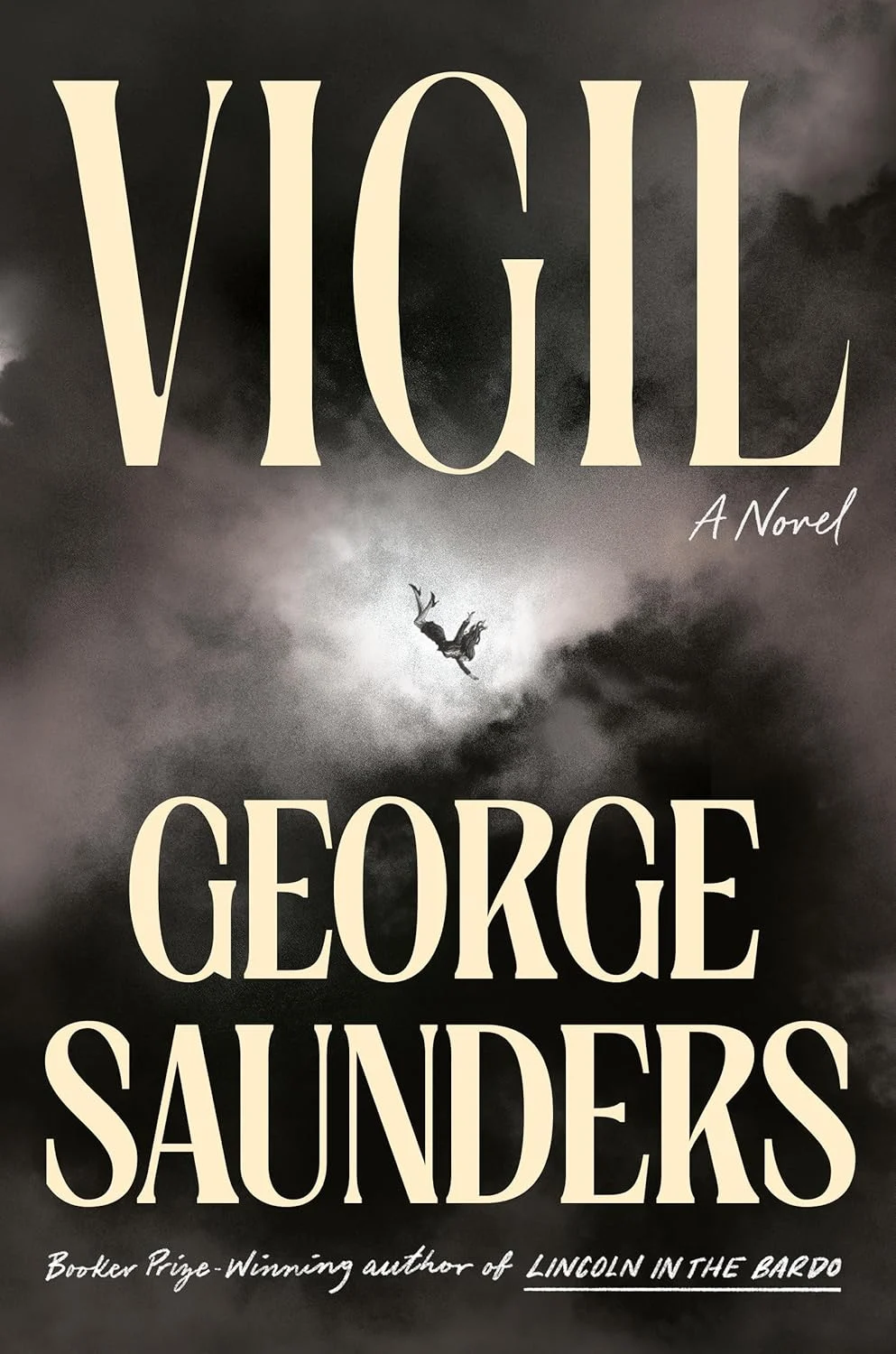
George Saunders occupies a singular space in the contemporary literary firmament. To call him a "literary darling" is not a critique of his merit, but a simple observation of his trajectory: from the sharp, satirical short stories of CivilWarLand in Bad Decline (1996) to the Booker Prize-winning heights of Lincoln in the Bardo (2017). A recipient of a MacArthur Fellowship—the prestigious "genius grant"—and a tenured professor at Syracuse University, Saunders has become a rare breed of author who manages to satisfy both the high-minded academic critics and the mass-market bestseller lists.
With the release of his latest novel, Vigil, the literary world has turned its gaze toward the afterlife once again. However, where Lincoln in the Bardo was a profound, experimental meditation on national grief and the intersection of the historical and the supernatural, Vigil presents a more complicated proposition. It is a work that asks whether even a master of the sentence can sustain his magic when the thematic foundations—in this case, climate change and corporate culpability—feel somewhat under-cooked.
Chronology of a Literary Titan
To understand the reception of Vigil, one must contextualize the evolution of Saunders’ career. His rise was not meteoric but methodical, built on a bedrock of dark, absurdist satire that skewered American consumerism and the erosion of the middle class.
- 1996: Publication of CivilWarLand in Bad Decline, establishing Saunders as a voice of biting social commentary.
- 2017: The release of Lincoln in the Bardo, a genre-defying exploration of President Abraham Lincoln’s mourning for his son, Willie. The book effectively bridged the gap between historical fiction and the speculative "ghost story."
- 2021: Saunders releases A Swim in the Pond in the Rain, a pedagogical deep dive into the Russian masters, further cementing his status as a writer’s writer.
- 2026: The arrival of Vigil. Marketing materials and early reviews suggest the novel is intended to be a successor to the spiritual investigations of Bardo, albeit one with a more pointed, modern political edge.
The Narrative Arc: A Soul in Transit
Vigil centers on Jill "Doll" Blaine, a woman who passed away in the 1970s. In the purgatorial landscape of the afterlife, she is tasked with a difficult spiritual assignment: the "consolation" of a newly deceased oil tycoon named K. J. Boone.
The conflict is immediate and, at times, heavy-handed. Boone represents the archetype of the industrial titan—a man who built his fortune on the extraction of fossil fuels and the systematic disregard for environmental stability. Upon his death, he exhibits no remorse, nor does he feel the need for "consolation." He views his life through the prism of "corporate stewardship," framing his environmental destruction as merely the pursuit of a valid hypothesis.
Jill’s arc—which involves coming to terms with her own historical erasure and her lack of agency in the pre-feminist 1970s—is meant to serve as a mirror to Boone’s rigid ego. Yet, the reader often feels that the narrative is caught in a tug-of-war between the weight of the climate crisis and the lightness of a morality play.
Supporting Data: Stylistic Brilliance vs. Thematic Mundanity
While the thematic weight of Vigil has polarized critics, there is a consensus regarding Saunders’ technical prowess. At the sentence level, Saunders remains a virtuoso. He possesses an uncanny ability to inhabit the internal monologue of his characters, imbuing them with a cadence that is both jarring and deeply human.
Consider the description of K. J. Boone’s sickbed, a passage that serves as a masterclass in environmental storytelling:
"He was dying, for reasons unclear, in the least appealing room of his magnificent home. A pair of red velvet drapes hung on the eastern wall, as if to frame a view out a window. But there was no window. The space would also have been ideal for a valued painting and no indication that one have ever hung there."
The room is a graveyard of symbols. The red velvet drapes suggest royalty and blood, yet they frame nothing. The brass knights and the Old West antlers represent a desperate, contradictory attempt to mythologize a life that was fundamentally about extraction and exploitation. As the historian Barbara Tuchman observed in A Distant Mirror, the knightly ideal often served as a thin veneer for violence and disorder—a parallel Saunders clearly intends to draw between the chivalry of the past and the "pull-them-up-by-the-bootstraps" capitalism of the modern era.
Implications: The Climate Change Dilemma
The primary critique leveled against Vigil is that it approaches climate change from a surprisingly narrow angle. In an era where the climate crisis is an existential, planetary threat, Saunders focuses on the individual conversion of a "misguided" executive.
Critics argue that the book drifts into the territory of "saccharine" fiction—reminiscent of the commercial sentimentality found in works like Matt Haig’s The Midnight Library. The implication is that if only the "bad guys" realized the error of their ways, the systemic collapse would be mitigated. This creates a disconnect between the magnitude of the subject matter and the resolution offered by the narrative.
However, Saunders’ defenders—and indeed, his many fans—would argue that he is not a political polemicist, but a writer of the human heart. His interest has always been in how people justify their own existence. If Vigil feels less "trenchant" than his earlier work, it is perhaps because the stakes of the real world have become so overwhelming that the subtle, satirical scalpel of Saunders feels slightly insufficient for the task.
The Verdict: Why We Still Listen
Despite the unevenness of its themes, Vigil remains a book of significant interest. The mainstream literary press continues to cover Saunders with fervor because he is, fundamentally, a master of craft. Even when the central conceit of the novel falters under the weight of its own message, the prose remains electric.
As critic Jay McInerney once noted, Saunders has a rare, almost dangerous ability to blend satire with sentiment. He can make you laugh at the absurdity of a dead man clinging to his "corporate hypothesis," and, in the very next paragraph, force you to confront the grief of a woman who realizes her life—and her name—have been forgotten.
Vigil may not reach the transcendental heights of Lincoln in the Bardo, nor does it hit with the visceral punch of his early short fiction. But in a landscape of increasingly homogenized storytelling, George Saunders remains one of the few writers capable of making the reader stop, pause, and re-examine the mechanics of their own consciousness. Whether or not Vigil is a "great" book, it is a necessary one—a reminder that in the face of both death and planetary catastrophe, the only thing we truly have is our own ability to change, however belatedly, our internal narrative.
As Jill Blaine eventually realizes, the "doll" she once was is gone, and the process of shedding that identity is the only true work left in the afterlife. Whether Saunders’ readers will be willing to follow him on this particular journey of spiritual shedding remains to be seen, but as long as he continues to sharpen his prose, the literary world will undoubtedly continue to read.

 Laily UPN
 Iffa Jayyana