Sagoh
Sagoh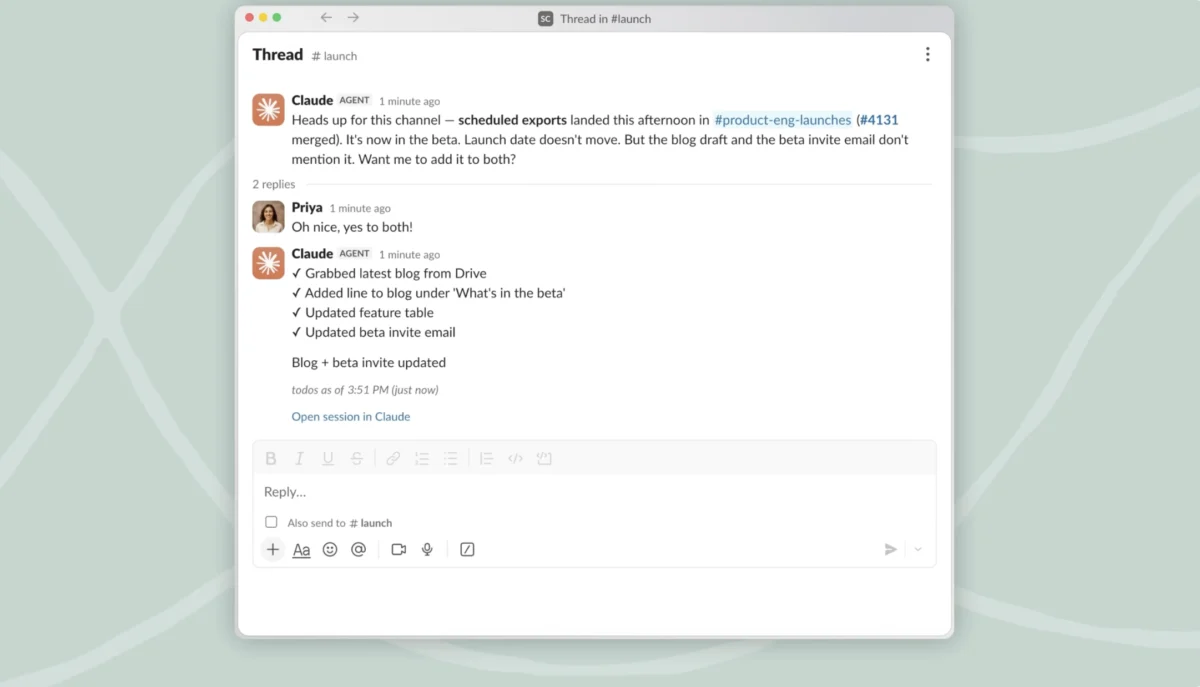
In an era where the digital workplace is defined by a frantic stream of notifications, threads, and disconnected silos, Anthropic is betting that the solution isn’t just a faster chatbot, but a more present one. The AI research company, known for its focus on safety and high-reasoning models, has introduced "Claude Tag"—a persistent, "always-on" AI agent designed to live permanently within Slack environments.
This development marks a significant shift in how enterprises interact with generative AI. Rather than a tool that requires a specific prompt to trigger a reaction, Claude Tag acts as a collaborative teammate, capable of following channel discourse, retaining historical context, and proactively intervening to move projects forward. Currently available in a research preview for Claude Enterprise and Claude Team customers, the feature represents a bold attempt to bridge the gap between static software and autonomous agents.
The Evolution of the AI Teammate
To understand the significance of Claude Tag, one must look at the trajectory of Anthropic’s integration strategy. For some time, users have been able to interact with Claude through direct messages or by tagging the bot in specific channels for ad-hoc assistance. More recently, the introduction of "Claude Code" in Slack signaled a shift toward functional, task-oriented AI that could handle complex coding assignments and post updates back to a team.
However, these previous iterations functioned primarily as transactional interfaces. A user asked a question; the AI provided an answer. Claude Tag, by contrast, introduces the dimension of persistent context.
"As Claude follows along with its channel, it learns ever more about the work," Anthropic noted in its official release. This "always-on" capability allows the AI to develop a nuanced understanding of a team’s internal language, project goals, and individual responsibilities—a level of awareness previously reserved for human employees.
How Claude Tag Operates: A Technical Overview
At its core, Claude Tag is designed to function as a shared organizational resource. When integrated into a Slack channel, the identity of the AI is communal. Any team member can view what Claude is working on, see its previous contributions, and pick up a conversation exactly where a colleague left off. This creates a "memory bridge" that prevents the loss of information common in high-turnover or fast-paced project environments.
The Mechanism of Ambient Intelligence
The functionality is divided into two primary modes:
- Assigned Task Execution: When a user tags @Claude with a specific instruction, the agent does not merely respond with a draft. It breaks the project down into actionable stages, leverages the tools it has been granted access to, and systematically works through the requirements, providing updates in the thread as it completes each milestone.
- Ambient Mode: Perhaps more revolutionary is the "ambient" feature. Claude can proactively join a conversation or provide updates without being explicitly prompted. It monitors threads to flag potential blockers, reminds team members of forgotten tasks, and synthesizes information from other parts of the organization—provided it has been granted the appropriate administrative permissions.
To ensure organizational safety and data integrity, system administrators maintain strict oversight. They define the specific "scope" of each Claude identity. A Claude instance assigned to a legal review channel can be siloed, ensuring it cannot access or share information with the engineering or marketing channels, thus preventing the cross-contamination of sensitive internal data.
The Competitive Landscape: The Battle for Enterprise Context
Anthropic is entering a crowded arena. As the "AI gold rush" transitions from model development to enterprise integration, the primary value proposition has shifted from "Can it write?" to "Does it know my business?"
The race to capture the "enterprise brain" is intense:
- Microsoft and the Copilot Ecosystem: Microsoft continues to leverage the deep integration of its Graph technology, which maps relationships between people, documents, and meetings across the entire Microsoft 365 suite. Through Copilot and Work IQ, Microsoft aims to make the AI an omnipresent layer in the daily workflow.
- The Rise of Intelligence Layers: Companies like Glean are positioning themselves as the connective tissue between disparate enterprise data sources. Glean builds an "intelligence layer" that sits beneath the interface, ensuring that when an AI agent makes a decision, it is based on the most accurate, real-time data within the company’s internal document ecosystem.
- Data Back-ends as AI Foundations: Platforms like Snowflake and Databricks are pivoting from being mere data repositories to becoming the "source of truth" for AI agents. By housing the tacit knowledge of an organization, these platforms are making it easier for models like Claude to query internal documentation without hallucinating or relying on outdated information.
Claude Tag, in this context, is Anthropic’s effort to win the "interface war." While others are focusing on the back-end data architecture, Anthropic is betting that the most effective way to gain adoption is by embedding the AI directly into the primary communication tool used by modern businesses: Slack.
Implications for the Future of Work
The introduction of an "always-on" AI colleague brings with it profound implications for corporate culture and workflow design.
The Public Nature of AI Work
One of the most striking changes is that Claude’s work is done in "public view." By operating within Slack threads, the AI’s decision-making process, its research, and its output are transparent to the entire team. This shifts the perception of AI from a "black box" tool to a visible, accountable teammate. If Claude makes a mistake, the team sees it; if it provides a breakthrough insight, the team can immediately iterate on it.
The Risk of Over-Reliance and "Alert Fatigue"
While the benefits of ambient intelligence are clear, there are inevitable risks. The introduction of an AI that proactively jumps into conversations could, if not properly managed, lead to "alert fatigue." Teams will need to develop new social norms regarding when to allow an AI to intervene and how to manage the "noise" generated by an autonomous agent that is constantly scanning for tasks.
The Evolution of Management
Managers will now be tasked with "managing" an AI teammate. This includes defining the parameters of its work, auditing its contributions, and ensuring that the permissions granted to the AI remain aligned with security protocols. It also raises questions about performance management—if a project succeeds because of Claude’s proactive intervention, how is that credit attributed?
Official Responses and Strategic Outlook
Anthropic’s strategy reflects a broader trend toward "agentic AI"—systems that do not just provide information, but take action. By positioning Claude Tag as a collaborator rather than a tool, the company is attempting to humanize the AI experience, making it feel less like a software utility and more like an extension of the team’s collective intelligence.
While the feature is currently in a research preview, the feedback from early adopters will likely dictate the speed at which these capabilities are rolled out to the broader market. Industry analysts suggest that the success of Claude Tag will hinge on its reliability and the degree to which it can truly handle "multi-step" tasks without requiring constant human course-correction.
Conclusion: A New Paradigm of Collaboration
We are currently witnessing the second wave of the generative AI revolution. The first wave was about utility—can AI summarize this document? Can it write this email? The second wave, which Claude Tag exemplifies, is about integration and context.
By living in the same Slack channels as human employees, Claude is moving beyond being a digital assistant to becoming a digital coworker. It is an ambitious, high-stakes experiment in human-AI collaboration. If successful, it may well prove that the most valuable AI isn’t the one that is the smartest, but the one that is the most helpful, the most present, and the most aware of the team it serves.
As companies continue to integrate these agents into their daily operations, the boundary between "human work" and "AI work" will continue to blur. For now, Anthropic is inviting the enterprise world to test that boundary, one Slack thread at a time.

 Evan Lee Salim
 Suro Senen